
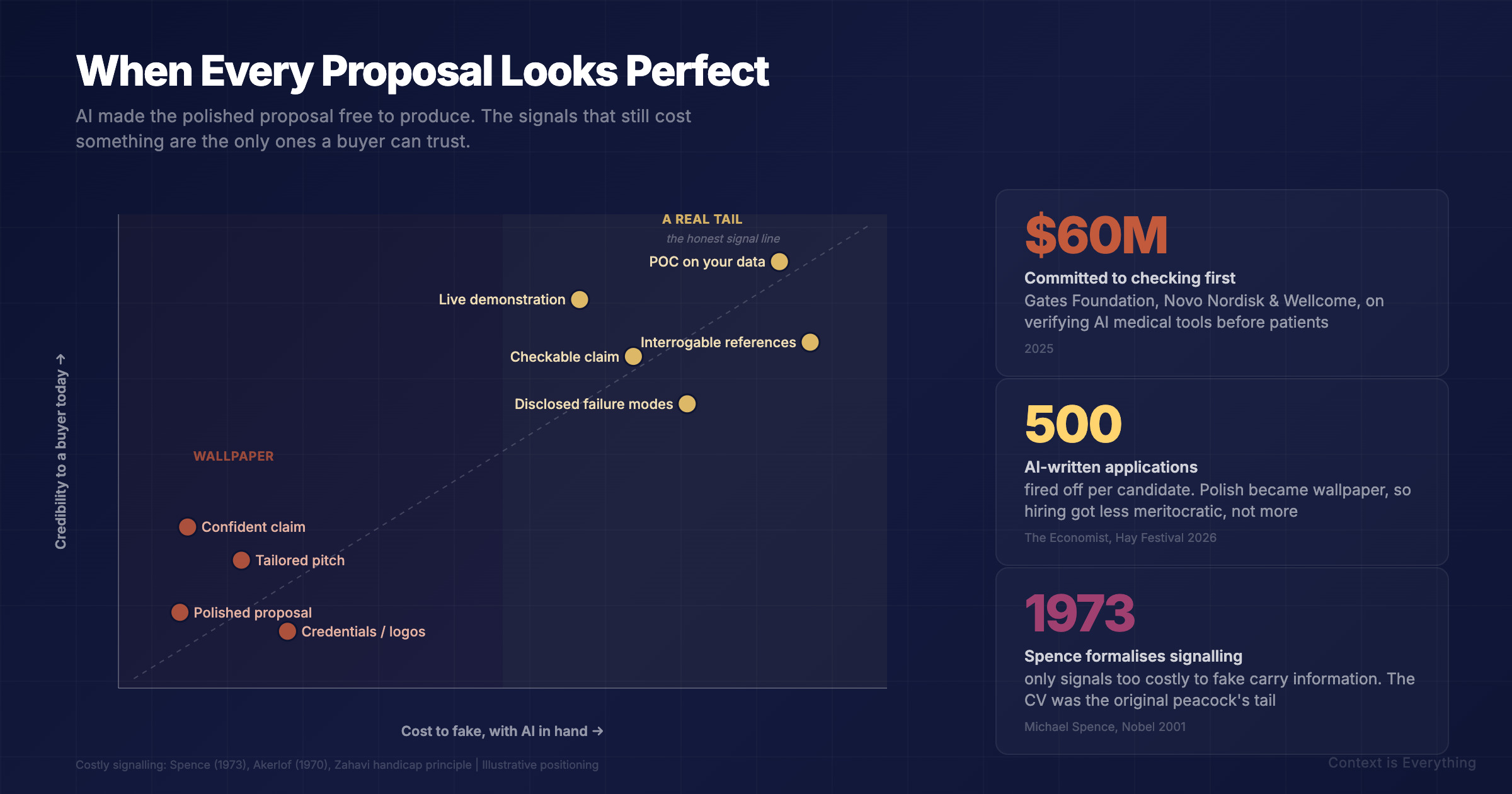
When Every Proposal Looks Perfect
You are evaluating five AI vendors and every proposal is immaculate, and you cannot tell them apart. That uniformity is the market telling you the signal you relied on has died. AI made polish free, so polish stopped meaning anything. Here is what is still expensive to fake, and what to demand instead.
You are evaluating five AI vendors. Every proposal is immaculate. Clean structure, confident claims, a tidy implementation plan, the right logos. And you cannot tell them apart.
That uniformity is not bad luck. It is the market telling you something: the signal you used to rely on has just died.
Two economists, one Nobel, one problem
In 1970 George Akerlof described how a market breaks when buyers cannot verify quality. His example was used cars. You cannot tell the good one from the lemon, so you assume the worst, so the honest sellers leave, so the market fills with lemons. We wrote about that already, in the article on information asymmetry.
Akerlof shared his Nobel with Michael Spence, who worked the same problem from the other side. If buyers cannot verify quality, Spence asked, what do sellers do about it? They grow tails. They invest in signals that are expensive to fake, on the logic that only a genuinely good seller can afford the cost. His example, in 1973, was the job market. The degree, the credential, the application that visibly took effort. The content mattered less than you would think. The hours were the proof.
Biologists call the same thing costly signalling. The peacock's tail is heavy and useless and expensive, which is exactly why it works: only a healthy bird can afford to carry it. The waste is the message.
For fifty years, the polished proposal was a tail. It took three evenings. That cost was the proof that someone serious sat on the other end.
AI is a fake-tail machine
Now anyone can produce the three-evening proposal in ninety seconds. The careful cold email, the tailored pitch, the credible-looking implementation plan: all of it, instantly, at no cost.
When the cost of a signal collapses, the signal stops meaning anything. A tail anyone can photocopy in twelve seconds is not a tail. It is wallpaper.
The editor of The Economist recently described hiring as two smart speakers talking to each other: candidates fire off five hundred AI-written applications, employers use AI to read them, and no human touches any of it. The result is not more meritocratic. It is less. When every application looks equally good, the thing that gets you through the door is knowing someone.
The same thing is happening to your vendor shortlist. When every proposal looks perfect, you fall back on the firm you already know, or the one with the best dinner. That is a worse way to buy, and you will pay for it in month four.
The signals that did not die
Here is the useful part. Every fakeable signal that dies makes the unfakeable ones shine brighter.
Some signals are still expensive, and expensive in ways AI cannot shortcut:
These cost something real, and that cost is the point. The Gates Foundation, with Novo Nordisk and Wellcome, has put sixty million dollars into checking whether AI medical tools work before they reach patients. Sixty million dollars on checking first. You cannot photocopy that.
The same pattern shows up wherever AI is rolled out well rather than loudly. The International Rescue Committee scaled an AI teaching tool from 400 teachers to 4,700, by building it on WhatsApp because that is what teachers in northeast Nigeria actually use.
These are not polished claims. They are costly, contextual, checkable results. That is a peacock's tail.
What to demand
So change what you ask vendors for. Stop scoring the deck. Score the things that are expensive to fake:
The vendor who can do these has grown a real tail. The one who only sends polish has handed you a photocopy and hoped you would not notice.
The peacock never had the option of faking it. That was always its advantage. In a market flooded with perfect proposals, your evaluation rigour is the costly signal that still cuts through. Make vendors grow a real tail, and demonstrate yours while you are at it.
This piece has a shorter, more personal companion in The Contour: The Peacocks tail. If you want a structured way to brief work so the thinking goes in before the polish, try Briefing in Contours.
Also from The Contour
The personal-voice version of these ideas, from Spencer Thursfield's newsletter.

Related Articles
Information Asymmetry: Buying IA vs AI
The AI consulting market exhibits classic information asymmetry—buyers can't distinguish quality until after commitment. Learn the difference between generic AI and contextual Intelligence Augmentation, and how to identify consultants who'll actually deliver.
Using AI to Compare Vendor Proposals: Where It Helps and Where It Doesn't
Mozart's string quartet still takes twenty-five minutes. A finance director's judgement still cannot be hurried. But everything around the decision can be compressed. A £15M procurement, 1,200 pages of supplier documentation, and what context-first AI actually surfaces.
The Verification Debt Nobody Budgeted For
The agent worked in the demo. The bill arrives in month four. Verification debt, comprehension debt, and operational debt are the three categories of operational cost that nobody budgeted for. Practitioners are talking about them constantly. Buyers are not.
The Intelligence AI Can't Replicate
49% of procurement teams ran AI pilots in 2024. Only 4% reached meaningful deployment. The gap isn't technical. It's the moment the tool encounters knowledge that was never written down.