

Information Asymmetry: Buying IA vs AI
The AI consulting market exhibits classic information asymmetry—buyers can't distinguish quality until after commitment. Learn the difference between generic AI and contextual Intelligence Augmentation, and how to identify consultants who'll actually deliver.
In 1970, economist George Akerlof wrote a paper about used cars that won him the Nobel Prize. The insight: when buyers can't tell a good car from a bad one until after purchase, the market fills with bad cars.
The seller knows everything—every oil leak, every reason they're selling. You know nothing until you've driven it for six months. So buyers assume all cars might be lemons. Good sellers leave. Only desperate sellers with actual lemons remain.
The AI consulting market has the same problem.
Why is buying AI like buying a used car?
I've written before about why 95% of AI projects fail. But there's a puzzle: why do capable buyers struggle to identify the consultants who'll actually deliver?
The answer is information asymmetry. You can't fully evaluate AI consulting quality until months into the engagement—when changing course becomes expensive.
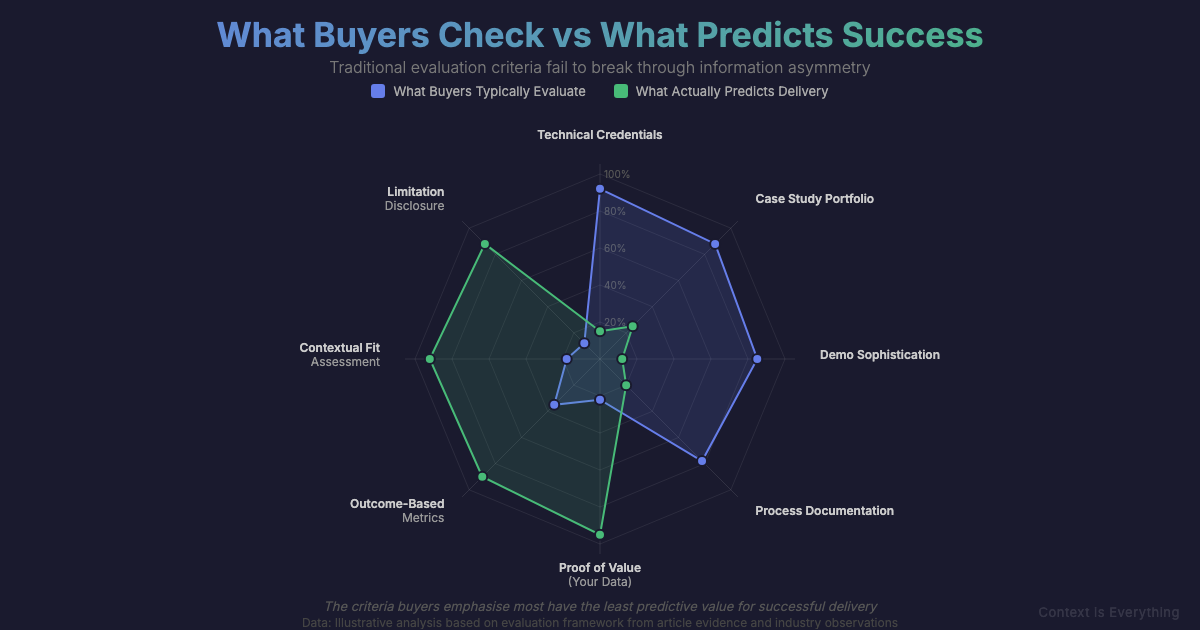
Every consultant presents well: solid credentials, relevant case studies, impressive demos, technical fluency. The differences that matter—whether they'll understand your specific context—only become visible during implementation.
This creates what Akerlof called a "market for lemons." Not because all consultants are bad, but because the good ones and the generic ones are nearly indistinguishable at the buying stage.
What You Think You're Buying vs. What You Need
Most buyers think they're purchasing Artificial Intelligence: advanced technology, sophisticated models, technical expertise.
What successful buyers actually need is Intelligence Augmentation: AI that learns your proprietary knowledge and amplifies what makes you unique.
AI is generic. ChatGPT in your workflow. The same models your competitors buy. Efficiency everyone gets simultaneously. A commodity.
IA is contextual. AI that understands why your Manchester operation differs from your Birmingham one, why your New York clients behave differently from your Los Angeles ones. Systems that know which "best practices" don't apply to you. Technology that captures the tribal knowledge that actually makes you work.
AI is rented. IA is built.
The problem? They look identical in sales presentations.
The Evidence
An insurance brokerage thought standard medical malpractice practices applied to them. But they specialised in medical aesthetics—where UK regulations differ from US ones, where Botox providers have different risk profiles than surgical practices, where licensing varies by state and country.
Generic AI would have automated their existing 20% conversion rate. Understanding that specific context enabled 150% improvement—from 20% to 50% conversion.
A procurement project needed to evaluate stadium catering vendors. Generic approach would have compared spreadsheets. Contextual approach asked: "What assumptions do vendors make that don't apply to stadium catering?" That question led to finding £200K in hidden costs.
The difference wasn't better AI technology. It was understanding context.
How can buyers reduce AI information asymmetry?
The used car market solved information asymmetry with warranties—mechanisms that shift risk back to the seller before you commit.
AI consulting needs the same thing.
Look for consultants who:
Start with your actual problem. Using your data, your context, your specific challenge. Not generic demos showing what's possible—proof of what works for you.
Define success as your outcomes. Conversion rates, cost savings, time reductions. Not "AI implemented successfully."
Build for your context, not theirs. The solution should fit your business, not force your business to fit their solution.
Tell you what won't work. Upfront. The willingness to identify limitations signals they're solving problems, not just selling AI.
One limitation vendors rarely volunteer: whether your client data remains inside your infrastructure. For professional services firms with confidentiality obligations, this is non-negotiable — Private AI Deployment for Professional Services explains the architectural difference between a vendor promise and an architectural guarantee.
These aren't questions they can rehearse. They're mechanisms that put expertise at risk before you commit.
The Choice You're Actually Making
MIT found 95% of AI projects fail because the market is full of lemons—generic AI sold as bespoke IA.
Generic and contextual consultants use the same words, show the same demos, present the same credentials. Information asymmetry makes them indistinguishable.
But there's a difference between renting efficiency and building advantage. Between automating existing processes and transforming them. Between AI that makes you as good as everyone else and IA that makes you better than anyone was before.
You're not just buying software. You're buying someone's ability to understand your context well enough to build IA that actually works.
The lemon market depends on you not being able to tell the difference. Now you can. Score whether your current AI approach has the patterns associated with success or failure before you commit.
Also from The Contour
The personal-voice version of these ideas, from Spencer Thursfield's newsletter.

Related Articles
Why Most AI Projects Fail (And What the 5% Do Differently)
MIT's Project NANDA found 95% of enterprise AI pilots deliver zero return. Companies have invested £30-40 billion with nothing to show. But 5% achieve rapid revenue acceleration. The difference isn't the technology - it's implementation and context.
The Complete Cost of AI: What Successful Implementations Actually Budget For
The average company spends £68K monthly on AI, but only half can measure ROI. The real cost is typically 2-3x the initial proposal - here's what successful implementations budget for.
5 Signs Your Business Actually Needs AI (And 5 Signs It Doesn't)
Most businesses don't need AI right now. Here are 5 signs you genuinely need it—and 5 signs you definitely don't. The honest assessment most consultants won't give you.
Private AI Deployment for Professional Services: The Complete Guide
Most professional services firms can't use generic cloud AI. Not because it's not good enough — but because their clients' data can't leave the building. Private AI deployment solves this. Here's how it works.