

Why Most AI Projects Fail (And What the 5% Do Differently)
MIT's Project NANDA found 95% of enterprise AI pilots deliver zero return. Companies have invested £30-40 billion with nothing to show. But 5% achieve rapid revenue acceleration. The difference isn't the technology - it's implementation and context.
MIT's Project NANDA just published something that should worry every executive: 95% of enterprise AI pilots deliver zero measurable business return.
Not "disappointing results." Not "below expectations." Zero return.
Companies have poured £30-40 billion into generative AI, yet the vast majority see nothing back. The failure rate is so severe it recently spooked stock markets and prompted serious questions about whether we're in an AI bubble.
But here's what's interesting: about 5% of AI pilots achieve rapid revenue acceleration. Some startups have gone from zero to £20 million in revenue within a year using AI.
So what's the difference?
Why do 95% of AI projects fail?
The Real Problem Isn't the Technology
The biggest problem wasn't that the AI models weren't capable enough, MIT found. The technology works. What fails is how companies implement it.
The research identified three patterns that kill AI projects:
1. Building Instead of Buying
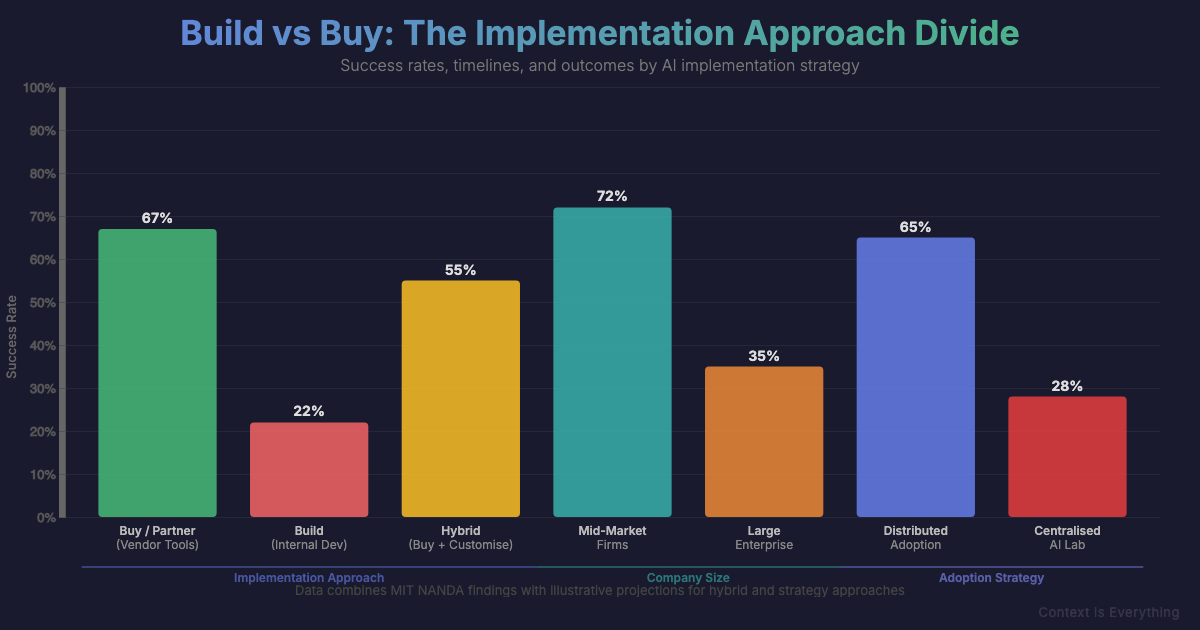
Purchasing AI tools from vendors succeeds about 67% of the time, while internal builds succeed only one-third as often. Yet companies, especially in regulated industries, keep insisting they need to build proprietary systems.
The logic seems sound - more control, better security, tailored to our needs. But building AI from scratch requires expertise many companies don't have and can't afford to hire.
2. Centralising Instead of Distributing
Success requires empowering line managers - not just central AI labs - to drive adoption. When AI implementation gets locked in an innovation team, it never reaches the people who actually understand the work.
The 5% that succeed spread AI adoption across the business. They let the people closest to the problems determine how AI can help.
3. Generic Tools, Specific Problems
Most AI implementations fail because they apply generic solutions to specific contexts. When it comes to using AI in actual business cases, a 5% difference in reasoning abilities or hallucination rates can result in substantial difference in outcomes.
Your business isn't generic. Your challenges aren't generic. Why would generic AI work?
What do the successful 5% do differently?
The successful 5% share specific patterns:
They start with one specific pain point, not enterprise-wide transformation. Successful startups pick one pain point, execute well, and partner smartly rather than trying to solve everything at once.
They partner with specialists who've already solved similar problems, rather than learning expensive lessons themselves.
They integrate deeply with existing workflows instead of creating parallel AI processes that nobody uses.
Most importantly, they understand that AI needs context to be useful. Generic chatbots give generic answers. AI that understands your specific situation, regulations, and constraints gives useful answers.
The Context Problem
Here's what MIT's research reveals: most AI projects fail because the AI doesn't understand your business context.
It doesn't know:
Without this context, even the most sophisticated AI gives advice that sounds strategic but lacks the specificity to be useful.
What This Means for You
If you're considering AI implementation, the MIT research suggests three priorities:
First, be honest about whether you need to build or can partner. Building only makes sense if your situation is genuinely unique. Most aren't. And if you're buying, watch for hidden costs in vendor proposals. For firms handling client data with confidentiality obligations, also consider whether vendor-hosted AI creates data sovereignty risks — Private AI Deployment for Professional Services covers the architecture options.
Second, empower the people who understand the actual work. Your innovation lab doesn't know what your operations team needs.
Third, focus on context. Generic AI tools need to understand your specific business reality to deliver value.
The companies succeeding with AI aren't smarter or richer. They just recognised that implementation matters more than capability, and the true cost of AI matters more than the initial quote.
The research interviewed 150 executives, surveyed 350 employees, and analysed 300 individual AI projects. The patterns are clear.
The question isn't whether AI can work for your business. The question is whether you'll implement it like the 95% or the 5%. Score your approach against the failure patterns that determine which group you're in.
---
Want to discuss how context-aware AI could work for your specific situation? Let's talk.
Related Articles
8 AI Mistakes Costing UK Small Businesses £50K+ (And How to Avoid Them)
AI spending is up six-fold, yet UK small business adoption crashed from 42% to 28%. Discover the 8 expensive mistakes costing £5K-£50K+ each to fix—and learn how businesses getting it right avoided these patterns.
5 Signs Your Business Actually Needs AI (And 5 Signs It Doesn't)
Most businesses don't need AI right now. Here are 5 signs you genuinely need it—and 5 signs you definitely don't. The honest assessment most consultants won't give you.
The Complete Cost of AI: What Successful Implementations Actually Budget For
The average company spends £68K monthly on AI, but only half can measure ROI. The real cost is typically 2-3x the initial proposal - here's what successful implementations budget for.
Private AI Deployment for Professional Services: The Complete Guide
Most professional services firms can't use generic cloud AI. Not because it's not good enough — but because their clients' data can't leave the building. Private AI deployment solves this. Here's how it works.