
The Complete Cost of AI: What Successful Implementations Actually Budget For
The average company spends £68K monthly on AI, but only half can measure ROI. The real cost is typically 2-3x the initial proposal - here's what successful implementations budget for.
Do you know what your AI actually costs?
According to CloudZero's 2025 research, the average company now spends £68K per month on AI. That's up 36% from last year.
But here's what's really interesting: only half of organisations can actually measure whether they're getting value back.
The ones who can? They know something the others don't. They're budgeting for the complete picture, not just the technology quote.
The Five Investments Beyond the Proposal
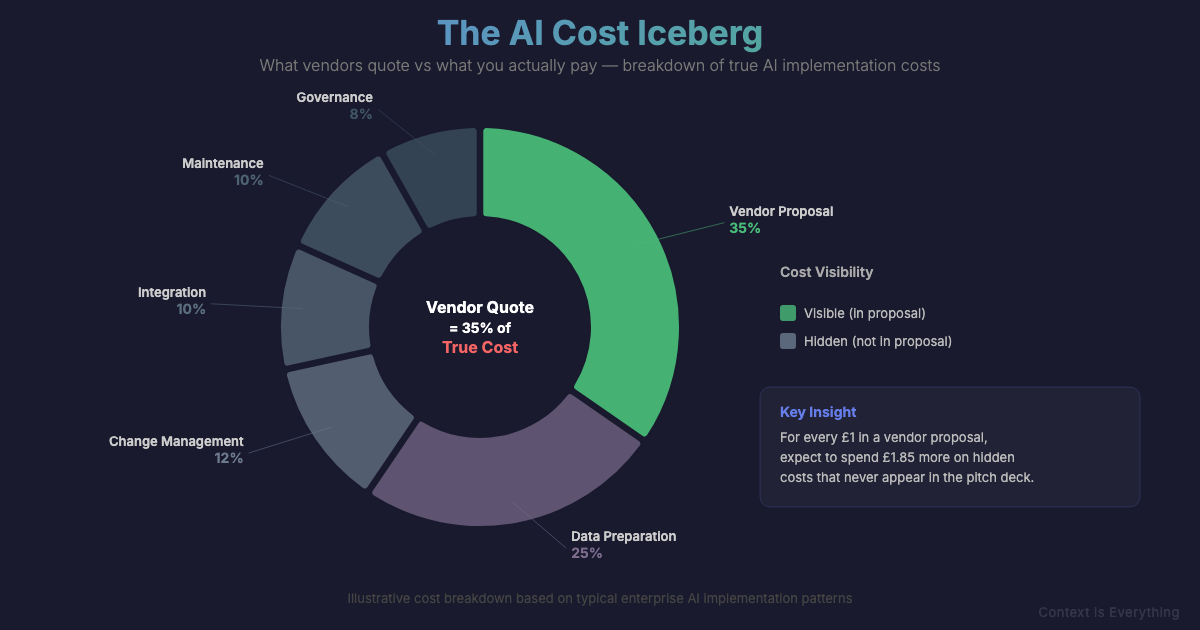
Most AI vendors quote you for the implementation. Fair enough. But that's typically only 30-40% of your actual investment. Here's what usually gets missed:
1. Getting Your Data Actually Ready
"AI-ready data" is a myth. Nobody has it. Your data is probably scattered across systems, inconsistent in format, and full of gaps you didn't know existed.
One client thought their customer data was clean. Turned out 40% of records had missing or contradictory information. Cleaning that took three months and significant resources.
This isn't unusual. Data preparation typically accounts for 40-50% of the real cost. Not because vendors hide it, but because everyone assumes "someone else" is handling it.
2. Helping People Actually Change
Technology is easy. Changing how people work is hard.
We worked with an insurance brokerage that had sophisticated AI but 70% of their team still used spreadsheets because "it's just easier." The AI sat unused, delivering zero value.
Change management isn't a luxury—it's often 20-30% of your true cost. Training, support, workflow redesign, dealing with resistance. All essential. All rarely in the initial budget.
3. Making It Play Nicely With Everything Else
"Integration included" in a proposal usually means "we'll answer questions while you do the work."
Integration is where costs explode. Your legacy systems need updates. APIs don't quite match. Security requirements add complexity. That "simple" integration becomes a six-month project.
Budget 15-25% of total cost for integration. More if your tech stack is complicated.
4. Keeping It Running Properly
AI isn't like normal software. It drifts. Performance degrades. Models need retraining.
One company discovered their AI's accuracy had dropped from 94% to 71% over six months. Nobody noticed because nobody was monitoring properly.
Ongoing maintenance is typically 10-20% annually. Not optional—essential to actually getting the value you paid for.
5. Making Sure It's Doing What It Should
Governance sounds boring until your AI makes a biased decision, violates a regulation, or does something nobody can explain.
For regulated industries, governance can add 10-15% to costs. Documentation, audit trails, bias monitoring, compliance checks. All necessary, all often overlooked.
The Context Advantage
Here's where understanding your specific situation changes everything.
That insurance brokerage? When we actually understood their context, we eliminated $200,000 in annual technical debt by removing 85% of their middleware—complexity they didn't need.
They didn't spend more. They spent smarter.
Generic AI implementations add complexity. Context-aware implementations often reduce it.
What Smart Buyers Do Differently
Before signing anything, they ask:
About data:
About people:
About integration:
About maintenance:
About governance:
The Bottom Line
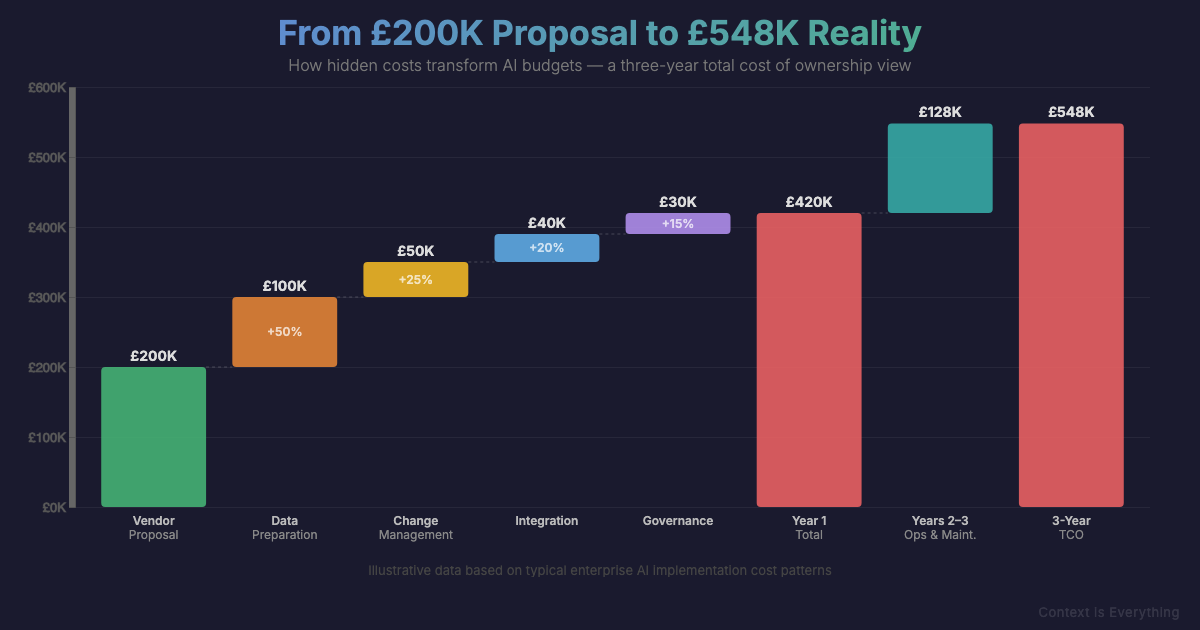
The real cost of AI is typically 2-3x the initial proposal.
This isn't a reason to avoid AI. It's a reason to budget accurately.
CloudZero's research shows companies achieving 3.5X ROI on AI (some hit 8X). But those are the ones who understood the complete investment upfront.
The question isn't whether AI is worth it. It's whether you're budgeting for what it actually takes to succeed. Estimate your real costs before committing.
Smart companies don't just buy AI. They invest in AI that understands their context—and budget for making that understanding real.
---
Want to understand your complete AI investment picture? Let's talk about your specific situation.
Related Articles
Why Most AI Projects Fail (And What the 5% Do Differently)
MIT's Project NANDA found 95% of enterprise AI pilots deliver zero return. Companies have invested £30-40 billion with nothing to show. But 5% achieve rapid revenue acceleration. The difference isn't the technology - it's implementation and context.
Why Most of Your Technology Stack Adds No Value
We helped an insurance brokerage improve conversion from 20% to 50% by eliminating 85% of their middleware - the worthless complexity that added cost without adding value.