
Why Most of Your Technology Stack Adds No Value
We helped an insurance brokerage improve conversion from 20% to 50% by eliminating 85% of their middleware - the worthless complexity that added cost without adding value.
We recently helped an insurance brokerage improve their customer conversion rate from 20% to 50%. The solution wasn't adding more technology.
It was deleting most of what they had.
How much of your technology stack actually adds value?
We eliminated 85% of their middleware - the complex systems sitting between their customer-facing application and their data. Everything still worked. Actually, it worked better.
Faster responses. Fewer failures. Lower costs. More secure.
This pattern repeats across industries: companies accumulate layers of technology that add complexity without adding value.
How Did We Get Here?
The complexity usually grows like this:
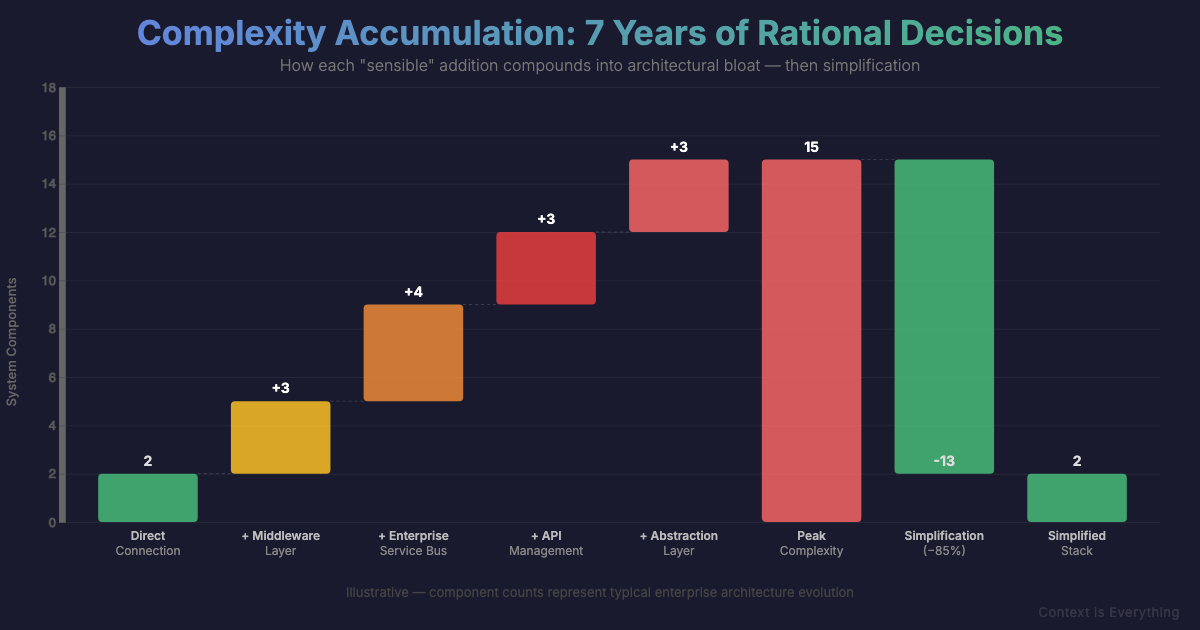
Year 1: "We need to connect System A to System B"
Year 2: "Let's add middleware for flexibility" Year 3: "We should use an enterprise service bus for standards" Year 5: "We need an abstraction layer to manage complexity" Year 7: "Why is everything so slow and expensive?"Each decision made sense at the time. Together, they created a system nobody fully understands and everyone's afraid to touch.
The Actual Problem
Most middleware doesn't do anything valuable. It takes data from one place, maybe renames a few fields, and passes it somewhere else.
No decisions. No transformations. No business logic.
Just expensive copying with multiple failure points, slower performance, higher maintenance costs, and increased security vulnerabilities.
The insurance brokerage was paying for:
When we eliminated the middleware that added no value, something interesting happened: the system became more reliable, not less.
How to Spot Worthless Complexity
Try this exercise: trace a piece of data through your system.
Count how many times it gets transformed. How many systems it passes through. What value gets added at each step.
For each component, ask:
Then calculate the true cost:
What should you do about technology that adds no value?
Not all complexity is worthless. That remaining 15% often contains your competitive advantage.
In the insurance case, we preserved:
The key is distinguishing between:
Your competitive advantage isn't in your middleware. It's in your domain expertise, your business logic, your understanding of what makes you different.
Everything else is just expensive noise.
The Real Benefit
When the insurance brokerage eliminated worthless complexity:
But the biggest benefit? They could innovate again. Their developers could understand the system. Changes that took months now took days.
Your Situation
Every organisation accumulates worthless complexity over time. It's not anyone's fault - it's how systems evolve without regular pruning.
But every day you tolerate it costs you:
What to Do
Start with one integration. Trace the data flow. Ask the hard questions about what's actually happening at each step.
You'll likely find that a direct connection could replace three layers of middleware.
The insurance brokerage proved it: when you eliminate worthless complexity, you don't just save money - you transform how quickly you can move.
Because here's the truth: in most technology stacks, the majority of what you're paying for adds no business value. It just makes everything slower, more expensive, and more fragile.
Adding AI to an over-complex stack without simplifying first is one of the reasons most AI projects fail to deliver return.
The question is: are you brave enough to delete it?
---
Want help identifying worthless complexity in your systems? Let's talk.