
The Hidden Costs in Your Vendor Proposals
We found £200,000 hidden in a vendor proposal - not through negotiation, but by understanding what normal looks like in the industry and spotting what was missing.
We found £200,000 hidden in a vendor proposal last week.
Not through negotiation. Not through efficiency gains. It was hiding in plain sight on page 247 of a 300-page document.
The client nearly signed a contract that looked competitive on paper but contained substantial concealed costs. They're not alone - every complex vendor proposal contains hidden expenses.
Here's how to find yours before signing.
Where do vendors hide costs in AI proposals?
Vendor proposals hide costs through three main methods:
Method 1: Shifting Responsibilities
One proposal stated "training provided" whilst another included "comprehensive training programme". Sounds similar, right?
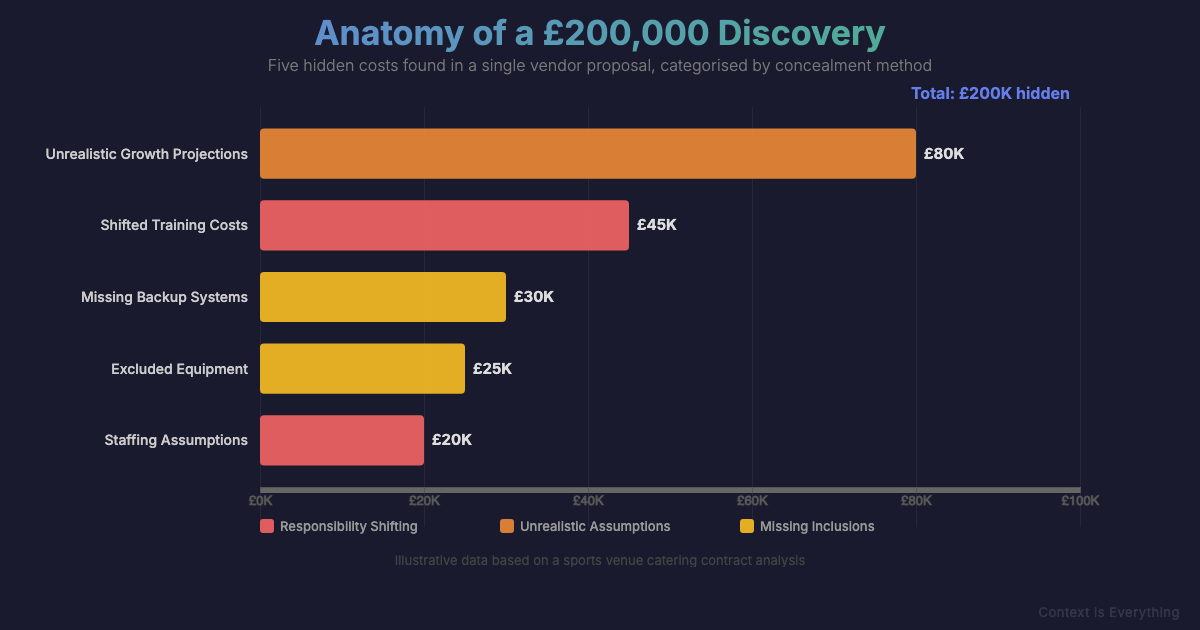
The difference: £45,000 annually. The first vendor's "training" meant online documentation. The second included on-site sessions, materials, and ongoing support.
Both technically told the truth. One just shifted the actual training cost to the client.
Method 2: Unrealistic Assumptions
A catering proposal assumed 15% year-on-year growth. Sounds optimistic and positive.
The problem: it was built into the pricing model. If growth didn't materialise, unit costs would increase significantly. The client's actual growth? 3% annually.
That unrealistic assumption represented £80,000 in hidden costs over the contract term.
Method 3: Missing Standard Inclusions
The most expensive trick is what's not mentioned. One vendor's proposal was £50,000 cheaper than competitors.
Investigation revealed they'd excluded items other vendors included as standard: backup support, certain integrations, and specific reporting capabilities.
Adding those excluded items? The "cheaper" option became the most expensive.
How can you spot hidden costs before signing?
Finding hidden costs requires three steps:
Step 1: Establish Baselines
Before comparing proposals, research what's normally included in your industry. Talk to peers. Review industry standards. Understand the complete picture.
Without baselines, you can't recognise what's missing.
Step 2: Standardise Proposals
Complex proposals use different structures, making comparison difficult. Before evaluating, translate everything into a common format.
Identify every responsibility, assumption, and inclusion across all proposals. Create a matrix showing what each vendor actually provides.
Step 3: Question Everything
For every line item:
Read footnotes. Challenge vague language. Verify every assumption against your reality.
The £200,000 Discovery
The procurement case involved a major sports venue's catering contract. Three vendors submitted proposals ranging from £3.2M to £3.8M annually. The full engagement, including the methodology applied, sits in our stadium catering procurement case study; the broader thinking on what AI compresses (and what it doesn't) is in Using AI to Compare Vendor Proposals.
The middle proposal looked strongest: competitive pricing, reasonable terms, solid references.
Detailed analysis revealed:
The "competitive" £3.4M proposal was actually £3.6M once hidden costs were included. The initially expensive £3.8M proposal included everything and was actually the best value.
What This Means for You
Hidden costs aren't about vendor dishonesty. They're about information asymmetry — complexity creating places for costs to hide.
Every complex procurement contains them. Our experience suggests 5-10% of contract value typically remains concealed through these methods.
The question isn't whether your proposals contain hidden costs. It's whether you'll find them before signing.
Your Action Plan
Before your next vendor decision:
Before RFP Review:
During Review:
Before Deciding:
The Bottom Line
Context matters in procurement. Understanding what normal looks like lets you spot what's missing.
The £200,000 we found wasn't unusual - it was typical. But it required systematic analysis to uncover because complexity obscures truth.
You don't need AI to find these costs. You need context - understanding your industry well enough to recognise anomalies.
Your next vendor proposal contains hidden costs. The question is whether you'll find them before signing. Signing without scrutiny is one of the reasons most AI implementations fail to deliver return.
---
For management consultancies evaluating AI vendors specifically, the same patterns apply — and the stakes are higher when the vendor is selling AI itself.
Score your AI procurement approach against the three patterns that lead to failure before you sign.
Want help identifying hidden costs in your procurement? Let's talk.