
Using AI to Compare Vendor Proposals: Where It Helps and Where It Doesn't
Mozart's string quartet still takes twenty-five minutes. A finance director's judgement still cannot be hurried. But everything around the decision can be compressed. A £15M procurement, 1,200 pages of supplier documentation, and what context-first AI actually surfaces.
There is something defiant about a string quartet.
Around 1787, Mozart wrote a piece for four musicians that takes roughly twenty-five minutes to perform. Two violins, a viola, a cello. Twenty-five minutes then, twenty-five minutes now. No shortcuts have been discovered. No one has successfully suggested removing the viola to streamline delivery.
You can digitise the sheet music. You can optimise the ticketing. You can even improve the chairs. But when the music starts, time resumes its original shape.
This irritated the economist William Baumol. Not the music itself, but the economics of it. While the quartet had not become any faster, the cost of hiring those four musicians had steadily risen. Factory workers produced more. Engineers built faster. Entire industries accelerated. And if the quartet did not keep up, the cellist would eventually wander off to become a software developer.
This is what Baumol called the cost disease: sectors where productivity stubbornly refuses to improve still become more expensive, simply because everything else does.
A teacher still teaches a class. A haircut still takes as long as it always has. The tools around them have improved enormously. The work itself resists compression.
The procurement problem
Four suppliers. A contract worth north of £15 million. Twelve hundred pages of documentation scattered across Excel, PDFs, and Word files, each structured just differently enough to resist comparison. Pricing models that do not quite align. Assumptions tucked into footnotes. One finance director, two weeks, and a board that would quite like a clear answer.
In theory, this is a three-week job.
In practice, very little of that time is spent thinking. Most of it is spent doing something closer to archaeology. Extracting numbers. Rebuilding tables. Translating one supplier's logic into another's format. Creating, from fragments, something that can be compared without accidentally misleading everyone in the process.
Only once that is done does the actual work begin.
What AI compresses
This is where AI enters the story, usually wearing the slightly overconfident expression of someone who believes they can play the cello after watching a YouTube tutorial.
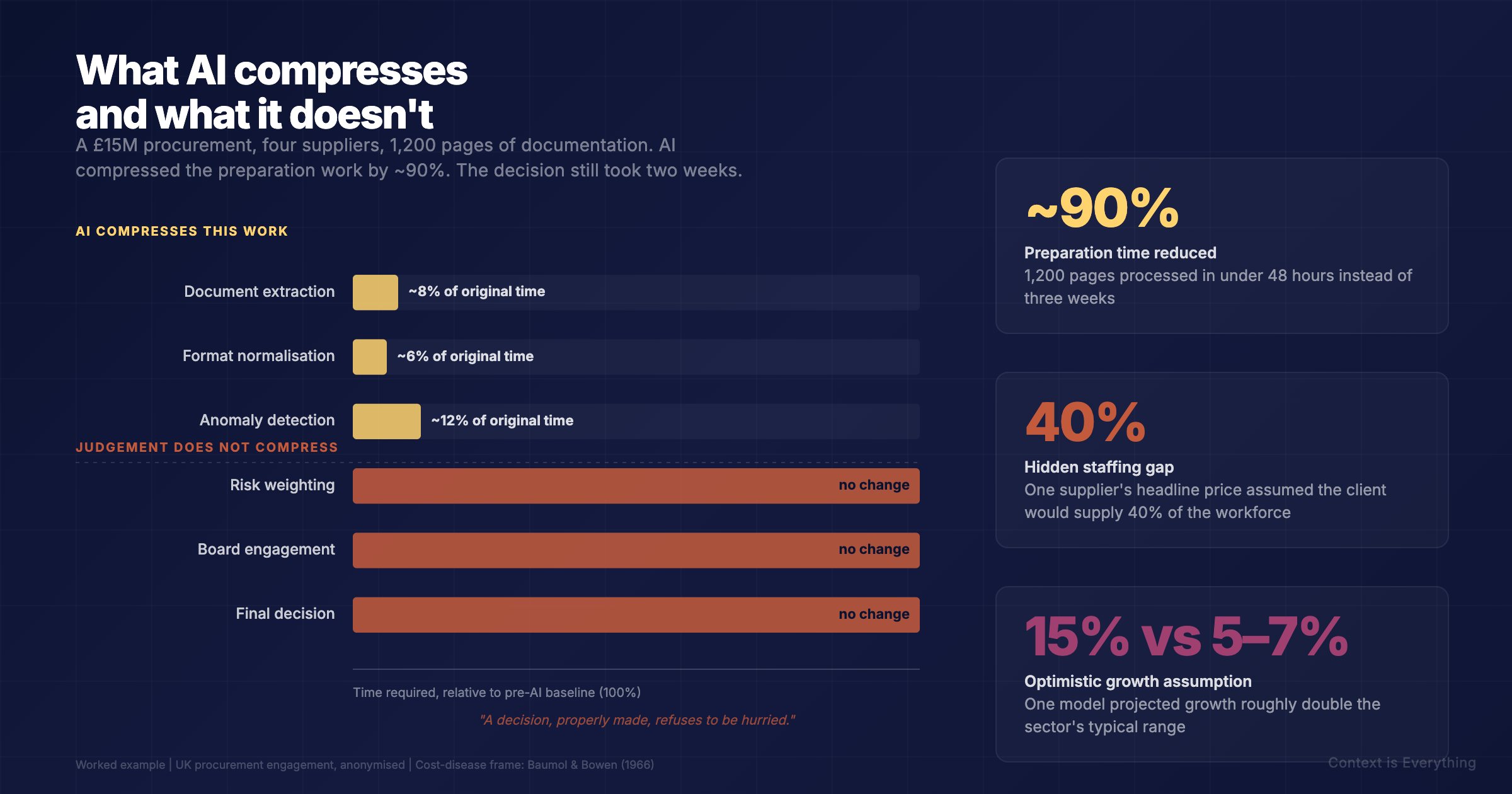
To be fair, it can help. We processed the 1,200 pages in under 48 hours. Standardised the formats. Extracted the key data. Surfaced the obvious differences.
But raw processing is not understanding. It is typesetting.
If you give most AI systems four proposals, they will give you back a beautifully organised comparison. Every number in its place. Every table aligned. The analytical equivalent of a perfectly tuned instrument waiting, rather awkwardly, for someone to actually play it.
Because something is missing. Context. Not the kind you can scrape from a document, but the kind that accumulates quietly over years. What normal looks like in stadium catering. What staffing ratios tend to hold under pressure. What growth rates are ambitious versus quietly implausible. The difference between a clever assumption and a dangerous one.
What changes when you build context first
Before any documents were processed, we built that context around the problem. Benchmarks. Ratios. Ranges. The invisible scaffolding that experienced people carry in their heads without ever writing down.
In other words, we gave the AI something to disagree with.
That is when it became interesting.
One supplier appeared to be the most competitive on price. Clean numbers, sensible structure. But something felt off, not in the totals but in the shape of them. The AI flagged a discrepancy: staffing levels were around 40% lower than the others.
Buried in the assumptions was the explanation. They were not under-staffing. They were simply expecting the client to provide a significant portion of the workforce. Perfectly reasonable, if you happen to notice it. Less so if you do not. The headline price remained attractively low. The hidden cost did not.
Another proposal projected 15% annual growth in a market that tends to hover somewhere between five and seven. Not impossible. Just optimistic in the way that tends to become expensive later.
Neither issue was concealed. Neither announced itself, either. Without context, they pass straight through the system: immaculately processed, beautifully presented, and entirely unchallenged. The full receipts for this engagement, including the £200,000 of cost surfaced through context-first analysis, sit in our stadium catering procurement case study; the related thinking on the broader pattern is in The Hidden Costs in Vendor Proposals.
What this means for procurement teams
The decision, in the end, still belonged to the finance director. That part does not compress. Judgement rarely does.
But everything leading up to it had changed shape. Instead of three weeks spent assembling something usable, the work arrived already structured, already interrogated. The anomalies surfaced. The assumptions stress-tested. The noise reduced to something closer to signal.
For the first time, the human part of the process, the part that actually matters, had room to breathe.
Baumol was right. Some work resists acceleration. A quartet still takes twenty-five minutes. A decision, properly made, refuses to be hurried.
But you do not have to speed up the performance to change the experience of it. You can compress everything around it. Preparation. Translation. Reconstruction. The noiseless, necessary friction that so often consumes the very people you rely on to think clearly.
Which leads to a different question. Not which roles can be replaced, but what knowledge sits inside them, unspoken, and what happens when it leaves. We've written about that elsewhere in The Intelligence AI Can't Replicate.
Context is not a feature. It accumulates. Every decision adds to it. Every mistake refines it. Strip it away, and you are left with information that looks complete but understands nothing. Build it deliberately, and something else happens.
Score whether your AI approach is set up to surface hidden assumptions or just process documents.
Also from The Contour
The personal-voice version of these ideas, from Spencer Thursfield's newsletter.

Related Articles
The Hidden Costs in Your Vendor Proposals
We found £200,000 hidden in a vendor proposal - not through negotiation, but by understanding what normal looks like in the industry and spotting what was missing.
Information Asymmetry: Buying IA vs AI
The AI consulting market exhibits classic information asymmetry—buyers can't distinguish quality until after commitment. Learn the difference between generic AI and contextual Intelligence Augmentation, and how to identify consultants who'll actually deliver.
The Intelligence AI Can't Replicate
49% of procurement teams ran AI pilots in 2024. Only 4% reached meaningful deployment. The gap isn't technical. It's the moment the tool encounters knowledge that was never written down.