
The Intelligence AI Can't Replicate
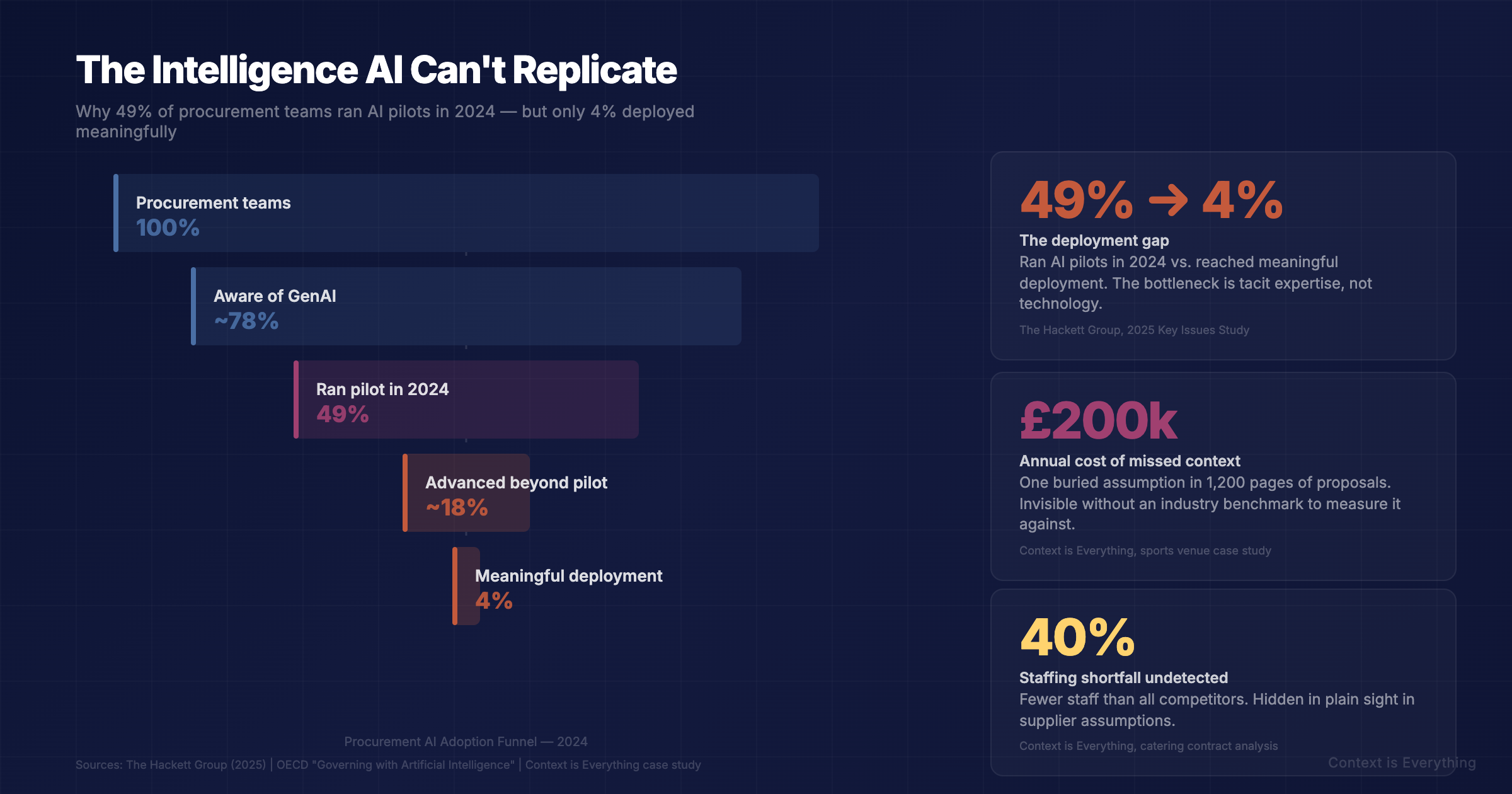
49% of procurement teams ran AI pilots in 2024. Only 4% reached meaningful deployment. The gap isn't technical. It's the moment the tool encounters knowledge that was never written down.
A financial director had fourteen days to recommend a catering partner for a major sports venue contract. Four international suppliers. More than 1,200 pages of proposals. The kind of deadline where you read faster rather than better.
One supplier had proposed 40% fewer staff than every competitor. The reason was written into the document in plain language: the client would provide the sales staff. Not flagged. Not highlighted. Just sitting in the assumptions, in a stack of material that one person didn't have time to read properly. Annual cost if nobody caught it: £200,000.
This is the sort of thing AI is supposed to find. So why didn't it? Most AI projects fail for exactly this reason.
Why do 49% of procurement AI pilots fail to deploy?
According to The Hackett Group's 2025 Key Issues Study, 49% of procurement teams ran generative AI pilots in 2024. Only 4% reached meaningful deployment. The usual explanations (data quality, integration, change management) are real but insufficient. They don't explain why pilots keep stalling at the same point: the moment the tool encounters knowledge that was never written down.
The OECD put it well in their "Governing with Artificial Intelligence" report. Procurement managers aren't sceptical of AI because they don't understand it. They're sceptical because they understand their own work. Negotiation judgment. Category knowledge. The instinct for when a staffing ratio feels light or a growth projection feels optimistic. That expertise is tacit, refined over years, never formalised, because it never needed to be.
What does this mean for procurement professionals?
If you're a procurement professional, this should be reassuring. Your expertise is the thing AI can't replicate. You were right to be wary. The oversight paradox explains why this matters more, not less, as AI improves.
But here's the harder question. If that intelligence stays in your head, undocumented, unstructured, untransferable, it isn't protected. It's invisible. Not just to AI, but to your own organisation. The knowledge you think of as your competitive advantage is actually your ceiling, because it can't be scaled, shared, or amplified by anything.
How did context-first analysis change the outcome?
In the sports venue case, the analysis worked because the context came first. Before anyone touched a proposal, we built the reference layer: industry benchmarks for staffing ratios, post-pandemic growth rates for comparable venues, standard food cost percentages, realistic revenue projections. We call this mapping the contours of what an organisation actually knows, and it's the foundation of our methodology.
None of that context was in the proposals. All of it determined whether the proposals made sense.
With that foundation in place, three things surfaced immediately. The £200,000 staffing gap, quantifiable the moment you knew the industry benchmark. Growth projections of 12-15% from two suppliers, in a sector where the post-pandemic norm is 5-7%. And food cost percentages ranging from 28% to 35%, calculated on entirely different bases, not comparable until standardised against a common framework.
The financial director had a board-ready recommendation, with full audit trail, within the deadline.
Where does the real gap lie?
The gap in procurement AI isn't between human judgment and machine capability. It's between organisations that have made their best people's knowledge explicit, and organisations that haven't. The former can use AI to genuinely dangerous effect. The latter will keep running pilots that stall the moment the tool needs to understand what it's looking at.
Your expertise isn't what AI is replacing. It's what AI requires. The question is whether you're going to leave it locked in your head. Map where AI can add the most value in your procurement workflow.
Also from The Contour
The personal-voice version of these ideas, from Spencer Thursfield's newsletter.

Related Articles
Why Most AI Projects Fail (And What the 5% Do Differently)
MIT's Project NANDA found 95% of enterprise AI pilots deliver zero return. Companies have invested £30-40 billion with nothing to show. But 5% achieve rapid revenue acceleration. The difference isn't the technology - it's implementation and context.
The Irreplaceable Expert: Why AI Without Human Oversight Fails in High-Stakes Consulting
As AI gets better, you would expect to need less human oversight. The opposite is true. When AI is 95% correct, the 5% that is wrong is camouflaged by the quality of everything around it. The oversight paradox in high-stakes professional services.
Your AI Pilot Worked. So Why Isn't Anything Changing?
The pilot worked. Leadership nodded. Six months later, nothing's changed. The distance between a successful AI pilot and organisational transformation is where most AI investment quietly dies.