
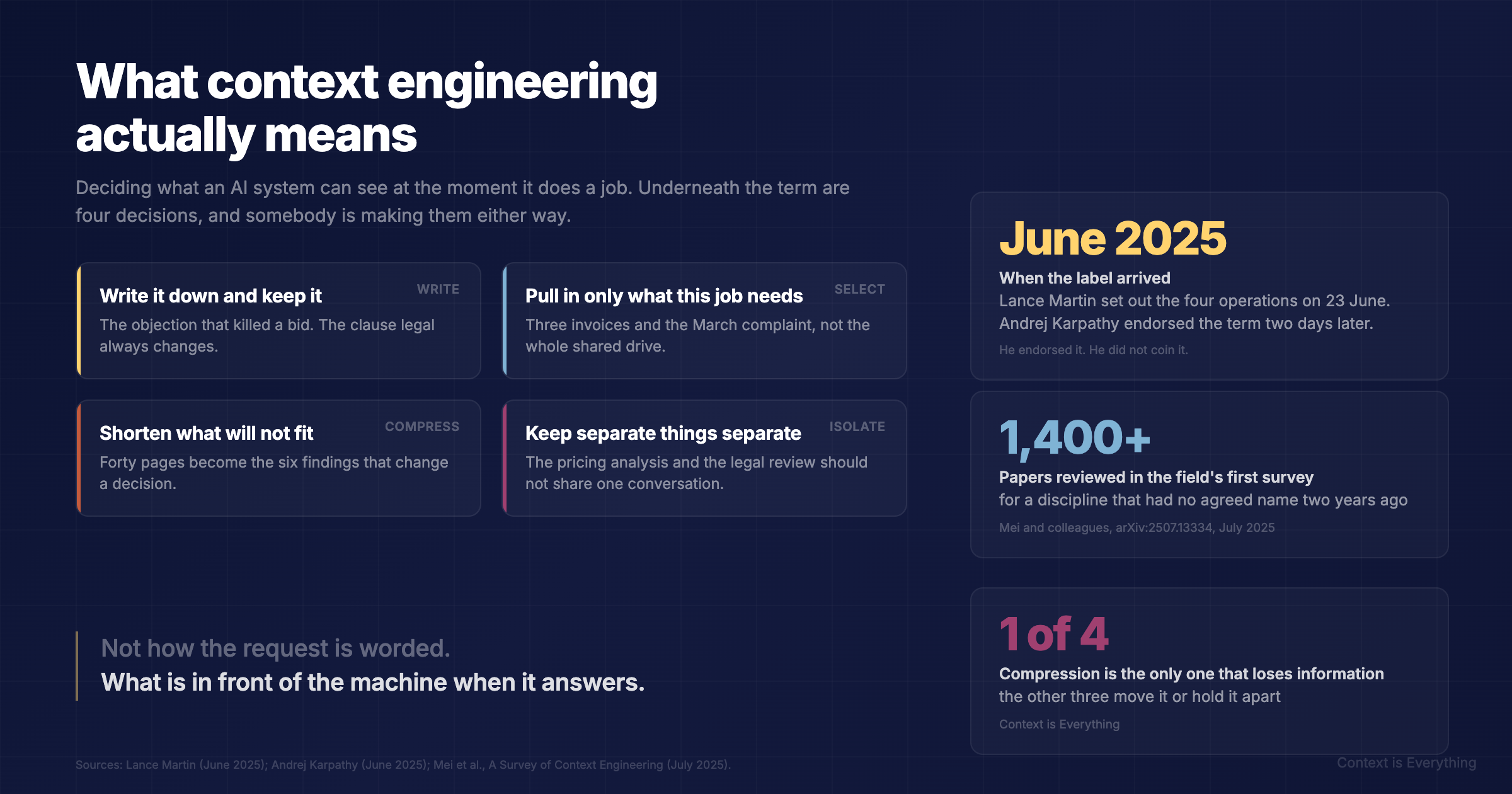
What Context Engineering Actually Means
A label arrived in June 2025 for an old problem: deciding what an AI system can see at the moment it does a job. Underneath the term are four decisions, and most of what you will be sold is a combination of them. Here is the vocabulary, the evidence behind it, and the two questions to put to a supplier.
Context engineering is deciding what an AI system can see at the moment it does a job. Not how the request is worded. What is in front of the machine when it answers.
Andrej Karpathy, who led AI at Tesla until 2022, gave it its working definition in June 2025: supplying "just the right information for the next step". A system holds only so much at once, so somebody chooses what it gets for this task. In most organisations we walk into, that somebody is nobody.
It is not the older habit of wording the question better, renamed. That assumed the request was the lever. This is about what is present when the answer is produced, and more expensive to get wrong.
Why the industry needed a new word
For two years the assumption was that the next model would fix it. It did not. Often what failed was not the reasoning but what the reasoning needed: a folder nobody connected, a spreadsheet on a partner's laptop.
Then the labs said it themselves. A Google tech lead, Hangfei Lin, put it sharply in December 2025: what a model sees is not text you write once, it is a view assembled at the moment of the task from sources held elsewhere. In July 2026 Anthropic deleted more than four fifths of the standing instructions it gives its own coding tool, with no measurable loss on its own coding tests, which is why one of your documents should be shrinking.
The four things you are actually deciding
Standing instructions and the record are the two things you manage. These four operations are how. The clearest statement of them is Lance Martin's, June 2025, republished by LangChain. Most of what you are sold combines them.
Write it down and keep it. The objection that killed a bid. The clause your legal team always changes. If it lives only in somebody's head, no system can use it.
Pull in only what this job needs. A renewal conversation needs three invoices and the complaint from March, not the shared drive. What the system finds first shapes much of what it says, which is one of seven fixes for made-up answers.
Shorten what will not fit. A forty page report becomes the six findings that change a decision. Cheap, useful, and it loses things. Shortening here means cutting material before the system sees it, not work going faster.
Keep separate things separate. The pricing analysis and the legal review should not share one conversation, because each contaminates the other. On one financial workflow we built, seven specialist assistants each had a narrow job, which is what that looks like in practice.
If you are buying rather than building
What separates a system that works in your firm from one that does not is the assembly: what is written down, pulled in, shortened, held apart.
Two questions do the work. Where does the record live between tasks, and do you own it? Which of the four are they doing, and which are they calling optional? A supplier doing only the shortening is selling summaries. The store itself is where the advantage sits.
The honest limits
The label is barely a year old and the vocabulary may not survive. Its evidence is mostly engineering notes from single companies, not controlled trials. What is durable predates the label: systems use what they can reach, and nothing else.
Nine things worth reading
Start here:
Then:
Context engineering is not a technology and there is nothing to install. It is a set of decisions about what the machine can see, and somebody is making them either way.
Related Articles
Bigger Context Windows Don't Mean Better Answers
Suppliers quote how much material a system can be handed at once as though that were the specification that mattered. Two published results show why it is the wrong thing to buy on: position inside the pile changes accuracy, and advertised capacity is not sustained capacity.
Your AI Rules Should Be Getting Shorter
Anthropic deleted more than 80% of the instructions it gives its own AI tool and lost nothing. A peer-reviewed paper found the opposite: detail beats summary. Both are right, because two very different things get called context, and only one of them should be growing.
AI Business Context: Why Generic AI Fails and Yours Doesn't Have To
Around 95% of enterprise AI pilots produce no measurable return, and the research is clear it is not the models. What is missing is business context: the accurate, current, organisation-specific knowledge the AI operates on. Here is what that means and how to get it right.
The Two Moats: Why Consultancies' AI Advantages Are Structural, Not Timing
Most professional services firms are still asking 'should we explore AI?' The firms pulling ahead are already in production. But the advantage isn't timing — it's structural. Two competitive moats are forming that can't be bought, replicated, or rushed: private data and custom tooling.