
AI Business Context: Why Generic AI Fails and Yours Doesn't Have To
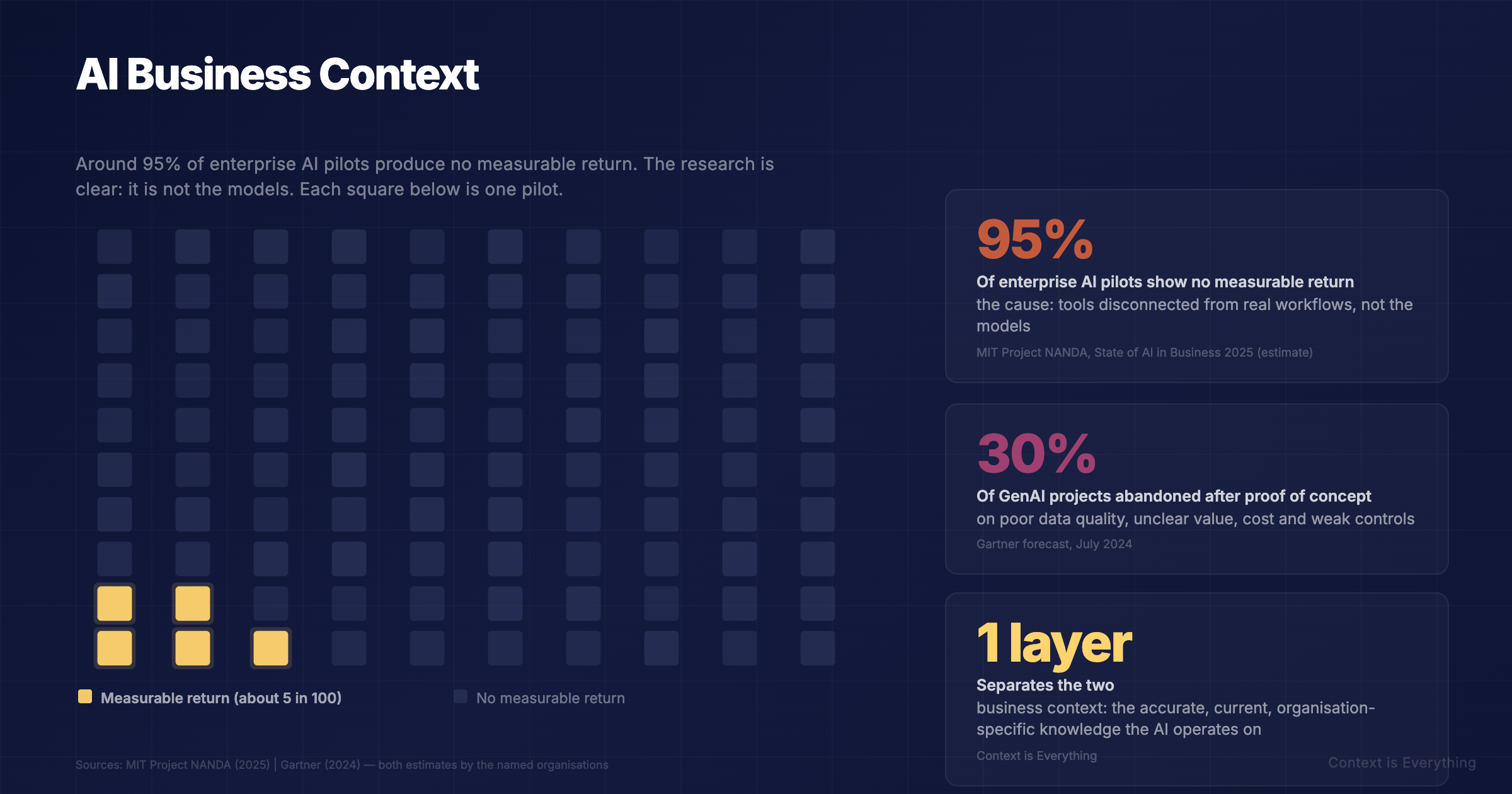
Around 95% of enterprise AI pilots produce no measurable return, and the research is clear it is not the models. What is missing is business context: the accurate, current, organisation-specific knowledge the AI operates on. Here is what that means and how to get it right.
In its 2025 report, MIT's Project NANDA examined 300 enterprise AI deployments, 150 interviews and a survey of 350 staff, and found that around 95% of enterprise generative AI pilots had produced no measurable return. The striking part is the reason. The researchers were explicit that it was not the models. It was that the tools were disconnected from real workflows, could not learn from feedback, and were pointed at problems nobody had defined properly.
Gartner reached the same wall from a different direction, predicting that at least 30% of generative AI projects would be abandoned after proof of concept by the end of 2025, citing poor data quality, unclear business value and escalating cost.
Read those two findings together and a single word keeps surfacing: context.
What "AI business context" actually means
A public model like Claude or GPT is trained on the public web. It is astonishingly good at general knowledge and completely ignorant of your organisation. It does not know your pricing logic, your client history, which supplier always slips a deadline, why the 2019 project failed, or what your best analyst quietly checks before signing anything off.
That organisation-specific knowledge is business context. It is the difference between an AI that writes a plausible answer and one that writes the right answer for you. A generic model tops out at public knowledge. Everything valuable your business actually runs on sits above that ceiling, in a private layer no public model has ever seen.
Why the demo works and the deployment doesn't
Almost every AI pilot demos well. That is the trap. A demo runs on a tidy example the general model can handle. The deployment runs on your messy reality, where the right answer depends on things only your organisation knows, and the general model has access to none of it.
This is why buying a better model rarely rescues a failing project. The model was never the constraint. As we have argued before, most AI projects fail on context, not technology, and private context is the richest kind there is. It is also, as we set out in The Two Moats, the one advantage a competitor cannot simply buy.
Business context validation: why wrong context is worse than none
Here is the part most teams miss. Context is not a one-off upload. It decays. Prices change, people leave, policies get rewritten, last year's best practice becomes this year's mistake. An AI confidently operating on stale context is more dangerous than one that admits it does not know, because it is wrong with authority and at scale.
So supplying context is only half the job. The other half is validation: checking that what the AI relies on is accurate, current and complete, and knowing which sources it drew from when it answered. An AI you cannot interrogate is an AI you cannot trust with anything that matters.
What this means in practice
Three things follow, and none of them start with the model.
Start with a defined process, not a capability. "Draft first-pass supplier risk summaries" beats "roll out AI." The narrower the job, the clearer the context it needs, and the easier it is to tell whether it worked.
Supply the context deliberately. Decide what the AI must know to do that job, and from which sources, then make that connection explicit rather than hoping the model infers it.
Validate and maintain it. Treat context like any other critical business input: owned by someone, dated, checked, and correctable when it drifts.
The organisations pulling ahead are not the ones with the best models. Everyone has the same models. They are the ones who have done the unglamorous work of getting their own context in order, so the model finally has something real to work with.
That is the whole game. The intelligence is off the shelf. The context is yours, and it is the only part nobody can buy.
Related Articles
The Two Moats: Why Consultancies' AI Advantages Are Structural, Not Timing
Most professional services firms are still asking 'should we explore AI?' The firms pulling ahead are already in production. But the advantage isn't timing — it's structural. Two competitive moats are forming that can't be bought, replicated, or rushed: private data and custom tooling.
Why Most AI Projects Fail (And What the 5% Do Differently)
MIT's Project NANDA found 95% of enterprise AI pilots deliver zero return. Companies have invested £30-40 billion with nothing to show. But 5% achieve rapid revenue acceleration. The difference isn't the technology - it's implementation and context.
The Intelligence AI Can't Replicate
49% of procurement teams ran AI pilots in 2024. Only 4% reached meaningful deployment. The gap isn't technical. It's the moment the tool encounters knowledge that was never written down.
The Hidden Complexity: Why AI Tuning Determines Everything in Professional Services
Two identical consulting analyses. Same frontier AI model. Wildly different results. What changed? Everything invisible. The difference between accurate AI and expensive mistakes comes down to configuration choices end users never see.