
Private AI Deployment for Professional Services: The Complete Guide
Most professional services firms can't use generic cloud AI. Not because it's not good enough — but because their clients' data can't leave the building. Private AI deployment solves this. Here's how it works.
Most professional services firms can't use generic cloud AI. Not because it isn't capable enough — but because their clients' data can't leave the building.
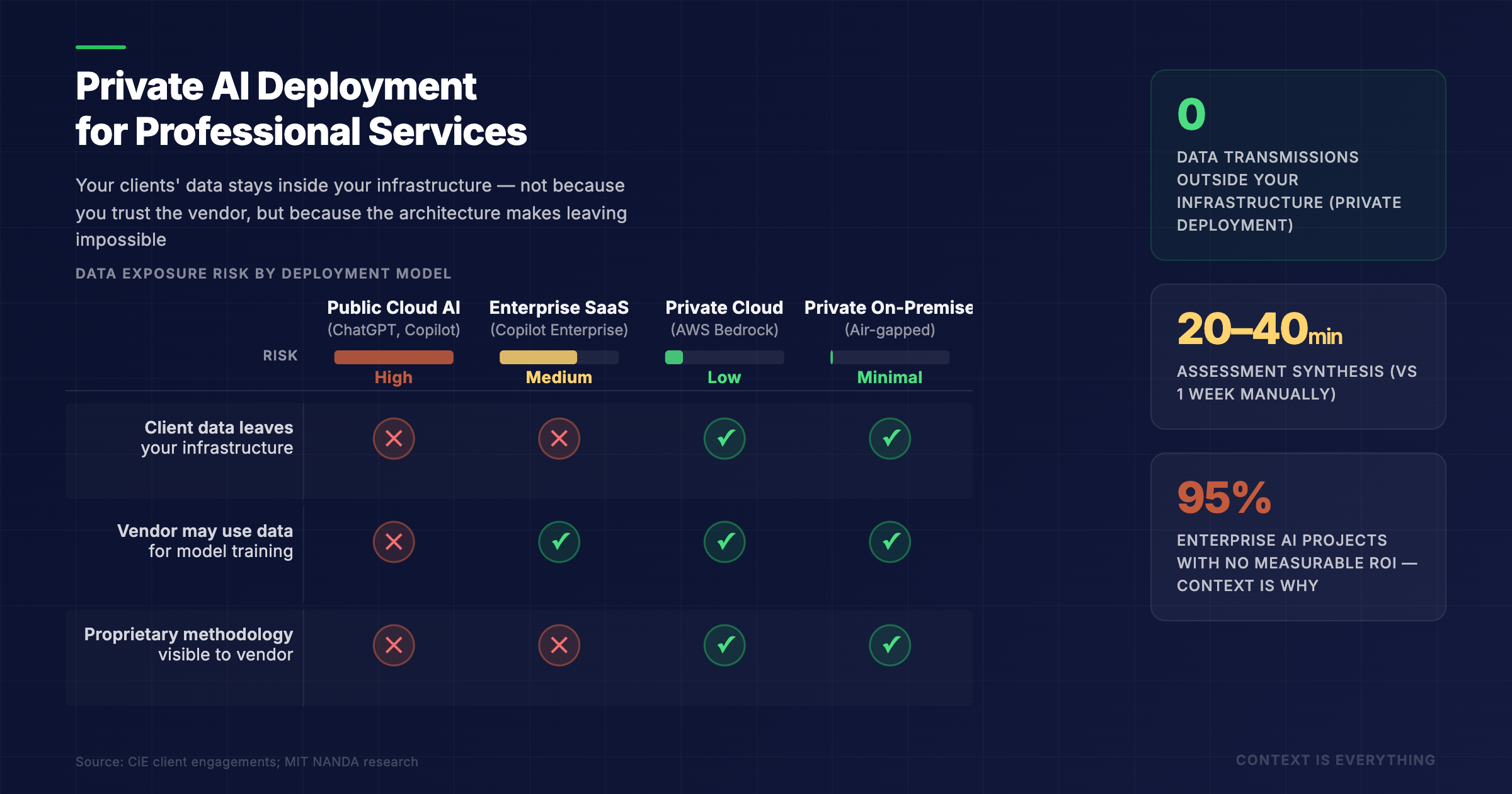
Every time a consultant pastes client content into ChatGPT, that content leaves the firm's infrastructure and enters a third-party system. That's not a risk acceptable to any firm handling M&A strategy, regulatory advice, personnel assessments, or client financial data.
Private AI deployment solves this. The AI runs inside your infrastructure. Client data never leaves your servers. Not because of a vendor promise — because the architecture makes it impossible.
What Private AI Deployment Actually Means
"Private AI" is used loosely. In the context of professional services deployment, it means one specific thing: the language model itself runs inside your infrastructure, not on a third-party cloud.
This is different from:
True private AI deployment means the LLM is running on your servers (or a cloud instance that you control and that is fully isolated), processing your data inside your security perimeter, with no internet connectivity required.
The architecture that makes this work in practice for professional services firms is AWS Bedrock — a managed service that runs foundation models inside a dedicated, isolated instance within your own AWS environment — or an equivalent arrangement with Azure. Your data never leaves your cloud account. Your encryption keys. Your audit trail.
For firms with the highest sensitivity requirements, fully air-gapped deployment is available: the model runs on local infrastructure with zero external connectivity.
Who Actually Needs This
Not every firm needs private deployment. But for professional services firms in the following situations, it isn't optional:
Client confidentiality obligations. Law firms, accountancy practices, and management consultancies handle client information under explicit confidentiality agreements. Using a generic cloud AI to process that information breaches those obligations regardless of what the vendor's terms say.
Proprietary methodology. If your firm's value is the methodology — the frameworks, the assessment tools, the analytical approaches — that methodology cannot sit on a third-party platform. You'd be giving your intellectual property to an infrastructure that has no obligation to protect it.
Regulated industries. Financial services, healthcare, and legal sectors operate under data handling regulations (GDPR, FCA rules, SRA guidelines) that restrict where client data can be processed. "The vendor is SOC 2 compliant" is not sufficient answer to a data residency requirement.
Personnel and organisational data. Hogan assessments, 360-degree reviews, organisational restructuring analyses — this is sensitive data about named individuals. It has no place on public cloud infrastructure.
The Tuesday Test
The most direct way to understand why private deployment matters for professional services is what we call the Tuesday Test.
Without private AI: Sarah's on holiday. Nobody knows what she knows about the Henderson account. You're manually transcribing interview notes. The week-long process of compiling Hogan assessment reports is bottlenecked by the fact that only trained consultants can do the work — and it's taking a week.
With SASHA deployed privately: You upload the interview transcripts. SASHA applies your firm's proprietary methodology and produces comprehensive analysis in 20-40 minutes. Sarah's knowledge is accessible to the whole team. Client data never left your infrastructure. The whole engagement just became dramatically faster and the quality is consistent with your documented standard, not variable depending on who's available.
The origin client's reaction to seeing this for the first time: "He fell out of his chair."
The Deployment Approach
Private AI deployment isn't just a security configuration. Done properly, it's an institutional intelligence build: the system is trained on your methodology, your previous work, your frameworks — so outputs reflect your firm's thinking, not generic AI text.
The deployment sequence:
For a full assessment of which deployment option fits your situation, use the Shadow AI Risk Assessment.
Responsible AI in high-stakes environments requires more than private infrastructure — it requires expert oversight that becomes more critical as AI improves, not less.
What Good Looks Like
The benchmark is simple: does the system produce outputs that reflect your firm's methodology, in the time it would take to find the document rather than the time it would take to write the analysis?
For the origin client, Hogan assessment reports went from a week to 20-40 minutes. For a procurement engagement, 1,200 pages of supplier documentation went from weeks of analyst time to 48 hours — identifying £200K in hidden costs that wouldn't have been found at all in the manual process.
That's how the two structural competitive moats in professional services AI actually get built — the deployment is the mechanism, not the advantage.
The private deployment isn't the interesting part. The interesting part is what becomes possible when the AI has access to everything your business actually knows — and is deployed inside the infrastructure where that knowledge already lives.
Related Articles
Why Most AI Projects Fail (And What the 5% Do Differently)
MIT's Project NANDA found 95% of enterprise AI pilots deliver zero return. Companies have invested £30-40 billion with nothing to show. But 5% achieve rapid revenue acceleration. The difference isn't the technology - it's implementation and context.
AI for Management Consultancies: The Complete Guide
The expertise bottleneck is the oldest problem in consulting. AI doesn't eliminate the need for senior consultants. It eliminates the queue.
The Two Moats: Why Consultancies' AI Advantages Are Structural, Not Timing
Most professional services firms are still asking 'should we explore AI?' The firms pulling ahead are already in production. But the advantage isn't timing — it's structural. Two competitive moats are forming that can't be bought, replicated, or rushed: private data and custom tooling.
From ChatGPT Experiments to Production AI: What We Learned Integrating AI into Consultancy Work
We started with a question: could AI make our consulting work better? After months of continuous trialling and refinement, the answer is nuanced. The distance between AI hype and AI utility in professional services is measured in disciplined experimentation — here's what that journey actually looks like.
Information Asymmetry: Buying IA vs AI
The AI consulting market exhibits classic information asymmetry—buyers can't distinguish quality until after commitment. Learn the difference between generic AI and contextual Intelligence Augmentation, and how to identify consultants who'll actually deliver.