
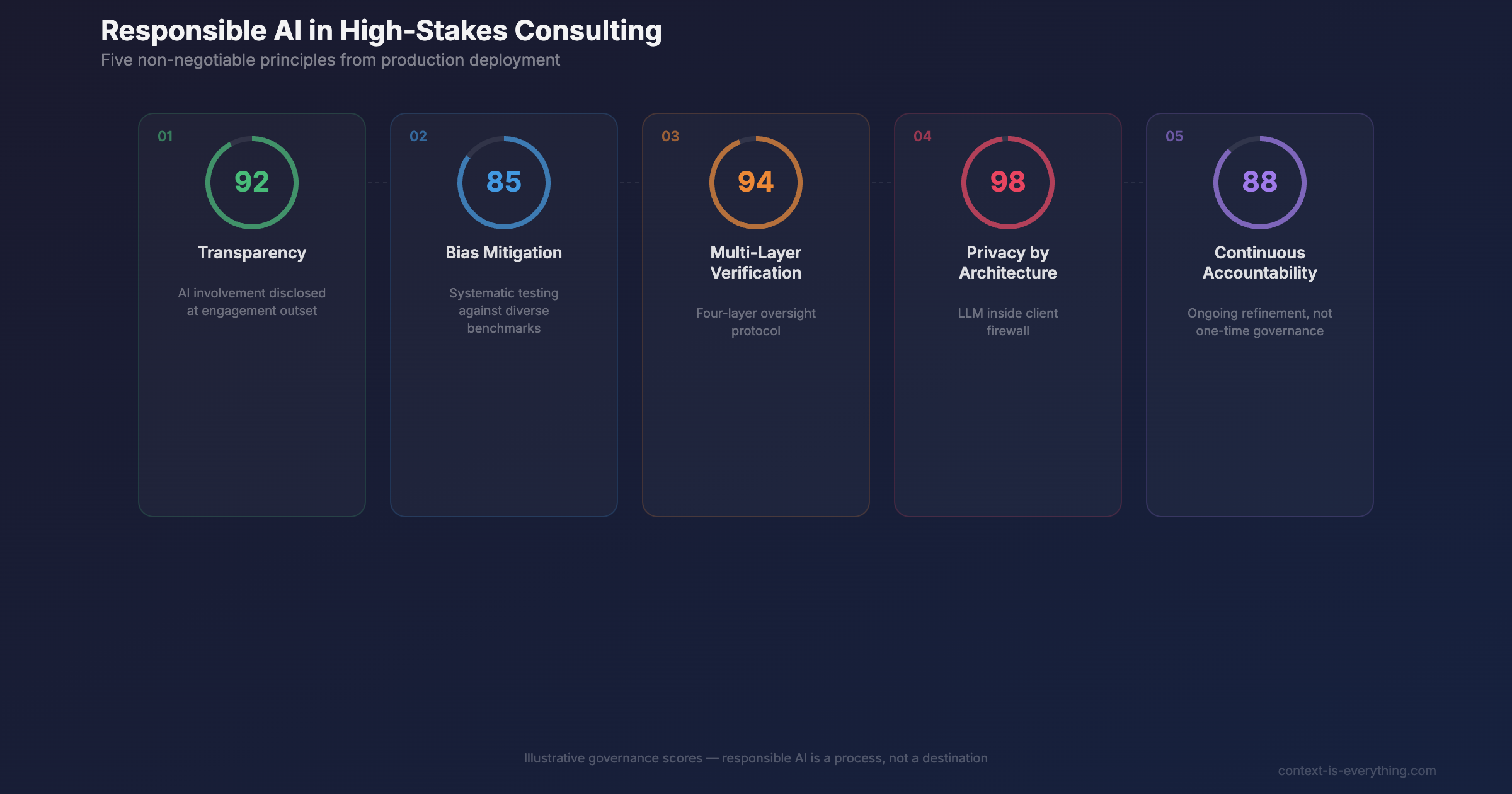
Responsible AI in High-Stakes Consulting: Principles from Production Deployment
Using AI in high-stakes consulting is ethically different from using it to recommend products. When decisions affect careers, organisations, and financial outcomes, the standards must be different too. Here are five non-negotiable principles from production deployment — including what we've got wrong.
Using AI in high-stakes consulting is ethically different from using it to recommend products or sort emails. When decisions affect careers, organisations, patient safety, and financial outcomes, the standards must be different too.
Here's what we've learned about responsible deployment — and what we've got wrong along the way.
Why Stakes Matter
AI recommending a film you don't enjoy wastes two hours. AI producing flawed analysis in a £150,000 consulting engagement can damage careers, misdirect strategy, or miss critical risks.
The error tolerance in professional services is fundamentally different from consumer AI. "Usually correct" isn't acceptable when the consequences of being wrong include regulatory penalties, failed transactions, misjudged leadership appointments, or overlooked safety signals.
This isn't theoretical anxiety. We've seen what happens when AI analysis isn't properly governed. Every principle below was learned through production deployment — including from mistakes.
Five Non-Negotiable Principles
1. Transparency About AI Involvement
Clients deserve to know when AI is part of the analytical process. Not buried in terms and conditions — communicated clearly and proactively.
This isn't just ethical. It's commercial. Clients who understand AI augments human expertise (rather than replacing it) develop appropriate trust. Clients who discover AI involvement after the fact lose trust permanently.
Our approach: AI involvement is disclosed at engagement outset. The division of labour — what AI handles, what experts handle — is explained clearly. No ambiguity.
2. Bias Detection and Mitigation
AI doesn't create bias. It amplifies existing biases in data and processes. In professional services, this amplification can have serious consequences:
The mitigation approach: systematic bias testing against diverse benchmarks, expert review specifically looking for bias amplification, and regular auditing of AI outputs for patterns that suggest unintended discrimination.
3. Multi-Layer Verification
Expert oversight isn't optional — but oversight needs structure, not just good intentions.
Every AI-generated analysis in high-stakes consulting goes through:
No single verification layer is sufficient. The layers catch different types of errors.
4. Data Privacy by Architecture
Handling sensitive client information in AI workflows requires more than policy. It requires architecture.
The LLM runs inside the client's infrastructure — behind their firewall, not connected to the internet. Client data doesn't leave their environment. This isn't a promise — it's an architectural constraint. There's no mechanism for data to be transmitted externally.
For professional services handling confidential client work — from financial due diligence to executive assessments to regulatory investigations — this architectural approach is the only credible answer to data privacy concerns.
5. Continuous Accountability
Responsible AI isn't a state you achieve. It's a process you maintain.
Error logs are reviewed systematically. Near-misses are treated as learning opportunities. Tuning is continuously refined based on error patterns. The verification framework evolves as new failure modes are identified.
The organisations that deploy AI responsibly aren't the ones with the best initial governance documents. They're the ones with the most rigorous ongoing improvement processes.
What We've Got Wrong
Transparency requires acknowledging mistakes.
Early in deployment, we underestimated the bias amplification risk in assessment work. AI trained on historical assessment data reinforced patterns that didn't reflect our current professional standards. We caught it through systematic review — but we should have tested for it earlier.
We also initially overestimated how much context AI could infer. Some engagements required explicit contextual framing that we assumed the AI would derive from the data. It didn't. The tuning complexity was greater than we anticipated.
These weren't catastrophic failures. They were learning moments that improved our governance framework. But they happened. Pretending otherwise would undermine the transparency principle.
The Consent Question
When should clients be told about AI involvement? Before the engagement begins. Not after.
The question isn't whether to disclose. It's how to frame it productively. AI as augmentation — enhancing expert analysis, not replacing it — is a capability worth communicating. Clients generally welcome it when they understand the oversight framework.
The firms that will lose trust aren't the ones using AI. They're the ones hiding it.
Trust Takes Years
Trust takes years to build. Seconds to destroy. Worth the caution.
Why most AI projects fail often comes back to governance gaps — not technology gaps. The firms that deploy AI responsibly in professional services aren't just being ethical. They're building the trust foundation that makes long-term AI-augmented practice sustainable.
Review your AI governance readiness — responsible deployment isn't just the right thing to do. It's the commercially sustainable thing to do.
Related Articles
The Irreplaceable Expert: Why AI Without Human Oversight Fails in High-Stakes Consulting
As AI gets better, you would expect to need less human oversight. The opposite is true. When AI is 95% correct, the 5% that is wrong is camouflaged by the quality of everything around it. The oversight paradox in high-stakes professional services.
The Hidden Complexity: Why AI Tuning Determines Everything in Professional Services
Two identical consulting analyses. Same frontier AI model. Wildly different results. What changed? Everything invisible. The difference between accurate AI and expensive mistakes comes down to configuration choices end users never see.
Why Most AI Projects Fail (And What the 5% Do Differently)
MIT's Project NANDA found 95% of enterprise AI pilots deliver zero return. Companies have invested £30-40 billion with nothing to show. But 5% achieve rapid revenue acceleration. The difference isn't the technology - it's implementation and context.