
The Ocean of Noise: Why 96% of Web Pages Get No Google Traffic
Ahrefs found 96.55% of web pages get no Google traffic at all. Since December 2025, a quality-focused core update and AI Mode becoming the default have raised the bar again. What changed, and how to check where your site stands.
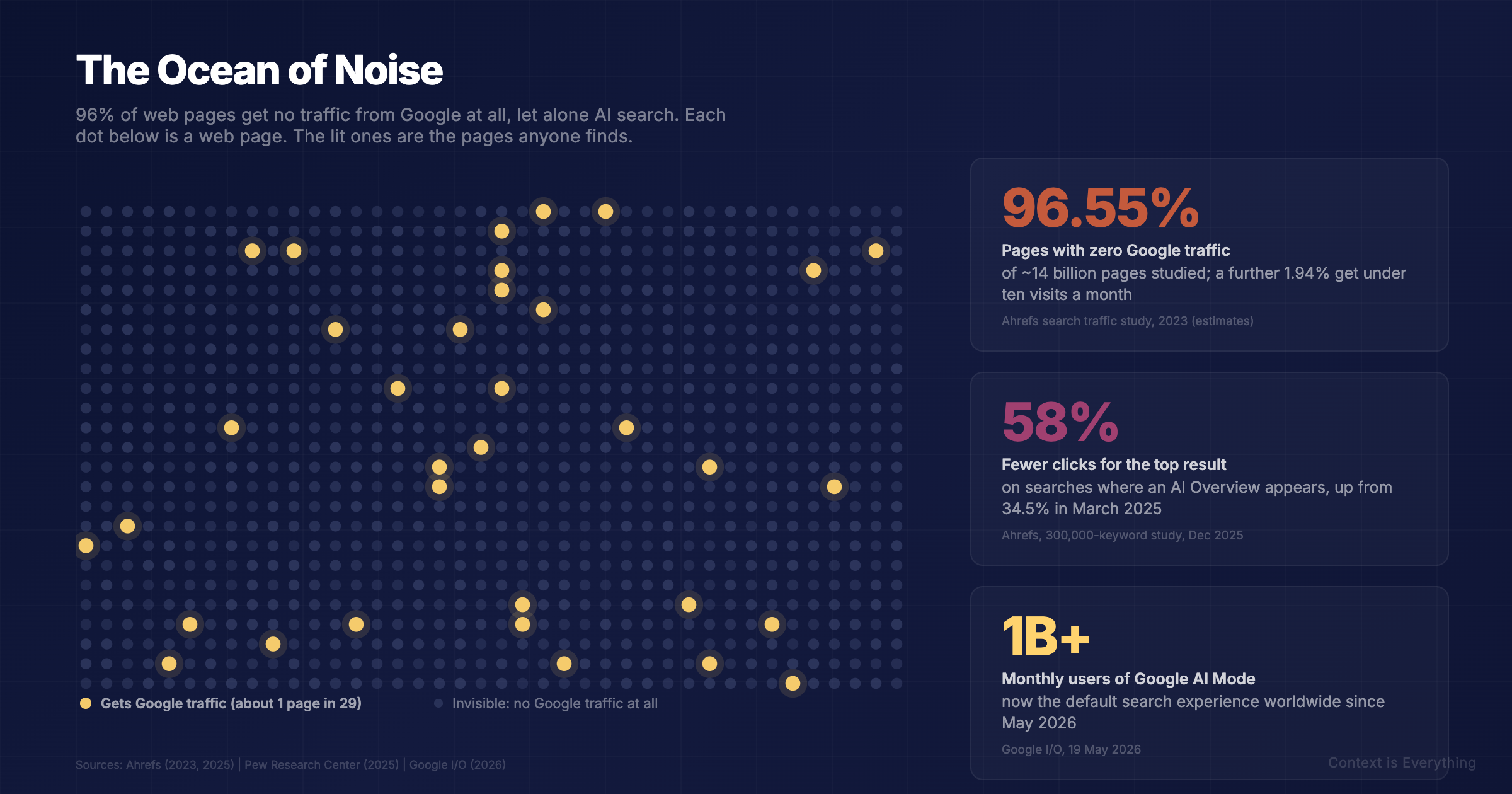
In 2023, Ahrefs analysed roughly 14 billion web pages in its index and found that 96.55% of them received no traffic from Google whatsoever. Another 1.94% got between one and ten visits a month. That leaves around one page in 66 getting anything you could honestly call an audience.
The number is an estimate, and Ahrefs says so themselves: it is built from their index rather than the whole web, and the traffic figures are modelled. But even with generous error bars, the shape holds. The web is an ocean of noise. Almost everything published sinks without trace.
For twenty years the response to that was a known playbook: pick topics people actually search for, earn links, fix the technical basics, climb the rankings. Hard work, but an understood game with understood rules.
Since December, the rules have moved twice.
December 2025: Google raised the quality bar
Google's December 2025 core update ran from 11 to 29 December, the third and final core update of the year. Google described it in standard terms: surfacing more relevant, more satisfying content. Analysts who tracked the 18-day rollout observed something sharper: sites demonstrating genuine first-hand expertise held or gained visibility, while thin, mass-produced content, much of it AI-generated at volume, lost it.
The irony is worth sitting with. The tools that made publishing effortless also made most publishing worthless. When anyone can generate a thousand adequate pages, adequate pages stop earning anything. Google's response was to get better at telling the difference.
May 2026: AI Mode became the default
At Google I/O in May 2026, AI Mode became the default search experience worldwide, having passed a billion monthly users in its first year. A core update landed the same week. Classic results still exist, but for a growing share of searches the first thing a person sees is an AI-composed answer, not a list of links.
The click data shows what that means for the pages that do rank. Ahrefs compared 300,000 keywords, half with an AI Overview present and half without. By March 2025 the top-ranking page earned around a third fewer clicks when an AI Overview appeared. By December 2025 that gap had widened to 58%. Pew Research, tracking 68,879 real searches from 900 US adults, found people clicked a traditional result on just 8% of searches that showed an AI summary, against 15% without one.
So even the 3.45% of pages that get Google traffic are now sharing it with the machine.
The honest counterweight
None of this means search is dead, and you should be suspicious of anyone selling that line. Ahrefs estimates ChatGPT handles around 12% of Google's search volume, yet Google still sends roughly 190 times more traffic to websites. Google remains where the visitors are. What has changed is the test your site has to pass.
There used to be one question: do you rank? There are now two: can machines read you, and will machines choose you?
AI systems assemble answers from pages they can parse and trust. If your site only makes sense with JavaScript running, buries its expertise, or carries no trust signals, you are not in the pool of sources the answer gets built from. You are in the 96%, and the 96% is getting deeper.
Find out where you stand
Being readable is not the same as being chosen. Chosen is earned, with genuine expertise, over time. But unreadable guarantees unchosen, and readability is a fixable, checkable engineering problem. Start with the checkable one.
bernard, a sister product built by part of the CIE team, has a free tool for exactly this: The Ocean. Paste in your web address and it runs fifteen honest checks the way a search robot actually reads your site: no JavaScript, no benefit of the doubt. Titles, headings, readable text, trust signals, speed, security. You get a plain-English report and a prioritised fix list, and it declines to flatter you.
It takes about a minute: check your site on The Ocean.
96% of the web is invisible. The point of checking is to stop guessing which side of the line you are on.
Elsewhere on this
From bernard, our sister company, which builds and looks after small-business websites. Same argument, written for the businesses on the other end of it.
Related Articles
Why Your B2B Buyers Don't Visit Your Website Anymore (And Why That's Actually Good News)
B2B buyers have adopted AI search at 3x the rate of consumers and now trust it more than vendor websites. But the surprising data shows AI-referred visitors spend 300% more time on site and convert at higher rates. Declining traffic might be the best thing that's happened to your marketing.
The Two Moats: Why Consultancies' AI Advantages Are Structural, Not Timing
Most professional services firms are still asking 'should we explore AI?' The firms pulling ahead are already in production. But the advantage isn't timing — it's structural. Two competitive moats are forming that can't be bought, replicated, or rushed: private data and custom tooling.
The Intelligence AI Can't Replicate
49% of procurement teams ran AI pilots in 2024. Only 4% reached meaningful deployment. The gap isn't technical. It's the moment the tool encounters knowledge that was never written down.
When Every Proposal Looks Perfect
You are evaluating five AI vendors and every proposal is immaculate, and you cannot tell them apart. That uniformity is the market telling you the signal you relied on has died. AI made polish free, so polish stopped meaning anything. Here is what is still expensive to fake, and what to demand instead.