
AI for Procurement: What Actually Works for Multi-Vendor Tender Analysis
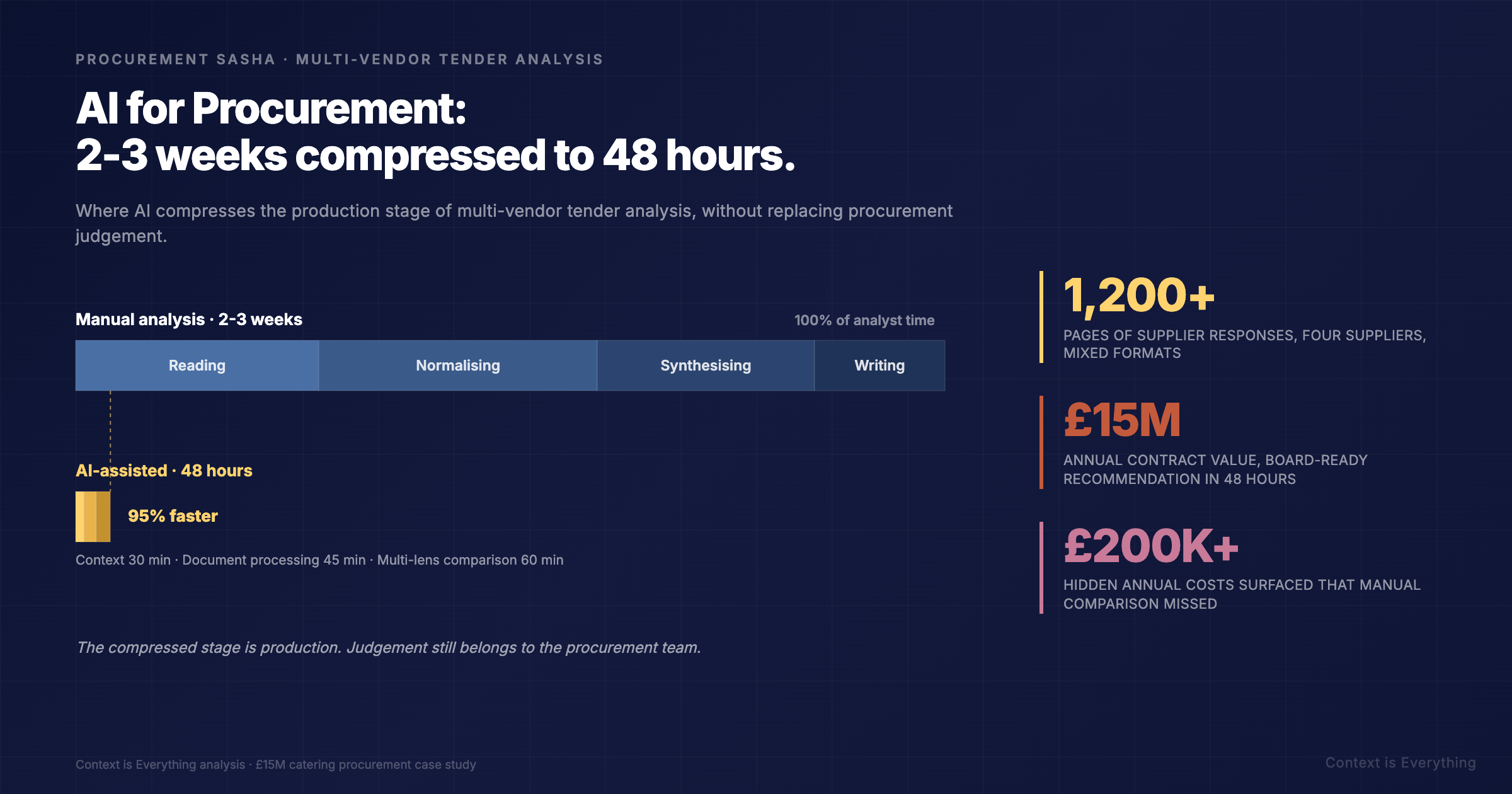
AI for procurement works when it compresses multi-vendor tender analysis from 2-3 weeks to 48 hours without replacing procurement judgement. The proof: a £15M catering decision, 1,200 pages of supplier responses, £200K+ of hidden costs surfaced that manual comparison missed. What it does, what it doesn't, and where to start.
AI for procurement works when it does the synthesis work that compresses a multi-vendor tender analysis from 2-3 weeks to roughly 48 hours. It does not replace procurement judgement. It removes the production bottleneck that prevents judgement from being applied in time. The proof is a £15M catering procurement decision we worked on: four international suppliers, 1,200+ pages of tender responses, 48 hours from brief to board-ready recommendation, £200K+ of hidden costs surfaced that manual comparison had missed.
That last number is the one that matters. The time saving is interesting. The £200K is the reason procurement teams care.
The real problem isn't decision quality. It's production time.
Procurement teams already know what good evaluation looks like. They have frameworks. They have category expertise. They have audit standards. What they do not have is the production capacity to apply that framework consistently to 1,200 pages of supplier responses inside the deadline the business actually gives them.
The production stage is where multi-vendor tenders quietly fail. Suppliers structure their answers differently. Each one frames the same question to flatter their own offer. A senior procurement professional ends up reading dense documents under time pressure, normalising data in their head, and producing a comparison spreadsheet that the committee can act on. The work is exactly the kind of pattern recognition that a category specialist is best placed to do, and exactly the kind of high-volume document processing that is most expensive to do at a human pace.
AI for procurement, used properly, is a production system. It takes the framework the team already trusts, applies it to the supplier responses, and gives the team back a normalised comparison they can interrogate in hours instead of weeks.
The £15M case in 200 words
A major sports organisation needed to evaluate four international catering suppliers for a contract worth £15-18M in annual revenue impact. Each supplier had submitted 300+ pages of tender response in mixed formats: Excel pricing models with embedded formulas, PDF executive summaries, Word documents describing operational structure. The executive deadline was 14 days. Manual analysis would have taken 2-3 weeks of a senior finance director's time, which the organisation did not have.
What we built read all four responses in parallel, normalised them against the organisation's evaluation framework, and produced three documents: a 15-slide board recommendation, a 25-page financial analysis, and an 8-page implementation roadmap. Time elapsed: 48 hours. Hidden costs surfaced that manual comparison had missed: £200K+ annually.
The full breakdown, including the audit-trail design that made the output defensible under scrutiny, is in the procurement analysis case study.
The three risk patterns AI catches reliably
From the £15M case, three specific anomaly types kept emerging. These are the patterns that justify the production-time investment, because each one was a multi-six-figure exposure that manual comparison was unlikely to catch in time.
Hidden staffing assumptions. One supplier proposed 40% fewer staff than its competitors. Buried in the operational appendix was an assumption that the client would provide sales staff at its own cost. Annual exposure: £200K+. The kind of footnote a tired reader skims past on page 247.
Unrealistic growth projections. Suppliers proposed annual revenue growth from 3% to 15%. Industry benchmark for the sector was 5-7%. Two suppliers were optimistically inflating the value they were promising to deliver. AI does not have an opinion on what is realistic. It does have the patience to check every projection against an external benchmark library.
Cost structure normalisation. Food costs ranged from 28% to 35% of revenue across the four responses. Labour was allocated using completely different methods. The true competitive position only became visible after every cost line had been standardised. This is exactly the kind of work a human can do well in two days, or sloppily in two hours, and AI does consistently in twenty minutes.
What AI for procurement doesn't do
It does not pick the winner. It does not run the negotiation. It does not own the relationship with the supplier. It does not decide which risk the organisation is willing to carry. Those are the things the procurement team is paid to do, and they get more time to do them when the production work is compressed.
The right test for any procurement AI tool is whether the procurement team is more accountable for the decision afterwards, not less. If the tool produces a recommendation the team cannot defend line by line, it has failed.
Where to start
The first useful step is not buying a tool. It is identifying which procurement decision is being slowed down by production-time constraints rather than by judgement-time constraints. Multi-vendor tender analysis, framework-driven supplier comparison, and contract review against a category-specific risk register are all production-time problems. They are the natural starting point.
For an honest pre-purchase view of how AI compresses or fails to compress these workflows, we built the AI Vendor Proposal Comparison tool. It is free, it runs against your own framework, and it shows you the failure modes before you commit budget.
If the £15M case maps onto something your procurement function is currently struggling with, the Procurement Sasha vertical page describes what a 90-day deployment looks like and what the team measures on day 90.
AI for procurement is one of the clearest examples of business systems built for AI: take the framework you already trust, encode it, and let the AI do the production work so the procurement team can do the judgement work.
Also from The Contour
The personal-voice version of these ideas, from Spencer Thursfield's newsletter.

Related Articles
Using AI to Compare Vendor Proposals: Where It Helps and Where It Doesn't
Mozart's string quartet still takes twenty-five minutes. A finance director's judgement still cannot be hurried. But everything around the decision can be compressed. A £15M procurement, 1,200 pages of supplier documentation, and what context-first AI actually surfaces.
The Hidden Costs in Your Vendor Proposals
We found £200,000 hidden in a vendor proposal - not through negotiation, but by understanding what normal looks like in the industry and spotting what was missing.
Responsible AI in High-Stakes Consulting: Principles from Production Deployment
Using AI in high-stakes consulting is ethically different from using it to recommend products. When decisions affect careers, organisations, and financial outcomes, the standards must be different too. Here are five non-negotiable principles from production deployment — including what we've got wrong.