
AI for Boutique Search Firms: Assessment Rigour Without the Headcount
AI for boutique search firms works when it holds the firm's assessment rigour steady across every consultant. The proof: a US talent advisory boutique evaluating senior PE-backed hires, with the firm's methodology encoded, the interview guided in real time, and every claim in the assessment writeup traceable to a moment in the conversation. What it does, what it doesn't, and where to start.
AI for boutique search firms works when it holds the firm's assessment rigour steady across every consultant, every interview, every senior hire. It does not replace the headhunter. It does not own the client relationship. It makes every interview as good as the firm's best consultant on their best day, and verifies its own output rather than guessing at it. The clearest live proof is the AI system behind the assessment work at a US talent advisory boutique that evaluates senior hires for private equity firms, where the methodology is encoded and the interview is guided in real time.
That last point is the one that matters. The time saving is interesting. The consistency of the assessment is the reason boutique principals care.
The real problem isn't access to AI. It's consultant variance.
The large search firms have spent the past year marketing AI-augmented search. The industry framing tells the boutique that AI scale belongs to the giants and the boutique competes on everything except that. That framing is wrong.
The constraint at a boutique is not access to AI tools. Every consultant has the same off-the-shelf software the giants have. The constraint is that a boutique sells the firm's reputation, and the firm's reputation is its placements. One bad senior call is reputationally expensive. The firm's actual product is the consistency of its assessment, and that consistency is hardest to achieve precisely because the boutique sells partner-led work with a small number of consultants at very different career stages.
The interview is where the variance lives. A consultant who has run two hundred senior assessments asks better follow-up questions than one who has run twenty. A consultant who has done four interviews this week asks better questions in the first one than the fourth. The methodology is supposed to control for this. In practice, under deadline pressure, the methodology compresses, the rigour drifts, and the writeup is produced from memory rather than from evidence.
This is the production stage where boutique search firms quietly cap out. The firm could take more senior mandates if the assessment work scaled. It cannot, because scaling assessment has historically meant hiring more senior consultants, which dilutes the partner-led economics the firm was built on.
AI for boutique search firms, used properly, is the production layer that holds the assessment steady. Encode the firm's methodology. Let the system guide the interview in real time. Generate the writeup from the conversation evidence, not from the consultant's recall. The partner still picks up the phone, still owns the relationship, still makes the call. What changes is that every interview hits the methodology's standard regardless of who is in the room.
The unnamed-boutique case in 200 words
A US talent advisory boutique evaluates senior hires for private equity firms. The work is methodology-driven assessment, with financial, strategic, and psychological dimensions. The firm has built a proprietary assessment and training framework over years of PE-facing engagements. The bottleneck was not the methodology. The methodology was the firm. The bottleneck was that applying the methodology consistently across every consultant on every interview required senior partner attention that did not scale.
The system we built guides the interview in real time. As the conversation runs, the consultant sees the next probe their methodology would call for, based on what the candidate has actually said. The assessment writeup is generated from the interview transcript, the methodology framework, and the firm's accumulated assessment pattern library, with every claim traceable to a moment in the conversation. No hallucinated qualities. No remembered impressions. Evidence-linked output.
The deliverable holds up to client challenge. A partner can defend every line of the writeup against any reader who wants to know where the assessment came from. That is the test boutique search work has to meet, and the only AI-assisted assessment worth using meets it too.
The three production patterns AI compresses reliably in search work
From the unnamed-boutique deployment and the engagements that have followed, three patterns recur. Each is the kind of work that historically required the firm's most experienced consultants to deliver consistently. Each compresses to a methodology-encoded production system when the framework is explicit.
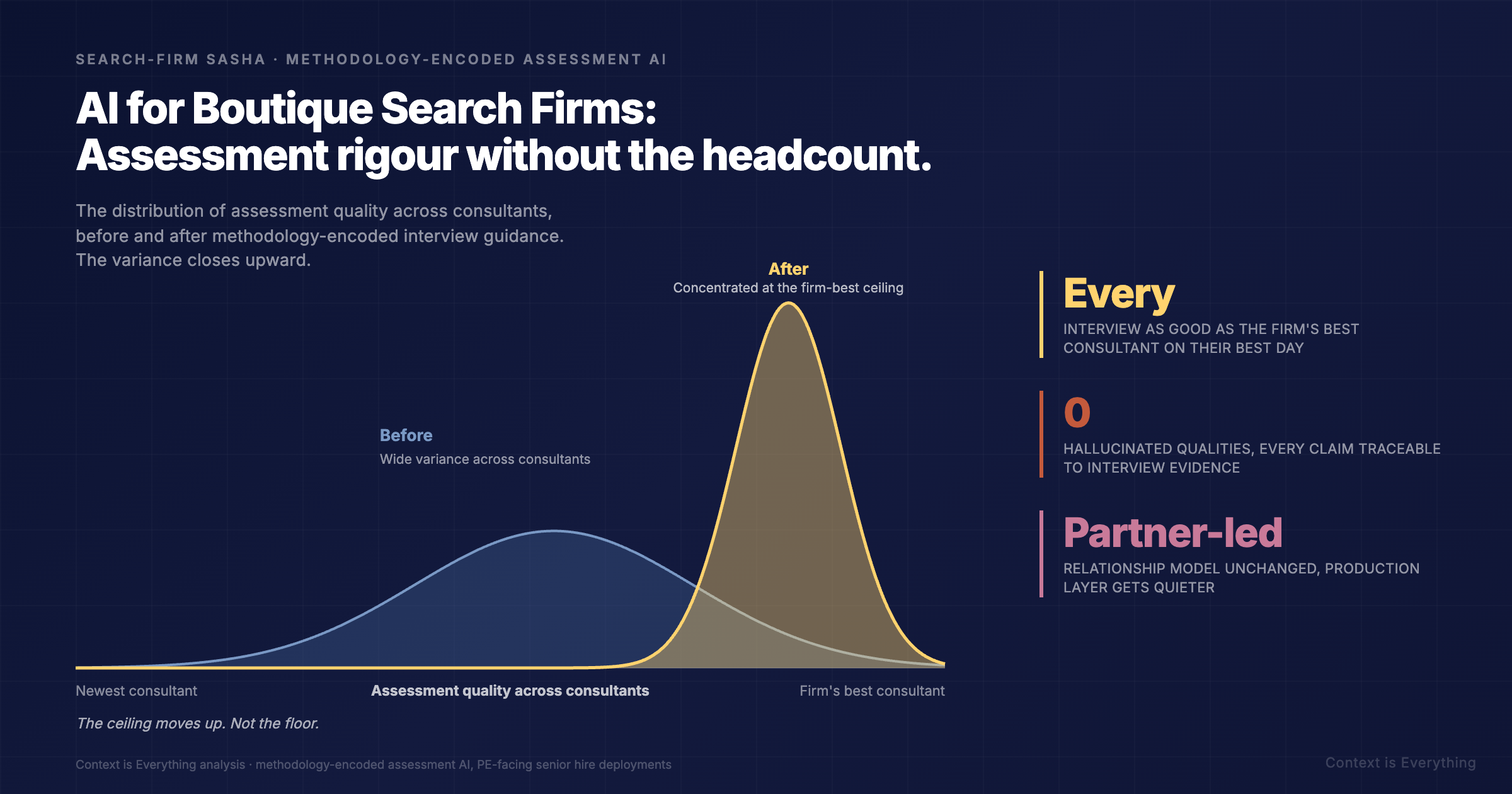
Real-time interview guidance. The methodology is in the consultant's head, but heads vary. The system surfaces the next probe the methodology would call for, based on what the candidate has actually said in the conversation so far. The consultant runs the conversation. The framework holds the rigour steady. The variance between the firm's best consultant and the firm's newest one closes, not because the new consultant becomes more experienced, but because the methodology is applied consistently regardless of who is in the room.
Verified output rather than recalled output. Senior assessment writeups are traditionally drafted from the consultant's recall of the interview, sometimes hours or days later. Memory is selective. AI-generated writeups produced from the conversation record, the methodology framework, and the firm's pattern library are traceable line by line. Every claim about the candidate links to a specific exchange in the interview. Hallucinated qualities cannot enter the assessment because the system is structurally incapable of producing claims that are not evidenced.
Consistency at the firm-best ceiling, not at the average. The goal is not that all consultants produce average-quality assessments. The goal is that every consultant produces the firm's best version. The output ceiling moves up. The reputational risk of variance comes down. Boutique principals who care about the firm's reputation in five years care about this more than about the time saving in any single interview.
What AI for boutique search firms doesn't do
It does not replace the headhunter. The relationship with the candidate and the client lives in the partner. AI does not pick up the phone, does not earn trust over years, does not have skin in the game.
It does not own the client relationship. Boutique search is partly an information problem and largely a relationship problem. AI compresses the information problem. The relationship problem is unchanged.
It does not source the longlist on its own. Sourcing is a separate problem, served by separate tools. The system described here begins once the candidate is in the room.
It does not pick the hire. The partner makes the call, with the client, after the assessment. The AI presents structured evidence. The judgement about which candidate the client should hire remains where it has always been.
It does not protect the firm from a methodology that has gone stale. AI encodes the methodology the firm gives it. If that methodology has not aged well, the AI produces work consistent with it. The methodology has to keep evolving. AI just makes the production cost of that evolution lower.
Where to start
The wrong first question is which AI tool to buy. The right first question is which assessment workflow inside the firm is being capped by consultant variance rather than by network depth.
Variance-capped workflows look like:
Relationship-capped workflows, by contrast, look like:
These are not where AI compresses meaningfully. The constraint is the partner's read of the situation, not the production of the assessment.
For a free pre-purchase view of where AI compresses or fails to compress assessment work in your firm, the AI Project Risk Scorecard runs against your firm's actual engagement types and surfaces the failure modes before you commit budget. If the consultant-variance problem maps onto something your firm is currently feeling, the right next step is a twenty-minute demonstration of the working version, not slides. Get in touch to book one.
AI for boutique search firms is one of the clearest examples of business systems built for AI: take the methodology the firm already trusts, encode it, and let the system hold the rigour steady so every interview is as good as your best one. The partner-led model survives. The reputational variance does not.
Related Articles
AI for Boutique Consultancies: What Actually Works When Senior Time Is the Margin
AI for boutique consultancies works when it encodes the firm's methodology and compresses the production work that currently consumes senior consultant time. The proof: a 92-page LSA contract analysis with 75+ cross-verified sources, delivered with the audit trail a senior consultant would produce by hand. What it does, what it doesn't, and where to start.
The Two Moats: Why Consultancies' AI Advantages Are Structural, Not Timing
Most professional services firms are still asking 'should we explore AI?' The firms pulling ahead are already in production. But the advantage isn't timing — it's structural. Two competitive moats are forming that can't be bought, replicated, or rushed: private data and custom tooling.
The Irreplaceable Expert: Why AI Without Human Oversight Fails in High-Stakes Consulting
As AI gets better, you would expect to need less human oversight. The opposite is true. When AI is 95% correct, the 5% that is wrong is camouflaged by the quality of everything around it. The oversight paradox in high-stakes professional services.