
AI for Boutique Consultancies: What Actually Works When Senior Time Is the Margin
AI for boutique consultancies works when it encodes the firm's methodology and compresses the production work that currently consumes senior consultant time. The proof: a 92-page LSA contract analysis with 75+ cross-verified sources, delivered with the audit trail a senior consultant would produce by hand. What it does, what it doesn't, and where to start.
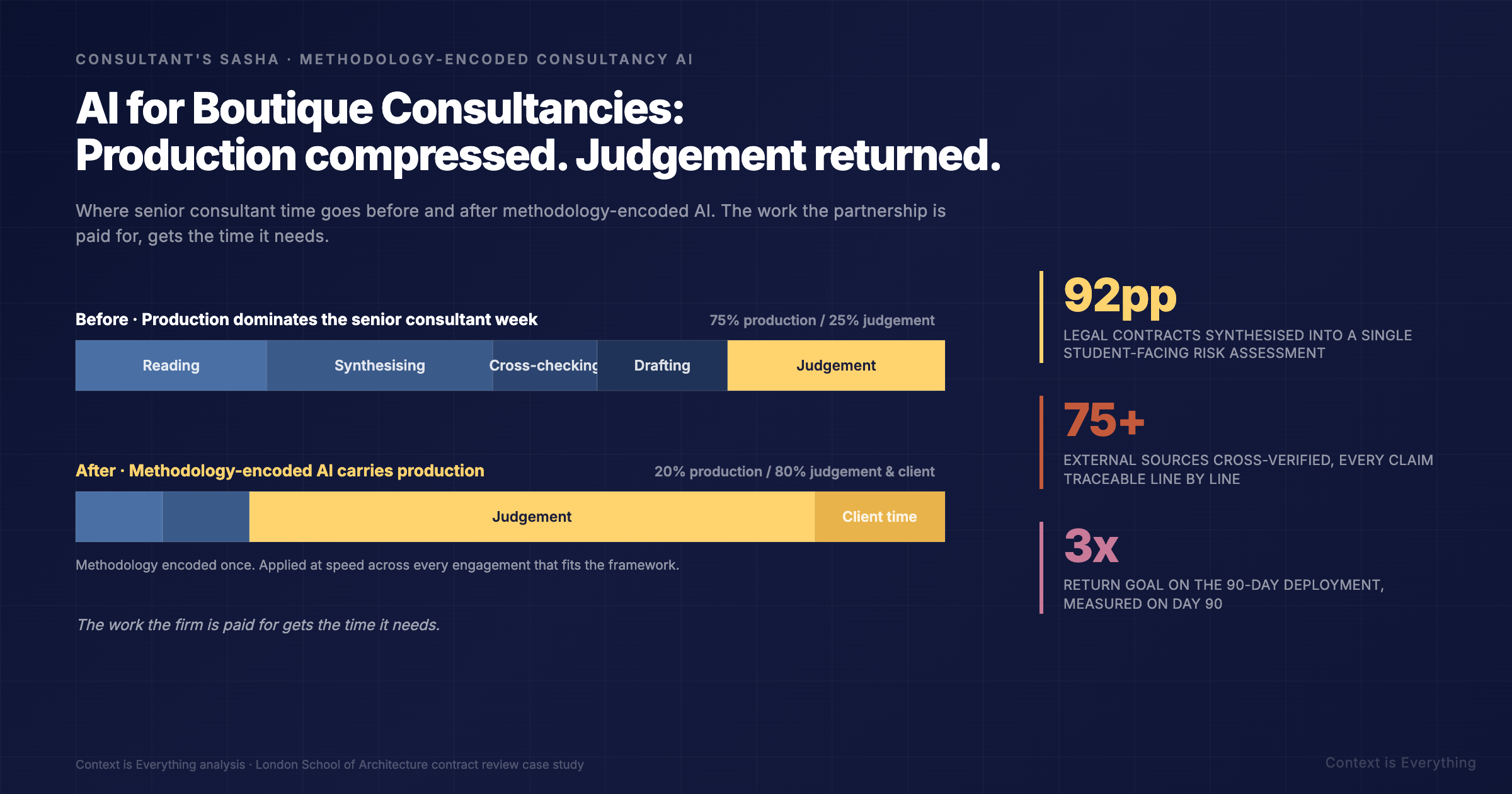
AI for boutique consultancies works when it encodes the firm's methodology and applies it to the production work that currently consumes senior consultant time. It does not replace judgement. It removes the production bottleneck that prevents judgement from scaling. The clearest proof is the London School of Architecture contract analysis we ran: 92 pages of student contracts across three documents, 75+ sources cross-verified, a complete risk assessment with £3,600 of student-side cost exposure surfaced, all delivered with the audit trail a senior consultant would produce by hand.
That last point is the one that matters. The time saving is interesting. The audit trail is the reason boutique consultancies care.
The real problem isn't methodology. It's production time.
Boutique consultancies already have the methodology. That is the firm. Years of engagement experience encoded into the way the team thinks about problems, the way reports are structured, the way client conversations unfold. The methodology is not the constraint.
The constraint is that applying the methodology to fresh client work requires senior consultant time. A 92-page contract review, a 200-page strategy document synthesis, a market analysis across 75+ sources, these are the production stages where the firm's per-engagement margin is set or lost. Junior consultants can scaffold the work. They cannot produce the final output that the firm's reputation rests on. Senior consultants can produce it, but their time is the most expensive input the firm has, and there are only so many hours.
The production stage is where boutique consultancies quietly cap out. The firm could take on more clients if the production work compressed. It cannot, because compressing production has historically meant hiring more senior people, which dilutes the partnership economics that made the firm work.
AI for boutique consultancies, used properly, is the production layer that has been missing. Take the methodology the firm already trusts, encode it, and let the system do the synthesis work so the partners spend their billable hours on judgement instead of drafting.
The LSA case in 200 words
A cohort of architecture students faced an institutional merger with 92 pages of legal contracts spread across three documents: 18 pages of Student Terms, 60 pages of Academic Regulations, 14 pages of Refund Policy. The contracts were technically transparent and functionally opaque, written in the kind of legal language that obscures meaningful risk rather than disclosing it.
What we built read all 92 pages, cross-verified the claims against 75+ external sources covering government records, regulatory bodies, and industry publications, and produced a complete student-facing risk assessment. The output surfaced specifics: a 10% annual fee escalation clause with no cap (£3,600 lifetime exposure), a 14-day refund window before the full annual fee became unrecoverable, complete institutional disclaimer of liability during mandatory work placements.
The deliverable was a published public resource with 10+ analysis documents, every claim sourced, the full audit trail visible to anyone who wanted to interrogate it. The work was reproducible. A senior consultant could defend every claim line by line. That is the test boutique consultancy work has to meet, and the only AI-assisted work worth publishing meets it too.
The three production patterns AI compresses reliably
From the LSA case and the consultancy engagements that followed, three production patterns recur. Each is the kind of work that historically required a senior consultant for two to four days. Each compresses to hours when the firm's methodology is encoded.
Multi-document synthesis against an explicit framework. Three contracts. A risk taxonomy. A consistent cross-reference structure. A team can do this manually in two days. An AI that has been trained on the firm's risk framework does it in twenty minutes and surfaces inconsistencies between the documents that a tired reader misses. The framework is the load-bearing piece. The AI is the production layer.
External verification at scale. Cross-referencing 75+ sources against the claims inside the document set is the kind of work that gets cut from the scope under deadline pressure. AI that knows which source categories the firm treats as authoritative (government records, regulatory bodies, named industry publications) does the cross-referencing exhaustively rather than indicatively. The verification gap that consultancy teams routinely apologise for at the end of an engagement disappears.
Structured output in the firm's house style. Boutique consultancies often have a recognisable output format. Report structure. Tone of voice. Visual conventions. AI that encodes this format produces drafts that match the firm's existing deliverables closely enough that the senior consultant edits rather than rewrites. The edit-to-rewrite ratio is the leverage. A junior-drafted, senior-rewritten report is roughly the same cost as senior-drafted from scratch. A senior-edited AI draft is materially cheaper for materially the same output quality.
What AI for boutique consultancies doesn't do
It does not develop the methodology. The methodology is the firm. If the firm does not have one, AI surfaces that absence rather than fixing it.
It does not pick the strategic direction. Strategy work depends on judgement that AI cannot replicate, particularly judgement about which client situation resembles which past pattern.
It does not own the client relationship. Boutique consultancy is partly an information problem and partly a relationship problem. AI compresses the information problem. The relationship problem is unchanged.
It does not protect the firm from a methodology that has gone stale. AI that encodes a methodology will produce work consistent with that methodology, including the parts that have not aged well. The methodology has to keep evolving. AI just makes the cost of that evolution lower because the production overhead drops.
Where to start
The wrong first question is which AI tool to buy. The right first question is which engagement type is being capped by senior consultant production time rather than by analytical insight.
Production-time-capped engagement types look like:
Judgement-capped engagements, by contrast, look like:
These are not where AI compresses meaningfully. The constraint is the senior consultant's read of the situation, not the production stage.
For a free pre-purchase view of where AI compresses or fails to compress consultancy production work, the AI Project Risk Scorecard runs against your firm's actual engagement types and surfaces the failure modes before you commit budget. The LSA case study shows the methodology applied at full scope.
If the boutique consultancy production-time problem maps onto something your firm is currently struggling with, the Consultant's Sasha vertical page describes what a 90-day deployment looks like and what the partnership measures on day 90.
AI for boutique consultancies is one of the clearest examples of business systems built for AI: take the methodology the firm already trusts, encode it, and let the system do the production work so the senior consultants do the judgement work.
Related Articles
The Two Moats: Why Consultancies' AI Advantages Are Structural, Not Timing
Most professional services firms are still asking 'should we explore AI?' The firms pulling ahead are already in production. But the advantage isn't timing — it's structural. Two competitive moats are forming that can't be bought, replicated, or rushed: private data and custom tooling.
From ChatGPT Experiments to Production AI: What We Learned Integrating AI into Consultancy Work
We started with a question: could AI make our consulting work better? After months of continuous trialling and refinement, the answer is nuanced. The distance between AI hype and AI utility in professional services is measured in disciplined experimentation — here's what that journey actually looks like.
AI for Procurement: What Actually Works for Multi-Vendor Tender Analysis
AI for procurement works when it compresses multi-vendor tender analysis from 2-3 weeks to 48 hours without replacing procurement judgement. The proof: a £15M catering decision, 1,200 pages of supplier responses, £200K+ of hidden costs surfaced that manual comparison missed. What it does, what it doesn't, and where to start.