
You Bought the AI. Do You Know What Problem It's Solving?
Organisations buy AI platforms and then try to work out what they're for. This is backwards — and expensive. Why context before technology is the only approach that actually leads somewhere.
There's a pattern we see so often it barely qualifies as an observation anymore: an organisation buys an AI platform, rolls it out, and then tries to work out what it's for.
It's not stupidity. It's urgency. Boards are asking about AI strategy. Competitors are making noise about "AI-powered" everything. Vendors are excellent at creating a fear of being left behind. So the technology gets procured, a team gets assigned, and everyone starts looking for problems that fit the solution they've already bought.
This is backwards. And it's expensive.
The technology-first instinct
The instinct to start with technology is understandable. AI tools are tangible. You can demo them, cost them, put them on a roadmap. "We're implementing AI" is a sentence that satisfies stakeholders. "We're mapping our operational context to identify where intelligent automation would create the most value" is a sentence that puts people to sleep.
But the second sentence is the one that actually leads somewhere.
We've written before about why most AI projects fail — and the pattern is remarkably consistent. It's rarely the technology that lets people down. It's the absence of a clearly defined problem, a realistic understanding of the data landscape, and an honest assessment of what the organisation is actually ready for.
When you start with the technology, you inherit whatever assumptions the vendor baked in. Their defaults. Their idea of what "good" looks like. Their training data. You get a generic tool applied to a specific context, and then you're surprised when the results feel... generic.
What starting with context looks like
The alternative isn't complicated, but it does require patience — which is harder to sell than software.
Starting with context means understanding the operational reality before recommending solutions. What does the business actually do, day to day? Where are the bottlenecks? What knowledge lives in people's heads rather than in systems? Where is time being burned on work that's too complex for humans alone, or too repetitive for humans to do well?
We've seen organisations discover that their biggest cost isn't visible in any line item — it's buried in process inefficiency, duplicated effort, or middleware that exists purely because nobody questioned it. You don't find that by deploying a chatbot.
You find it by asking better questions first.
The gap between demonstration and value
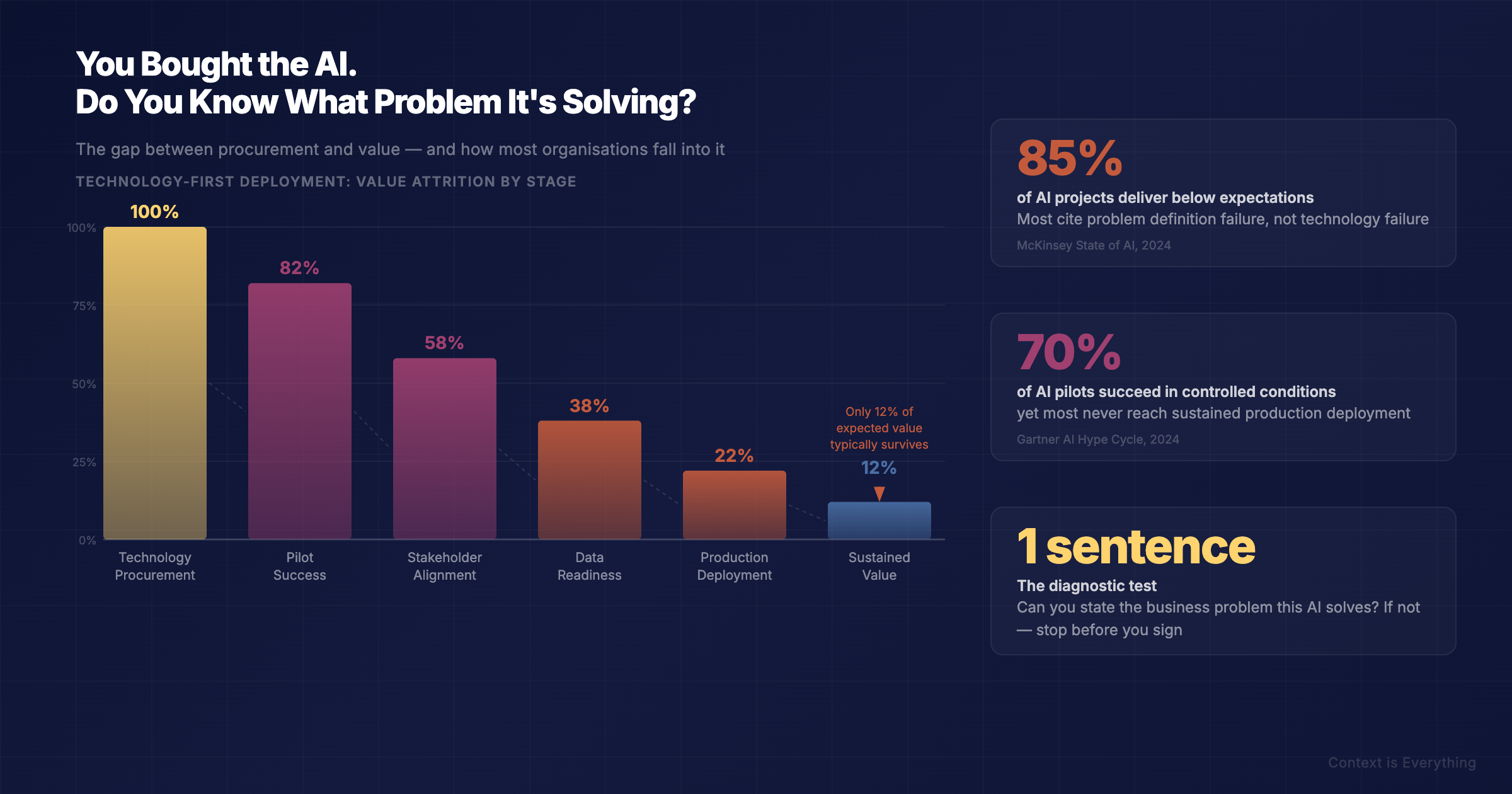
Most AI pilots succeed. That's part of the problem. It's not difficult to get an AI tool to do something impressive in a controlled environment with curated data. The gap isn't between "can AI do this?" and "no it can't." The gap is between a successful demonstration and sustained business value at scale.
Bridging that gap requires the boring work: understanding which processes are genuinely high-ROI, getting honest about data quality, designing workflows that humans will actually adopt, and building measurement frameworks that track outcomes rather than activity.
None of that starts with a technology purchase. All of it starts with context.
The question to ask
Before the next vendor demo, before the next board paper on AI strategy, there's a diagnostic question worth sitting with:
"Can we articulate — in one sentence — the business problem this technology is supposed to solve?"
If the answer is clear and specific, you're probably in good shape. If the answer is some variation of "we need to be doing AI" or "our competitors are ahead of us," you might be about to spend significant money discovering what your actual problem is — which you could have done for free, before signing anything.
Context before technology. It's less exciting. It's considerably more effective. Check your AI readiness across 5 dimensions before the next vendor conversation.
---
For a practical framework on identifying where AI delivers genuine value, see Identifying High-ROI Processes for AI Automation. For the full picture on what AI implementations actually cost, see The Complete Cost of AI.
Related Articles
Why Most AI Projects Fail (And What the 5% Do Differently)
MIT's Project NANDA found 95% of enterprise AI pilots deliver zero return. Companies have invested £30-40 billion with nothing to show. But 5% achieve rapid revenue acceleration. The difference isn't the technology - it's implementation and context.
Identifying High-ROI Processes for AI Automation
Most people intuitively know which tasks are too complex, too arduous, or too boring for humans alone. We've found high-value processes fall into three categories — and picking one from each is the fastest way to prove AI value.
The Complete Cost of AI: What Successful Implementations Actually Budget For
The average company spends £68K monthly on AI, but only half can measure ROI. The real cost is typically 2-3x the initial proposal - here's what successful implementations budget for.