
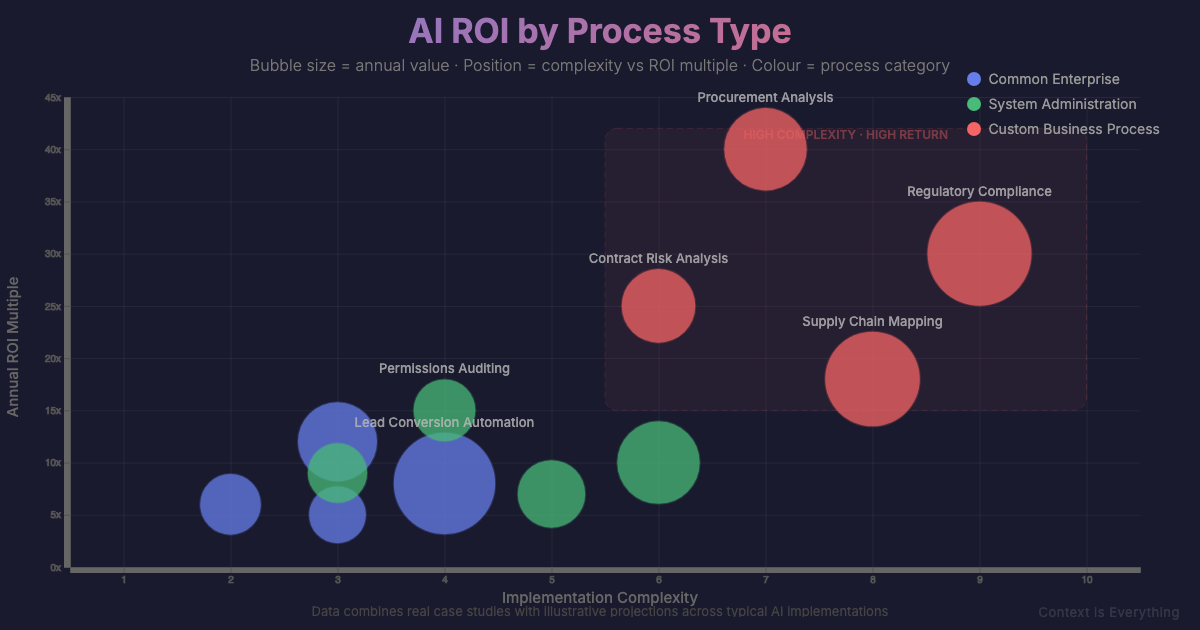
Identifying High-ROI Processes for AI Automation
Most people intuitively know which tasks are too complex, too arduous, or too boring for humans alone. We've found high-value processes fall into three categories — and picking one from each is the fastest way to prove AI value.
Most people intuitively know which tasks in their business are too complex or too numerous to solve with humans alone. The volume is too high, the complexity is too great, or both. These are your high-ROI candidates for AI automation.
We've found that high-value business processes fall into three distinct categories.
1. Common Enterprise Problems
The problems every business has: business development, SEO, brand management, marketing operations. Universal patterns, proven solutions, fast returns.
An insurance brokerage came to us converting less than 20% of qualified leads, with agents spending 70% of their time on admin. We built a context-aware routing system. Conversion jumped to 50%+, processing dropped from hours to 20 minutes.
2. System Administration and Operations
The category people underestimate. Onboarding and offboarding, permissions checking, cross-system visibility, error detection. Repetitive, error-prone, and carrying real risk when they go wrong.
That same insurance brokerage had 85% of its middleware doing nothing but moving data between boxes. We stripped it back: $200K+ annual savings, 10x scalability.
3. Custom Business Processes
Where the real competitive advantage lives — and where most businesses need the most help. These are domain-specific processes where "how we actually do it" differs from "how we think we do it."
A major sports organisation needed to evaluate four catering suppliers across 1,200+ pages of documentation for a £15-18M contract. Sasha processed it all in 48 hours and found £200K+ in hidden annual costs. At the London School of Architecture, 92 pages of legal contracts were decoded to reveal uncapped fee increases and critical liability gaps.
The most important insight: there is almost always a reality gap between how people describe their processes and how those processes actually work. One client's "complete" onboarding documentation turned out to be a high-level description, not an operational playbook. The implicit knowledge that made things work had never been written down.
How to Identify Your Top Three
When starting with Sasha, pick one from each category:
Some clients already know exactly which processes they want to automate. Others need help identifying and prioritising. Either way, the first step is identifying your top three problems, mapping the current state, and defining what success looks like.
The processes that deliver the highest return are the ones that are too complex or too numerous to solve with humans alone. You probably already know which ones they are. The question is which to tackle first.
---
Map your own processes with the AI Opportunity Mapper — it scores across all five dimensions and produces a ranked priority list.
See It in Action
Related Articles
Why Most AI Projects Fail (And What the 5% Do Differently)
MIT's Project NANDA found 95% of enterprise AI pilots deliver zero return. Companies have invested £30-40 billion with nothing to show. But 5% achieve rapid revenue acceleration. The difference isn't the technology - it's implementation and context.
5 Signs Your Business Actually Needs AI (And 5 Signs It Doesn't)
Most businesses don't need AI right now. Here are 5 signs you genuinely need it—and 5 signs you definitely don't. The honest assessment most consultants won't give you.
Where to Start with AI: The First Steps Every Business Should Take
You've decided AI makes sense. Now what? Three foundational questions help you prepare for productive conversations about AI implementation: what specific problem you're solving, whether context matters in your situation, and how you'll measure success.