
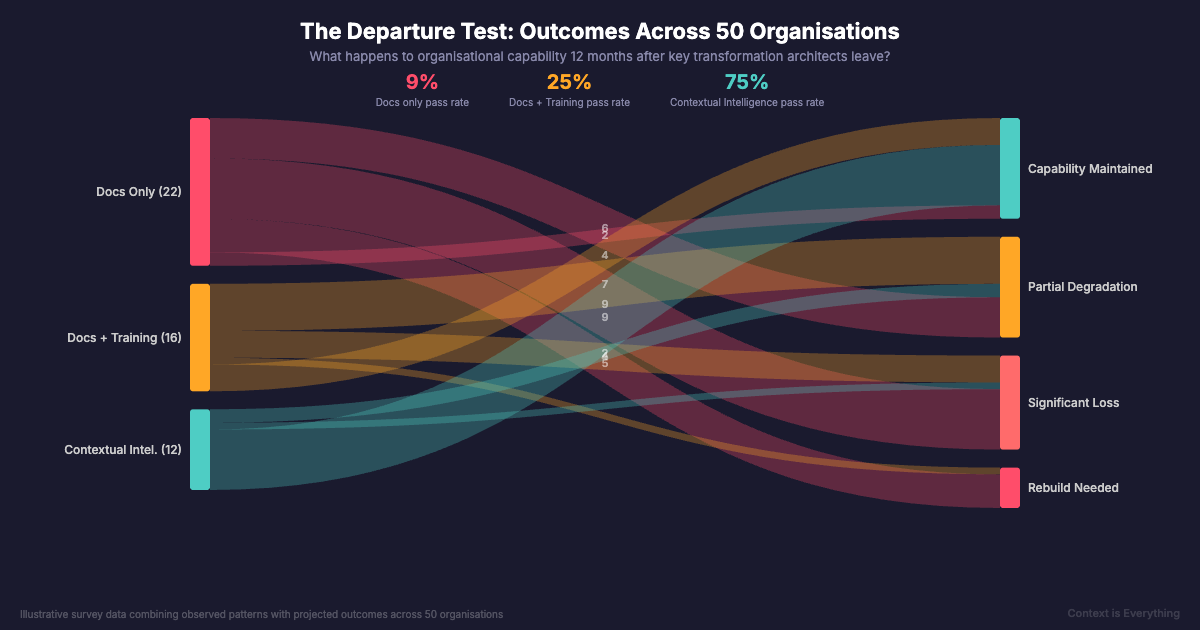
Why Transformations Fail the Departure Test
If everyone who built this left tomorrow, would it keep working? Most transformations fail the departure test because they're built on people, not infrastructure. Here's the knowledge architecture fix.
The honest answer is usually no. Not because the people failed or the strategy was wrong — but because most transformations are built on people, not infrastructure.
When expertise lives in people's heads, capability walks out the door with departing personnel. When methodology exists only in documentation, it becomes static artefacts nobody can actually apply. When success depends on heroic individuals bridging organisational silos, those bridges collapse when the heroes leave.
This isn't a people problem or a change management problem. It's a knowledge architecture problem.
Documentation Isn't Infrastructure
The standard response is: document everything. Create process manuals. Build comprehensive wikis.
The reality: documents nobody reads, wikis nobody updates, process manuals that become instantly outdated, and the same expertise bottlenecks — just with more documentation debt.
Documentation captures knowledge. It doesn't make knowledge executable. It can't understand what you're trying to achieve, know which pieces are relevant right now, or apply methodology to new situations.
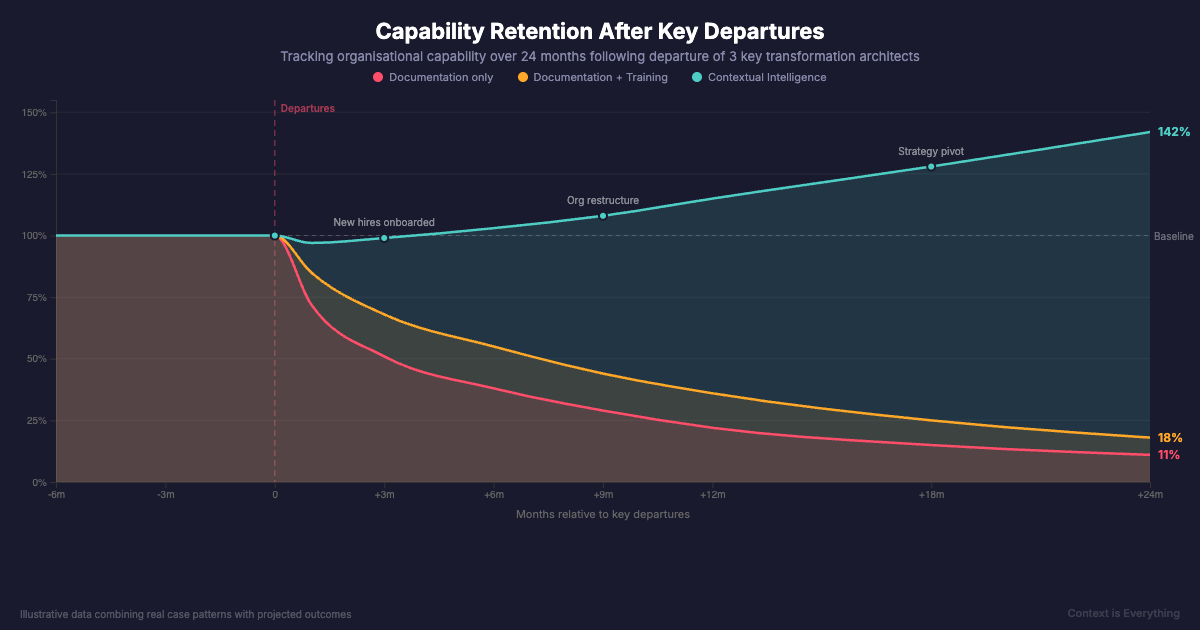
What "Context Is Everything" Actually Means
We're not talking about giving people more documents to search. We're talking about making organisational context automatically available at the moment of need, without requiring anyone to know it exists.
A consultancy was spending a week manually compiling assessments for £150,000 engagements — synthesising interviews, cross-referencing personality profiles against leadership frameworks, applying proprietary methodology. All entirely dependent on specific individuals. Identifying high-ROI processes like this — where expertise creates bottlenecks — is the first step.
Once that methodology became embedded in systems that could apply it — not just document it — the work went from one week to 20–40 minutes. The owner reviewed the first automatically generated analysis and "just fell out of his chair." Not because it was magic. Because the tacit expertise had become executable infrastructure.
From Rented to Built Capability
Most organisations operate on rented capability: expertise in consultants' heads, knowledge accessed through people as intermediaries, success requiring heroic individuals.
For consulting firms in particular, AI for Management Consultancies: The Complete Guide shows how built capability manifests in practice — from proposal automation to institutional knowledge preservation.
Built capability is different. Expertise embedded in accessible systems. Knowledge accessed automatically when relevant. Capability independent of specific individuals. When people leave, capability remains and improves. Platform infrastructure that captures methodology in code demonstrates this principle: automated report generation systems with three-layer architecture (data/design/output) survive consultant departures because the intelligence lives in the system, not individual expertise.
The solution is layered institutional intelligence — organisational context structured across four layers:
Junior staff immediately access senior-level insights. New hires become productive from day one. The infrastructure doesn't replace expertise — it democratises access to it.
Context as Competitive Moat
As AI capabilities proliferate, the competitive advantage isn't the technology — it's the context. Generic AI tools remain undifferentiated. Everyone has access to the same base capabilities.
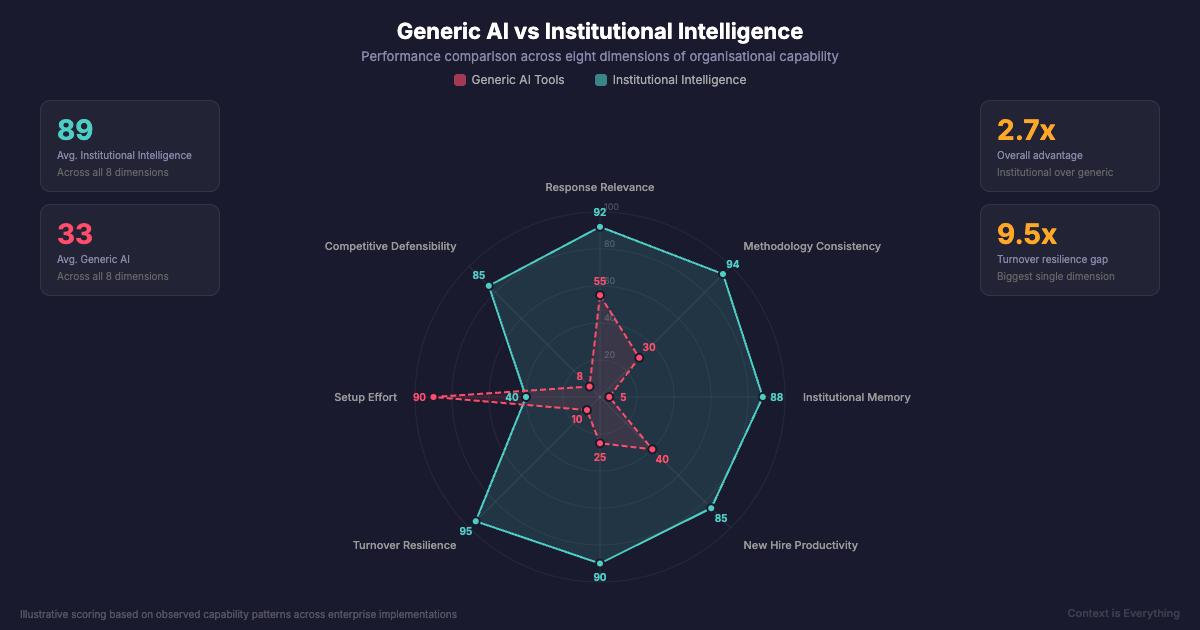
Competitive advantage comes from context depth, quality, integration, and accumulation. The longer you build contextual infrastructure, the more defensible your organisational capability becomes — not because competitors can't access the same AI, but because they can't replicate your accumulated organisational context.
Your context is your competitive moat. Not the tools. The context.
Passing the Departure Test
Traditional transformations: the knowledge walks out the door. Traditional documentation: the documents exist but no one can apply them. Contextual intelligence infrastructure: it keeps working. And it continues improving.
Transformation investments depreciate not because people fail, but because most transformations are built on artefacts rather than infrastructure. The structural solution: make context permanent and automatically accessible, make expertise executable through systems, and make knowledge institutional and accumulating.
That's how transformations outlast their creators. And infrastructure, properly built, passes the departure test every time. Assess whether your organisation has the foundations for AI transformation that lasts.
Also from The Contour
The personal-voice version of these ideas, from Spencer Thursfield's newsletter.

Related Articles
Why Most AI Projects Fail (And What the 5% Do Differently)
MIT's Project NANDA found 95% of enterprise AI pilots deliver zero return. Companies have invested £30-40 billion with nothing to show. But 5% achieve rapid revenue acceleration. The difference isn't the technology - it's implementation and context.
Why Most of Your Technology Stack Adds No Value
We helped an insurance brokerage improve conversion from 20% to 50% by eliminating 85% of their middleware - the worthless complexity that added cost without adding value.
Identifying High-ROI Processes for AI Automation
Most people intuitively know which tasks are too complex, too arduous, or too boring for humans alone. We've found high-value processes fall into three categories — and picking one from each is the fastest way to prove AI value.
AI for Management Consultancies: The Complete Guide
The expertise bottleneck is the oldest problem in consulting. AI doesn't eliminate the need for senior consultants. It eliminates the queue.