
The Three Things AI Will Not Replace in a Strategic Agency
There is a scene in The Matrix where Neo says "I know kung fu". He has downloaded the moves. Two minutes later, Morpheus walks into the dojo and kicks his ass. Downloading the moves is not the same as knowing why they work. The same gap is opening up across the agency category. Three things AI will not replace, and what to invest in instead.
There is a scene in The Matrix where Neo gets the kung fu download. The skill arrives as data, ported directly into his nervous system. He opens his eyes and says, with some satisfaction, "I know kung fu". Two minutes later Morpheus walks into the dojo and kicks his ass.
The download was real. Neo did know the moves. He knew them in the same way you know the lyrics to a song you have heard a thousand times. What he did not yet have was understanding, which is a different shape entirely. It only arrives through doing, getting it wrong, and doing it again.
This is, more or less, the shape of the AI conversation inside agencies right now.
A junior planner can produce a SWOT in twelve seconds with the right prompt. A creative team can produce thirty mood boards before lunch. A pitch deck arrives in an hour from a tool that has read four thousand pitch decks. All of these are real. None of them are nothing. They are also, almost universally, downloads rather than understandings.
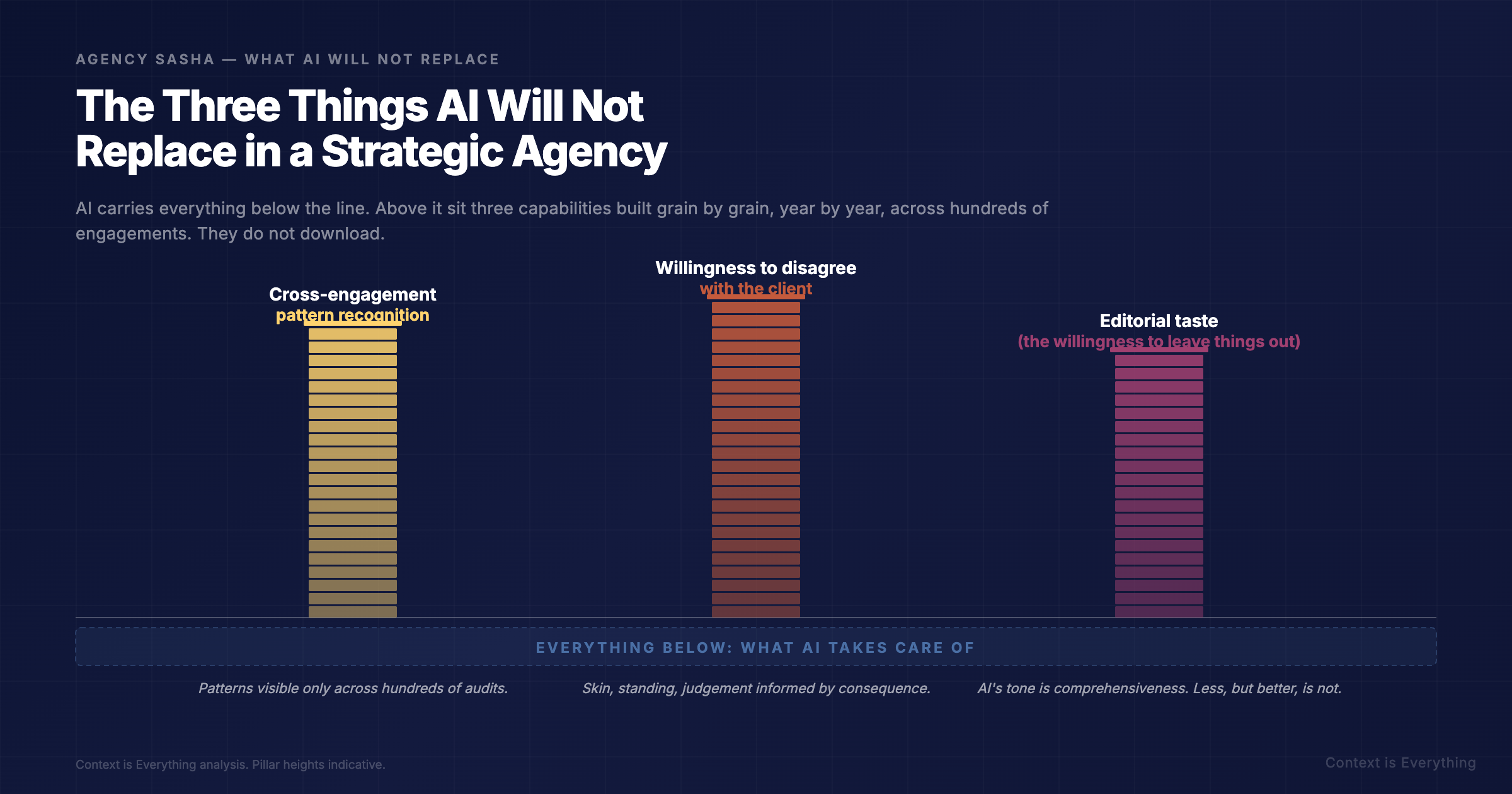
The principals who win the next decade will be the ones who industrialise around three specific things that cannot be downloaded. AI carries the rest. These three resist compression, resist commoditisation, and resist replication regardless of how good the next model gets.
One: deep cross-engagement pattern recognition
A senior strategist who has run three hundred category audits sees patterns a planner six months into the work cannot see. Not because the planner is less capable, but because the patterns do not show up in any single audit. They live in the cumulative noise across engagements.
This brand is making the same mistake a different brand in an adjacent category made three years ago. That client's defensiveness has the same shape as another client's defensiveness, which turned out to be a board issue rather than a brand issue. This category is moving the way wellness was moving in 2019, and the brands that survived had two things in common.
The patterns are everywhere. They are also invisible to anyone who has not lived through enough engagements to recognise them. A generic AI tool has read a great deal more than three hundred audits, but has read none of yours. It can recognise patterns across the public corpus. It cannot recognise patterns across your firm's accumulated work, because your firm's accumulated work is not in any training set.
This is the private-data moat in agency language. A consultancy version of the same argument sits in The Two Moats, which is worth reading alongside this piece because the conclusion is identical. The moat is not the AI. The moat is what the AI has been calibrated against.
If the firm has documented its accumulated category positions, the AI it deploys can run a first pass that draws on that history. If the firm has not, the AI is reading the public corpus like every other agency's AI is reading the public corpus. The output is generic. Which is to say it sounds like it could have come from anyone.
The Margaret problem applies here directly. We treat it in detail in The Irreplaceable Expert. Every agency has a Margaret, a strategist who knows not just what the data says but what it means in the context of fifteen years of seeing this kind of data. AI does not replace Margaret. AI either has access to what Margaret knows, captured in a queryable form, or it does not. The firms that figure out how to make Margaret's knowledge durable will have an advantage that compounds, not because their AI is better, but because their context is deeper.
Two: the willingness to disagree with the client
This is the one most people do not notice until it is too late.
The AI agrees. It always agrees. Not because of any flaw in the model. Because of how the model is trained: to be helpful, to satisfy the user, to produce outputs the user finds useful. Push back is a feature that has to be deliberately built in, and even when it is, the pushback tends to be soft. "You might consider". "Another perspective is". "It could be argued".
A senior strategist with twenty years of practice will look a marketing director in the eye and tell them that their stated brief is the wrong brief. That the question they think the agency is answering is not the question that needs answering. That the campaign their CEO has personally signed off on will damage the brand and they should kill it before launch. This is the willingness to disagree with the client. It is also the single most valuable thing the firm sells, and the thing AI will not learn, regardless of generation.
Why not. Because disagreeing with the client requires three things AI cannot have. Skin in the game (the strategist's reputation is on the line). Standing (the strategist has done this before and is willing to risk the relationship). Judgement informed by consequence (the strategist has seen what happens when this kind of brief is followed, and what happens when it is not). AI has none of these. AI is, by design, the most agreeable colleague in the room.
The agencies that allow AI to handle the parts of the work where agreement is correct (the read, the synthesis, the first-draft drafting) free up senior bandwidth for the part where disagreement is correct. The principals who industrialise this division of labour will be running boutique firms in 2030 that compete with networks twenty times their size, because their senior people will be spending most of their time on the work only senior people can do.
The principals who do not will be running firms where the disagreement work is squeezed between the synthesis work and the deck production, and the disagreement work is, eventually, the work that gets cut.
Three: editorial taste, which is mostly the willingness to leave things out
This is the quietest of the three, and the hardest to explain.
A strategy director's value, at the level where strategy directors are paid what they are paid, is not what they put into the deck. It is what they leave out. The four insights from the terrain read that did not make the cut. The three competitive moves that were noted and not pursued. The two creative directions that were live and got killed before they reached the client.
AI does not leave things out. AI produces. Asked for ten ideas, it produces ten. Asked for thirty mood boards, it produces thirty. Asked for a comprehensive category audit, it produces a comprehensive category audit. Comprehensiveness is the AI's tone. Less, but better, is not.
Dieter Rams' principle, treated in Design Principles for AI That Actually Works, is that good design is as little as possible. The same principle applies to good strategic agency work. The audit's value is in what it does not say. The pitch's value is in the recommendations the firm declined to make. The campaign's value is in the directions the firm did not pursue.
The editorial decision (this and not that) is the work that cannot be downloaded. Neo can have the kung fu download. He cannot, until he has been kicked across the dojo a few times, know which move to use when. The senior strategist's editorial taste is the accumulated kicking across the dojo. It is also, not coincidentally, what the firm is paid for.
What to invest in instead
If these three things resist AI replacement, the principal's investment question becomes specific. Not which AI tool to buy, but which structures to build around the three things AI cannot do.
For cross-engagement pattern recognition: build a queryable corpus of past audits, post-mortems, and category positions. AI that can read this corpus turns Margaret's intelligence into firm intelligence. Senior people stay. Their knowledge stops walking out of the door with them.
For willingness to disagree: protect senior time. The principals who treat their senior strategists' time as the firm's most valuable resource, and protect it from synthesis and production work, build firms where disagreement is the routine product rather than the rare occasion. AI carrying the synthesis is what makes this protection possible.
For editorial taste: hire for it, mentor for it, and refuse to scale the firm past the point where editorial taste can be maintained. This is the unfashionable answer. Boutique strategic agencies that try to scale past the point of editorial taste become networks. Networks have their place. They are not selling what boutique strategic agencies sell.
The principals who treat AI as a tool that handles the downloadable parts will be running firms in 2030 that are recognisably the same shape as the ones they run now, only with more time for the three things that matter. The principals who treat AI as a replacement for one of the three will be running firms that are indistinguishable from twenty other firms in the same market, all of them using the same tools, all of them producing the same outputs.
Neo can have the kung fu download. The fight in the dojo is still the fight in the dojo.
The full agency context for this argument is in AI for Strategic Agencies: The Complete Guide. The methodology that operationalises the divide between what AI does and what the strategist does is in Terrain, Narrow, Question, Voice. The structural-moat argument from the consultancy side is in The Two Moats. The Margaret problem in detail is in The Irreplaceable Expert.
Also from The Contour
The personal-voice version of these ideas, from Spencer Thursfield's newsletter.

The Contour · 22 Apr 2026
I know Kung Fu…
I genuinely think there is something awesome about the first time AI does something you didn’t think was possible. I don’t mean like “oh that’s clever”, I mean that is most-excellently - AWESOME. Like so good you want to tell someone. Immed

The Contour · 25 May 2026
That's how the light gets in…
In Islamic calligraphy there is a convention as old as the form itself. However refined the hand, the calligrapher leaves one small deliberate imperfection in the finished work. An irregularity in a letter, a break in the geometry, visible
Related Articles
AI for Strategic Agencies: The Complete Guide
The bottleneck in a strategic agency is not creativity. It is the upstream synthesis work that lets creative people start from a position of category insight rather than from a brief. AI that promises to replace the creative is selling the wrong product. AI that compresses the time-to-insight is the actual lever.
Terrain, Narrow, Question, Voice: The Four-Step Audit That Tells You Where a Brand Has Drifted From Its Category
Most brand audits start in the wrong place. They start at the brand. The result is a SWOT that any agency could have produced. The Contour Method starts at the terrain and narrows from there. The audit that emerges is one a competing agency cannot easily replicate.
The Two Moats: Why Consultancies' AI Advantages Are Structural, Not Timing
Most professional services firms are still asking 'should we explore AI?' The firms pulling ahead are already in production. But the advantage isn't timing — it's structural. Two competitive moats are forming that can't be bought, replicated, or rushed: private data and custom tooling.
The Irreplaceable Expert: Why AI Without Human Oversight Fails in High-Stakes Consulting
As AI gets better, you would expect to need less human oversight. The opposite is true. When AI is 95% correct, the 5% that is wrong is camouflaged by the quality of everything around it. The oversight paradox in high-stakes professional services.
Design Principles for AI That Actually Works
Strip the word "design" out of Dieter Rams' ten principles and replace it with "AI". Most of what we read about AI fails the tests. Three projects that don't: NHS EDITH mammography, UNHCR Jetson, and the Danish Refugee Council's Foresight tool. What they have in common, and how we apply the same shape with clients.