
Terrain, Narrow, Question, Voice: The Four-Step Audit That Tells You Where a Brand Has Drifted From Its Category
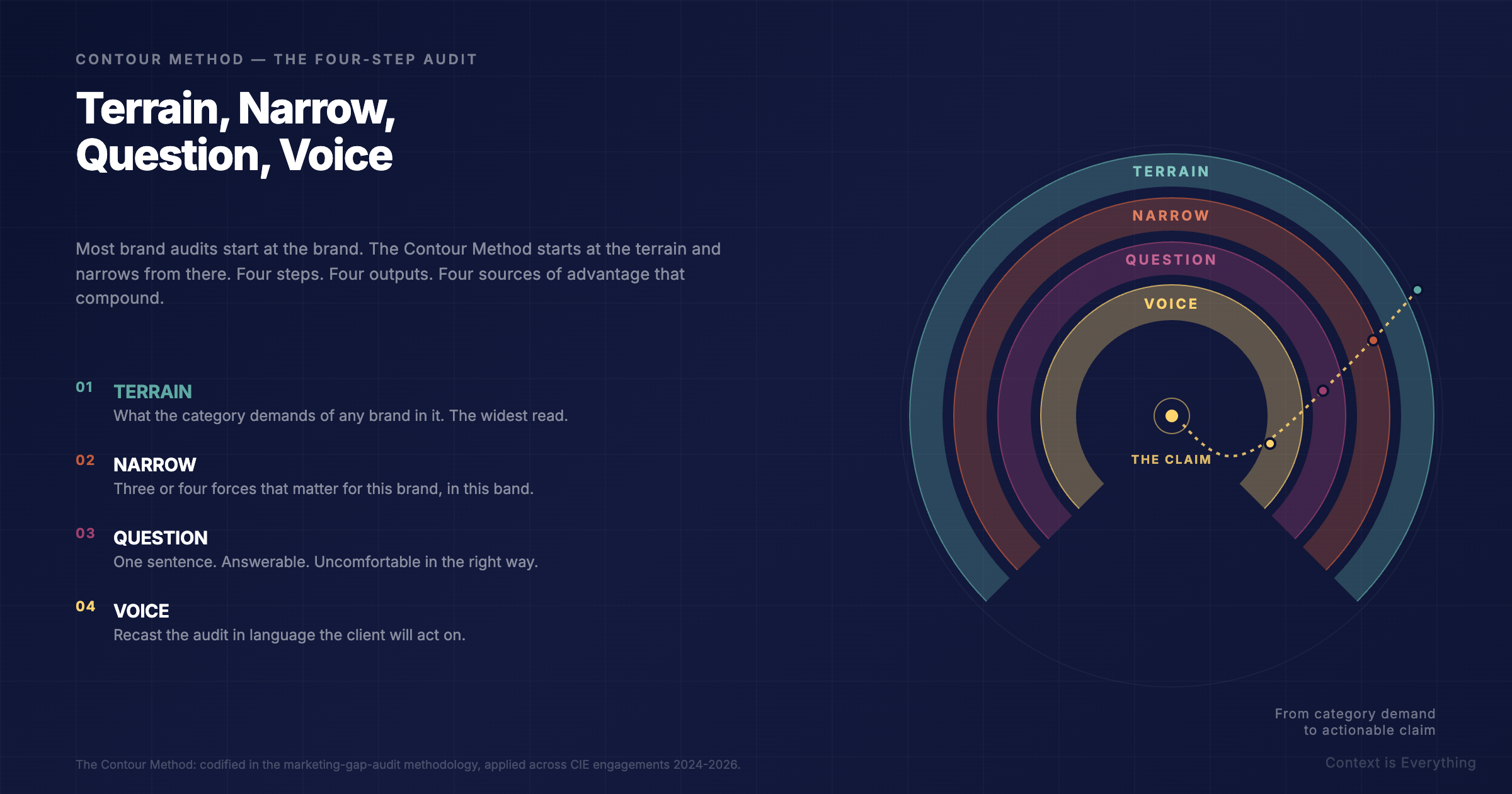
Most brand audits start in the wrong place. They start at the brand. The result is a SWOT that any agency could have produced. The Contour Method starts at the terrain and narrows from there. The audit that emerges is one a competing agency cannot easily replicate.
Most brand audits start in the wrong place. They start at the brand.
The planner gets the engagement, sits down with everything the client has sent over, and starts reading from the client's perspective outward. Brand book first. Then tone-of-voice guidelines. Then customer research. Then competitor decks. By the time the terrain comes into view, the planner is already three weeks in, has formed a working hypothesis, and is fitting the category to the hypothesis rather than the other way round.
The output is a SWOT that any agency could have produced. Strengths, weaknesses, opportunities, threats, all framed in the client's existing vocabulary. The pitch comes back, the client nods politely, and the work is awarded to whichever agency has the warmer relationship with the marketing director. The audit was not the differentiator. It rarely is, in that shape.
The Contour Method starts in the opposite place. It starts at the terrain, and narrows from there. The four steps: terrain, narrow, question, voice. The result is a brief grounded in something more durable than client preference. It is also, in our experience, the audit that wins the pitches client preference would not.
Step one: terrain
Terrain is what the category demands of any brand in it.
Not what this brand demands. What the category demands. Read regulators, trade press, analyst coverage, consumer research, the most-cited critics, the cultural noise around the category. Read three years deep, not three months. Read at scale, not selectively.
The question terrain answers is not "what is this brand doing". The question terrain answers is "what would any credible brand in this category have to be doing right now, to remain credible at all".
A worked example, drawn from the consultancy category itself. We ran this method against the consultancy category in early 2026 and built the output as a public methodology demo. The terrain step surfaced that the category is being reshaped by three forces: AI-augmented buyer research that arrives before any sales call, schema-readable structured data as a precondition for being cited in AI answers, and a flight from generic marketing back toward specialist methodology positioning. None of these came from any one firm's brand book. They came from reading what the category was rewarding and punishing across hundreds of public sources. The demo is live at cie-dashboard-ashen.vercel.app.
AI is good at terrain reading. Not at conclusions. At the read.
The reason terrain reading is the right place to start AI is that the work is high-volume, structurally repeatable, and rewards consistency. Feed AI three years of category coverage, regulator statements, trade press, and competitor announcements. Ask it to produce a structured terrain map: what is rewarded, what is punished, what is changing, what is stable. Cite every claim back to a primary source.
An afternoon of AI reading replaces two weeks of manual extraction. The output is auditable, the citations are visible, and the boundaries between fact and inference are preserved. Generic AI tools struggle with the last part. They blend confidently. Agency work cannot afford to.
Step two: narrow
The terrain read is too big to do anything with. That is the point.
The second step is to narrow. Given everything the terrain reading surfaced, what are the three or four things that actually matter for this particular brand, in this particular category, at this particular moment.
Narrowing is a judgement call. AI can produce candidate narrowings, can group findings, can score them against criteria. It cannot make the narrow call. The narrow call is where the senior strategist earns their seat.
A useful test for whether the narrowing is sharp enough: if any other brand in the same category could be subject to the same narrowed audit, the narrowing is too wide. If only this brand could be subject to it, but only in passing, the narrowing is too tight. The narrowing should hold for this brand and two or three of its closest competitors, and not for the rest of the category. That band is where pitch-winning insight lives.
A real example, from schema-impact work with a wellness-software platform working in the gym and studio management category. The terrain read surfaced dozens of forces shaping the category: regulatory shifts in personal data handling, the consumerisation of B2B buying, AI-citation pressure on category coverage, integrations as a moat, vertical-specialist competitors winning share from horizontal generalists. All true. All terrain.
The narrowing call was that one of these forces, AI-citation pressure on category coverage, was changing buying behaviour faster than the others. This was a category where the buyer's first move was an AI-mediated search for "best gym management software". The brands cited in those AI answers were the brands shortlisted. The brands not cited were not shortlisted, regardless of marketing spend, regardless of relationship depth. The narrowing held for this platform and two of its closest competitors, did not hold for the wider category, and pointed at a structural shift in buyer behaviour that the brand's existing marketing programme was not addressing.
That is what a narrowing looks like when it is doing its job. It does not feel comprehensive. It feels uncomfortably specific. That is the signal it is correct.
Step three: question
With the narrowing made, the question is now askable.
The question is not a SWOT. The question is the single thing the audit is asking the brand to confront. It should be possible to write the question in one sentence and have it survive contact with a senior client.
For the wellness-software engagement, the question was: where does the brand sit in AI-mediated buyer answers today, and what would it take to be cited in the answers that determine shortlisting in twelve months. That is one sentence. It does not paper over disagreement. It does not give the client a way to retreat into "we have always done it that way". It is also, importantly, answerable. The question has a measurable target state, a current state, and a gap.
For the consultancy-category demo, the question was: where is the category's coverage thin, and what content would close the gap fast enough to outpace the category's drift. One sentence. Specific. Answerable. Uncomfortable in the right way.
Generic brand audits ask many questions. None of them threatening. The Contour Method asks one question. It should threaten the comfortable answer.
Step four: voice
Voice is the step most agencies skip, and the one that determines whether the audit gets implemented.
The terrain is right. The narrowing is sharp. The question is uncomfortable. Then the strategist writes up the audit in the language of strategic consultancy, hands it to the client, and the client politely nods and changes nothing.
Voice is the recasting of the audit into the language the client will actually act on. A founder-led brand needs the audit in founder language. A regulated brand needs the audit framed against regulatory and reputational risk. A category-leader brand needs the audit framed against share threat. A challenger brand needs the audit framed against the opportunity to redefine the terms of the category.
This is not about softening. It is about precision. The same audit, in two different voices, lands in two different places. One ignored, one acted on. The judgement call about which voice this brand requires is something AI cannot make. Voice requires knowing the room.
The Contour Method's last step is to recast everything the first three steps produced into the voice the client can hear without flinching. That is the version that gets implemented. The version in the planner's preferred voice is the version that wins an industry award and changes nothing in the client's actual marketing.
Why this sequence works
The sequence is the whole methodology. Terrain before brand, because starting at the brand fits the category to the hypothesis. Narrow before question, because an unnarrowed question is unanswerable. Question before voice, because voice without a sharp question is just tone. Voice last, because the audit that does not land in the client's language does not get implemented.
Most brand audits collapse this sequence. They write the question first, fit the terrain to it, and present the conclusion in the agency's house voice. The result is fluent and circular. It also sounds, to anyone reading three of them in a row, identical.
A Contour audit reads different. Not because it has different fonts on the deck. Because it starts from a different position. It is also, structurally, harder for a competing agency to copy. The terrain read is the firm's accumulated category intelligence, the narrowing is the firm's judgement, the question is the firm's point of view, and the voice is the firm's read of the client. Four steps, four sources of advantage, all of which compound across engagements.
Which is what a methodology is meant to do.
Where this fits in the larger picture
The Contour Method is the procedural backbone of Agency Sasha, our methodology for AI-supported strategic-agency work. The full positioning is in AI for Strategic Agencies: The Complete Guide. The leverage map (which parts of the agency benefit most from AI support) is in Where Does AI Create the Highest Leverage in a Strategic Agency. The defensive piece (what AI will not replace, regardless of model generation) is in The Three Things AI Will Not Replace in a Strategic Agency.
The shape of the Contour Method shows up in the firm's home page too: three concentric rings, public context outside, organisational knowledge inside, SASHA at the centre. The same idea in visual form. The audit method narrows from terrain inward, and the firm's product narrows from public context inward. Methodology and product, the same shape.
Try the Method on a Brief You Have
If you have a live brief you're working on, Briefing in Contours runs the four-step shape against it: terrain, narrow, question, voice. The output is the kind of structured strategic frame you can take into a client conversation.
Which is the point. The methodology is the product. Everything else is just the rendering of it.
Also from The Contour
The personal-voice version of these ideas, from Spencer Thursfield's newsletter.


Related Articles
AI for Strategic Agencies: The Complete Guide
The bottleneck in a strategic agency is not creativity. It is the upstream synthesis work that lets creative people start from a position of category insight rather than from a brief. AI that promises to replace the creative is selling the wrong product. AI that compresses the time-to-insight is the actual lever.
Where Does AI Create the Highest Leverage in a Strategic Agency?
AI leverage in a strategic agency falls into three zones. Most agencies are investing in the most visible zone, which is also the lowest-leverage one. The agencies pulling ahead are investing in the zone where the tools do not exist commodity-shaped, and the advantage compounds.
The Three Things AI Will Not Replace in a Strategic Agency
There is a scene in The Matrix where Neo says "I know kung fu". He has downloaded the moves. Two minutes later, Morpheus walks into the dojo and kicks his ass. Downloading the moves is not the same as knowing why they work. The same gap is opening up across the agency category. Three things AI will not replace, and what to invest in instead.
Using AI to Compare Vendor Proposals: Where It Helps and Where It Doesn't
Mozart's string quartet still takes twenty-five minutes. A finance director's judgement still cannot be hurried. But everything around the decision can be compressed. A £15M procurement, 1,200 pages of supplier documentation, and what context-first AI actually surfaces.
Design Principles for AI That Actually Works
Strip the word "design" out of Dieter Rams' ten principles and replace it with "AI". Most of what we read about AI fails the tests. Three projects that don't: NHS EDITH mammography, UNHCR Jetson, and the Danish Refugee Council's Foresight tool. What they have in common, and how we apply the same shape with clients.