
Where Does AI Create the Highest Leverage in a Strategic Agency?
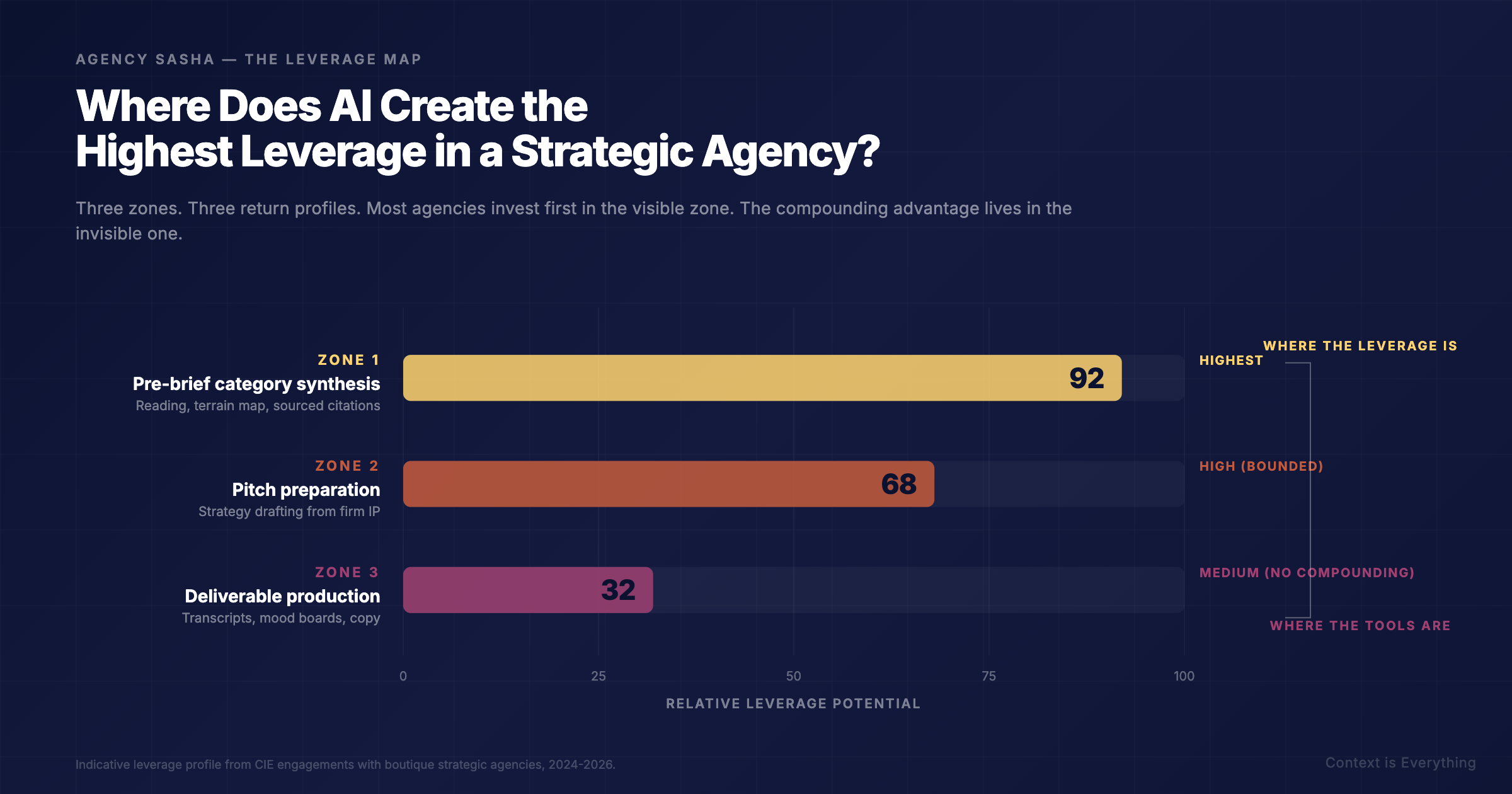
AI leverage in a strategic agency falls into three zones. Most agencies are investing in the most visible zone, which is also the lowest-leverage one. The agencies pulling ahead are investing in the zone where the tools do not exist commodity-shaped, and the advantage compounds.
The question most agency principals are asking is the wrong shape.
The question gets asked as "which AI tool should we adopt". Which assumes the answer is a tool. Which assumes the leverage is roughly the same across the agency, and that the question is just where the best tool lives.
The better question is: where in the agency does AI create leverage that compounds, versus leverage that everyone already has.
When the question is asked that way, three zones become visible, with very different return profiles. Most agencies are investing in the most visible zone. The agencies pulling ahead are investing somewhere else.
This is the same shape we mapped for high-ROI processes in Identifying High-ROI Processes for AI Automation, originally written for consultancies. The categories adapt directly to agency work. The conclusion is sharper, because agency margin is thinner and pitch outcomes are more visible.
Zone one: pre-brief category synthesis
This is where the highest leverage lives. It is also where the fewest commodity tools exist.
What it is. Reading the category. Mapping the competitive landscape. Surfacing the cultural and regulatory shifts that change what the category rewards. Reconstructing what a brand has been saying for three years against what the category now demands of it. Producing a structured terrain map that a strategist can interrogate.
Who currently does it. Senior people. Strategy directors. Planning directors. Partners. The expensive ones, with the finite hours.
When it happens. Under time pressure. Often the night before a pitch. Often by the person who can least afford the hours.
Quality variation. High. Depends on how many hours were available, which senior person was free, and how much category material they had time to read. The audit either reveals a category insight competitors did not have, or it does not. The pitch outcome reflects which it was.
Current tooling landscape. Almost nothing commodity. ChatGPT can read documents, but it cannot read your firm's accumulated category positions or hold the boundary between fact and inference. Generic AI tools produce generic audits. The methodology, the corpus, and the firm's point of view all have to come from inside the firm.
AI leverage potential. Highest. Compression from days to hours on the read phase, with auditable citations and a structured first-pass synthesis. The senior strategist's role shifts from extraction to interrogation. The firm builds an accumulated terrain layer that compounds with every engagement.
Why most agencies have not invested here. Because the tools are not visible. There is no obvious subscription to buy. Building this layer requires the firm to do the work itself, on its own corpus, in its own infrastructure. That is more expensive in the short term than buying ChatGPT seats. It is also categorically more valuable in the medium term, because it produces an asset rather than a cost.
This is where Agency Sasha sits. The product is the synthesis layer. The methodology, the Contour Method, is treated in detail in Terrain, Narrow, Question, Voice.
Zone two: pitch preparation and deck production
What it is. Drafting pitch responses. Writing the strategy section of decks. Producing supporting case studies. Formatting the firm's accumulated frameworks into pitch-fit form. The work that happens after the strategic core is right, but before the deck is signed off.
Who currently does it. Mixed. Mid-level strategists, senior planners, designers, sometimes account leads. Depends on the firm.
When it happens. Pitch week. Late nights. Last-minute changes from the senior reviewer at 9pm.
Quality variation. Significant. Decks vary in polish, consistency, and adherence to the firm's house style depending on who was available and how much time they had.
Current tooling landscape. Dense. A growing category of pitch-deck generators and slide-AI tools. Useful at the production layer. Less useful at the strategic-core layer, because the strategic core is what the firm sells and is not a commodity output.
AI leverage potential. High. 60 to 80 per cent reduction in first-draft time on pitch sections that draw on the firm's existing IP. Consistency benefits across teams. Less variation by which mid-level person was available.
Where the limits sit. AI trained on the firm's previous pitches and frameworks produces excellent first drafts. The senior strategist still has to read the draft, refine the argument, and decide what to cut. That work does not compress.
Why this zone is investable now. Because the tools exist, and the firm's previous pitches are a usable training corpus. The deployment path is shorter than zone one. The return is real but bounded by the fact that other agencies are also investing here. The advantage is real but does not compound the same way as zone one.
Zone three: client-deliverable production
What it is. Transcripts. Mood boards. First-draft copy. Image references. Presentation polish. Translation. Captions. The visible, audience-facing production layer.
Who currently does it. Designers, copywriters, production teams, account staff, increasingly augmented by commodity AI.
When it happens. Throughout the project lifecycle. Daily.
Quality variation. Lower than zone two, because the work is mostly templated and the failure cases are visible.
Current tooling landscape. Saturated. Mid-journey, Otter, ChatGPT, Canva, Descript, the entire stack of agency-facing productivity tools. Every agency has access to the same kit.
AI leverage potential. Medium. Real time savings. Real cost reduction on transcript work, image references, and first-draft copy.
Why the savings are bounded. Because every other agency has the same tools. Whatever the firm saves, the firm's competitors save too. The savings do not become competitive advantage. They become baseline.
Why most agencies invest here first. Because the tools are visible. The wins are easy to demonstrate. The marginal subscription is cheap. The conversation about adopting Mid-journey is faster and lower-friction than the conversation about building a category synthesis layer.
This is the agency-AI equivalent of fitting power steering. Useful. Standard. Not the engine.
What the zone map tells you
The pattern is consistent across the boutique strategic agencies we have worked with.
Zone one has the highest leverage, the longest deployment timeline, and the largest compounding return. Zone two has high leverage, a shorter deployment timeline, and bounded compounding because the tools exist commodity-shaped. Zone three has medium leverage, near-zero deployment timeline, and zero compounding because everyone has the tools.
Most agency AI investment has gone into zone three. Some into zone two. Almost none into zone one.
This is not because zone three is the wrong place to invest. Zone three savings are real. They free up junior time, reduce production cost, and remove friction. They are also priced into the category. Every agency that pays for the same tools gets the same benefits. The savings appear in the margin and then evaporate into the pitch.
The agencies that win pitches in 2027 will be the ones that invested in zone one in 2026. Not because their senior people work faster, but because the synthesis layer is already done by the time the senior people sit down. The category read happened in hours, not weeks. The terrain map exists before the brief is written. The accumulated firm context is queryable rather than locked in a partner's head.
That is the leverage that compounds. That is also the leverage no subscription will buy.
How to read your own zone investment
A short diagnostic for a principal trying to read their own firm's AI investment shape.
Zone three. How many subscriptions does the firm currently pay for that broadly fall under "AI productivity". Mid-journey, ChatGPT Team, transcript tools, deck assistants, image tools. If the answer is more than four, the firm is investing in zone three.
Zone two. Has the firm trained any AI tool on its own pitches and frameworks. If yes, the firm is investing in zone two. If no, the firm's pitch-prep work is still happening with commodity tooling.
Zone one. Does the firm have a structured corpus of past category audits, terrain reads, and brand-gap analyses that is queryable across engagements. If yes, the firm is investing in zone one. If no, the firm's category synthesis still happens senior-by-senior, engagement by engagement, with the firm's accumulated intelligence resetting each time.
Most firms answer the questions in that order: many, no, no.
The winning shape over the next three years looks more like: fewer (consolidate zone three), yes (invest in zone two pitch infrastructure), and yes (build zone one as the firm's methodology layer).
What this means for the principal
For a principal weighing AI investment, the question is not which tool to buy. The question is which zone to invest in, given the firm's current shape.
If the firm is still in pre-AI territory, the practical sequence is zone three first (because the wins are fast and the cost is low), zone two second (because the deployment timeline is moderate and the consistency benefit is real), and zone one third (because the deployment is the longest and the return is the most distant, but also the most defensible).
If the firm has already invested in zones two and three, the highest-return move is zone one. Not another zone-three subscription. Not another zone-two assistant. Zone one infrastructure. The category synthesis layer. The accumulated terrain map. The methodology that AI can run a first pass against without diluting it.
For a longer treatment of why this matters at the firm-strategy level, AI for Strategic Agencies: The Complete Guide. For the methodology itself, Terrain, Narrow, Question, Voice. For what AI cannot replace regardless of zone investment, The Three Things AI Will Not Replace in a Strategic Agency.
Run the Mapping for Your Agency
The AI Opportunity Mapper scores your processes across the same five dimensions covered here: leverage, repeatability, judgement requirement, data quality, and risk. The output is a ranked priority list, so you know where to invest first and where to leave the work in human hands.
The pattern in the consultancy world is the same: see the High-ROI Processes framework in Identifying High-ROI Processes for AI Automation and the firm-level guide in AI for Management Consultancies. The agency version has the same shape and the same conclusion. Most firms invest where the tools are visible. The firms that pull ahead invest where the leverage compounds.
Related Articles
AI for Strategic Agencies: The Complete Guide
The bottleneck in a strategic agency is not creativity. It is the upstream synthesis work that lets creative people start from a position of category insight rather than from a brief. AI that promises to replace the creative is selling the wrong product. AI that compresses the time-to-insight is the actual lever.
Terrain, Narrow, Question, Voice: The Four-Step Audit That Tells You Where a Brand Has Drifted From Its Category
Most brand audits start in the wrong place. They start at the brand. The result is a SWOT that any agency could have produced. The Contour Method starts at the terrain and narrows from there. The audit that emerges is one a competing agency cannot easily replicate.
The Three Things AI Will Not Replace in a Strategic Agency
There is a scene in The Matrix where Neo says "I know kung fu". He has downloaded the moves. Two minutes later, Morpheus walks into the dojo and kicks his ass. Downloading the moves is not the same as knowing why they work. The same gap is opening up across the agency category. Three things AI will not replace, and what to invest in instead.
Identifying High-ROI Processes for AI Automation
Most people intuitively know which tasks are too complex, too arduous, or too boring for humans alone. We've found high-value processes fall into three categories — and picking one from each is the fastest way to prove AI value.
AI for Management Consultancies: The Complete Guide
The expertise bottleneck is the oldest problem in consulting. AI doesn't eliminate the need for senior consultants. It eliminates the queue.