
AI for Strategic Agencies: The Complete Guide
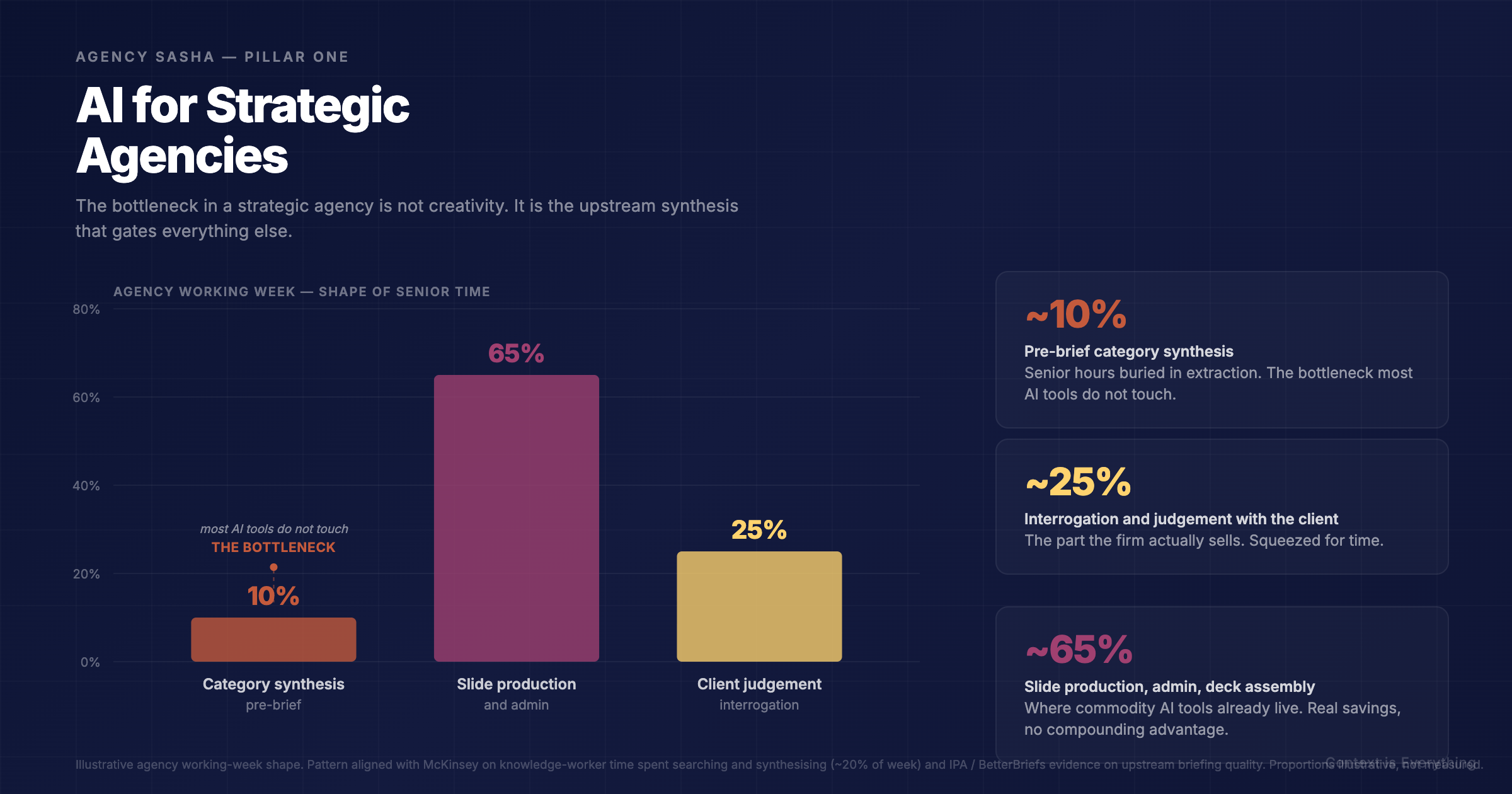
The bottleneck in a strategic agency is not creativity. It is the upstream synthesis work that lets creative people start from a position of category insight rather than from a brief. AI that promises to replace the creative is selling the wrong product. AI that compresses the time-to-insight is the actual lever.
The bottleneck in a boutique strategic agency is not creativity. It rarely has been.
The bottleneck is the work that has to happen before the creative people can do anything good. The category read. The competitive audit. The cultural temperature check. The reconstruction of what a brand has been saying for three years versus what its category now demands of it. The pile of decks, interviews, dashboards, and tabs that sits between a brief landing and a planner being able to start.
This is the part that gets quietly compressed when a pitch lands on a Tuesday and the response is due Friday. It is the part senior people end up doing themselves because nobody else can move fast enough. It is the part that determines whether the creative team starts from a position of category insight or from a one-page brief that summarises the client's existing assumptions back to them.
It is also the part that most generic AI tools miss entirely.
What the bottleneck actually costs
The cost of the synthesis bottleneck rarely shows up in a P&L. It shows up in the shape of the work.
It shows up when a strategy director spends Sunday rereading a category report so they can write a brief that sounds confident on Monday. When a creative team gets a brief that names the same three competitors they have always named, because there was no time to look beyond them. When a pitch is lost on a point of category insight that the winning agency had three more days to find. When the senior partner becomes the bottleneck on every engagement, because they are the only person who can hold the category in their head while interrogating the client's position against it.
None of this is a failure of talent. It is a structural consequence of how a boutique agency carries category knowledge: in the heads of its senior people. Knowledge concentrated in a small number of expensive humans, with finite hours.
AI does not solve this by replacing the senior people. It solves it by removing the queue of synthesis work that delays access to their judgement.
What AI actually does for a strategic agency
The agency use cases that deliver the highest return are not the glamorous ones. They are not AI-generated taglines or AI-generated campaign concepts. They are the unglamorous information-processing tasks that eat senior time before any creative thinking can begin.
Category synthesis. Feed AI three years of category coverage, competitor decks, regulator statements, trade press, and consumer research. Get a structured read on what the category is rewarding and punishing, with sourced citations, in an afternoon rather than a fortnight. The strategy director's role shifts from extraction to interrogation.
Gap analysis. Compare a brand's existing public surface (what it says, where it appears, who cites it) against the terrain the category demands. The difference is the gap. The gap is what the pitch is about. We use the four-step shape we call the Contour Method for this, covered in detail in Terrain, Narrow, Question, Voice.
Pitch preparation. AI trained on your firm's previous pitches, your house frameworks, and your accumulated category positions can draft pitch sections in hours. The strategist refines rather than starts from scratch. The slide team works from a strategic core that is already directionally right.
Institutional knowledge preservation. When senior strategists leave a boutique agency, much of the value walks out with them. AI trained on your accumulated frameworks, post-mortems, and case patterns keeps that intelligence accessible to the next hire.
None of these use cases asks AI to do the work that wins pitches. They ask AI to clear the runway so the work that wins pitches can begin earlier.
The leverage map: where AI actually pays back
Not every part of an agency benefits equally. Three zones, with very different return profiles:
Zone one: pre-brief category synthesis. Highest leverage. Currently performed by senior people, under time pressure, with no consistent output format. AI compresses this from days to hours and produces something auditable. This is where Agency Sasha exists.
Zone two: pitch preparation and deck production. High leverage. Currently performed by a mix of senior and mid-level staff, with significant variation in quality. AI compresses drafting time and improves consistency across teams.
Zone three: client-deliverable production. Medium leverage. Currently the focus of most commodity AI tools (decks, mood boards, transcripts, copy assistance). Real time savings, but the savings are widely available, so they do not become a competitive advantage.
A full treatment of the three zones, with worked examples, sits in Where Does AI Create the Highest Leverage in a Strategic Agency. The short version: most agencies are investing in zone three because the tools are visible. The agencies that pull ahead are investing in zone one.
Why generic AI tools miss the zone that matters
The agency-facing AI category is loud. Mid-journey for moodboards. Otter for transcripts. ChatGPT for first-draft copy. A growing list of pitch-deck generators promising slides in minutes.
All of these are zone-three tools. They are good at what they do. They are also available to every agency that pays the subscription.
What they cannot do is the work in zone one. Because the work in zone one requires three things a generic tool does not have:
The agencies that try to bridge zone one with generic tooling end up with confident-sounding analysis their planners then have to undo before the work can be defended in front of a client. The acceleration is illusory. The time saved on drafting gets spent on verification, and the verification work falls back on the senior people the AI was supposed to free up.
This is the same failure mode we treat at length in The Verification Debt Nobody Budgeted For. It is not specific to agencies. It is just particularly painful in agencies, where the verification cost falls on the people the firm sells.
What good agency AI deployment looks like
Good AI in a strategic agency looks like a change to how work gets done, not a new subscription. The pattern that works:
The agencies that get this right are not buying productivity tools. They are building a methodology layer that survives staff changes, holds the firm's accumulated category positions, and lets senior strategists spend their hours on the part of the work that no software replicates: interrogation, judgement, and the editorial taste that decides what to leave out.
For a longer treatment of what AI cannot replace in this work, see The Three Things AI Will Not Replace in a Strategic Agency.
The two moats, in agency language
The strategic agencies that will matter in five years are building two things at once.
A methodology moat. A documented, repeatable approach to category audit that pitches off the firm's specific point of view, not a generic SWOT. Yours. Not a competitor's. Codified to the point that AI can run a first pass without diluting it.
A context moat. Accumulated category intelligence from every engagement, every pitch, every post-mortem. Held in the firm rather than in any individual's head. Queryable by anyone the firm chooses to give access to.
AI deepens both moats, but only if the AI is trained on them. A generic AI tool is a subscription. It is not a moat. Every agency that pays the same fee has the same access. We treat this argument in more detail in The Two Moats, originally written for management consultancies but every word of it applies to strategic agencies.
The firms that build these moats now will be doing category audits in 48 hours that competitors still need two weeks for. Not because the senior people are faster. Because the synthesis layer is already done by the time the senior people sit down.
The ones still arguing about whether to allow ChatGPT in the building will have neither moat. They will be selling the same audit every other agency sells, at the same rate, on the same timeline.
The gap between those two positions is widening now. It is not theoretical. It is showing up in pitch outcomes.
Related Articles
Terrain, Narrow, Question, Voice: The Four-Step Audit That Tells You Where a Brand Has Drifted From Its Category
Most brand audits start in the wrong place. They start at the brand. The result is a SWOT that any agency could have produced. The Contour Method starts at the terrain and narrows from there. The audit that emerges is one a competing agency cannot easily replicate.
Where Does AI Create the Highest Leverage in a Strategic Agency?
AI leverage in a strategic agency falls into three zones. Most agencies are investing in the most visible zone, which is also the lowest-leverage one. The agencies pulling ahead are investing in the zone where the tools do not exist commodity-shaped, and the advantage compounds.
The Three Things AI Will Not Replace in a Strategic Agency
There is a scene in The Matrix where Neo says "I know kung fu". He has downloaded the moves. Two minutes later, Morpheus walks into the dojo and kicks his ass. Downloading the moves is not the same as knowing why they work. The same gap is opening up across the agency category. Three things AI will not replace, and what to invest in instead.
The Two Moats: Why Consultancies' AI Advantages Are Structural, Not Timing
Most professional services firms are still asking 'should we explore AI?' The firms pulling ahead are already in production. But the advantage isn't timing — it's structural. Two competitive moats are forming that can't be bought, replicated, or rushed: private data and custom tooling.
The Verification Debt Nobody Budgeted For
The agent worked in the demo. The bill arrives in month four. Verification debt, comprehension debt, and operational debt are the three categories of operational cost that nobody budgeted for. Practitioners are talking about them constantly. Buyers are not.
AI for Management Consultancies: The Complete Guide
The expertise bottleneck is the oldest problem in consulting. AI doesn't eliminate the need for senior consultants. It eliminates the queue.