

Your Buyers Are AI-Native. Is Your Marketing?
90% of B2B buyers use AI at every buying stage, but only 20% of marketing organizations have embedded AI in workflows. Understanding the five-to-one gap and strategies for closing it.
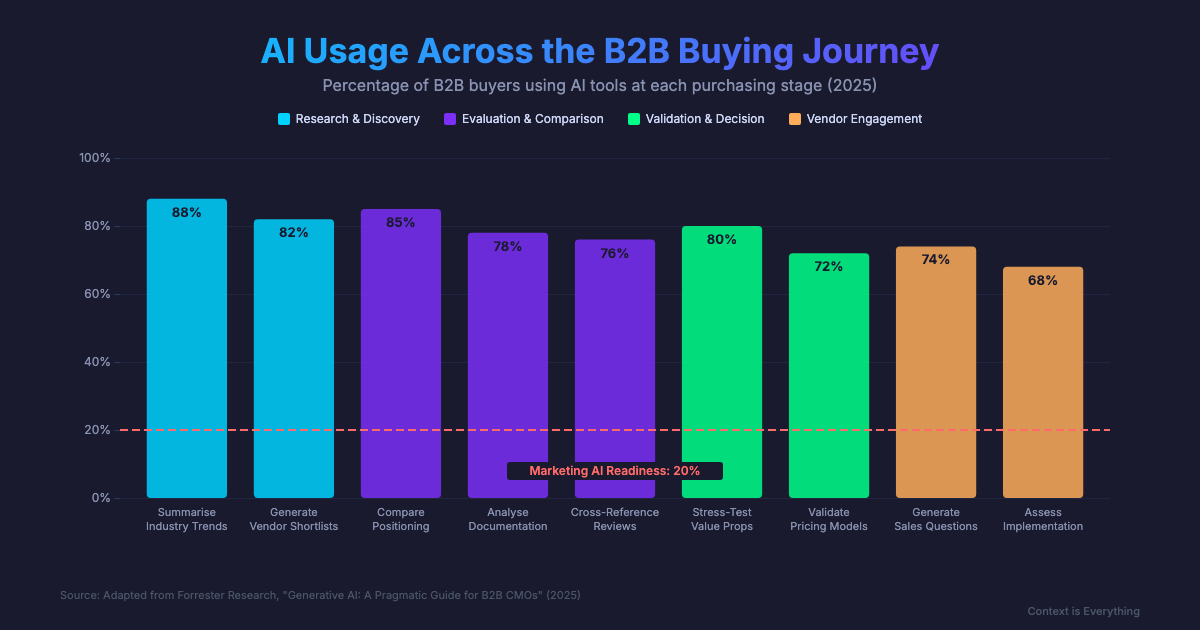
Something curious is happening in B2B buying. According to Forrester's 2025 research, nine in ten business buyers now use AI at every stage of their purchasing journey. Meanwhile, only two in ten marketing organisations have actually embedded AI into their workflows.
That's not a small gap. That's a fundamental mismatch in how buyers want to engage and how sellers are equipped to engage.
What's Actually Happening
B2B buyers are using AI tools to research vendors, compare solutions, and validate their decisions. They're asking AI to summarise whitepapers, identify key differentiators, and spot gaps in vendor claims. They're having AI draft comparison tables and generate questions for sales calls.
This isn't future behaviour. It's happening now, across industries, at every company size.
Meanwhile, most marketing teams remain in what Forrester calls the experimentation phase. They've run pilots. They've tested tools. They've created some AI-generated content. But very few have moved AI from interesting experiment to embedded capability.
The result? A growing disconnect. Buyers are conducting AI-assisted research on vendors who aren't prepared for AI-assisted scrutiny.
Why This Creates Problems
When buyers use AI to evaluate you, they're essentially crowdsourcing intelligence from everything publicly available about your company. Your website content, case studies, customer reviews, analyst reports, social media presence, competitor comparisons—all of it becomes training data for their buying decision.
If your content is inconsistent, your value proposition unclear, or your differentiation weak, AI tools will surface those gaps. They'll compare your claims against competitors'. They'll identify contradictions between your marketing messages and customer feedback. They'll highlight what you're not saying as clearly as what you are.
This isn't about AI being unfair. It's about AI being thorough in ways human researchers might not be. A buyer might read your homepage and three case studies. AI reads everything, cross-references it, and identifies patterns—both strengths and weaknesses.
Organisations that haven't thought about how their content performs under AI-assisted scrutiny may find themselves at a disadvantage they don't even know exists.
What's Changing
The organisations beginning to close this gap share some common approaches. They're not necessarily doing more with AI—they're doing different things.
Rather than focusing only on using AI to create more content, they're using it to stress-test their messaging. They're asking: "How does our positioning compare to competitors' when AI summarises both?" They're identifying content gaps by analysing what questions buyers ask AI that their content doesn't answer.
They're also being more honest about readiness. Forrester's framework identifies five areas that need attention:
Most organisations experimenting with AI focus on technology—the tools themselves. The ones making progress attend to all five dimensions.
Perhaps most importantly, they're accepting that this shift requires fixing some foundational issues first. If your content governance is weak, AI will amplify that weakness. The technology doesn't fix unclear thinking—it exposes it.
The Shift Required
The 90/20 gap suggests we're at an inflection point. Buyers have moved faster than sellers expected. The question isn't whether to update your navigation tools, but how quickly it's possible to do so without losing your way in the process.
This probably isn't about matching buyers' AI sophistication tool-for-tool. It's more likely about ensuring your content, positioning, and value proposition can withstand AI-assisted scrutiny. That your differentiation is clear enough to survive algorithmic comparison. That your claims are consistent enough to hold up under cross-referencing.
Not every organisation needs to be AI-native tomorrow. But understanding that your buyers increasingly are—and adjusting accordingly—seems less like a choice and more like a necessity.
Where to Start
Two diagnostic tools designed for this exact gap:
---
*Statistics and framework references from Forrester Research, "Generative AI: A Pragmatic Guide for B2B CMOs" (2025)
Elsewhere on this
From bernard, our sister company, which builds and looks after small-business websites. Same argument, written for the businesses on the other end of it.
bernard · Article
Where did the visitors go? Google since December, and the rise of AI search
The same shift, read from the small-business end: what changed in Google, and what being quoted by an assistant is now worth.
bernard · Tool
Can ChatGPT read your website?
A free check of whether AI assistants can actually reach and read your pages, run against your live site.
Related Articles
The Great AI Retreat: A Story in Four Acts
UK small business AI adoption crashed from 42% to 28% in just over a year. Discover the seven patterns causing failures and what successful implementations do differently—treating AI as experiments, not implementations.
Why Most AI Projects Fail (And What the 5% Do Differently)
MIT's Project NANDA found 95% of enterprise AI pilots deliver zero return. Companies have invested £30-40 billion with nothing to show. But 5% achieve rapid revenue acceleration. The difference isn't the technology - it's implementation and context.
5 Signs Your Business Actually Needs AI (And 5 Signs It Doesn't)
Most businesses don't need AI right now. Here are 5 signs you genuinely need it—and 5 signs you definitely don't. The honest assessment most consultants won't give you.