
From More Data to Better Insights: How AI Expands Analytical Depth for Consultants
The best consulting has always been limited by human processing capacity. That constraint just changed. The real value of AI isn't automation — it's the ability to synthesise broader, deeper datasets than any individual could process, and surface patterns that only become visible at scale.
The best consulting has always been limited by human processing capacity. That constraint just changed.
The real value of AI in professional services isn't automation. It isn't speed, though speed matters. It's the ability to synthesise broader, deeper datasets than any individual could process — and surface patterns that only become visible at scale.
The Analysis Bottleneck
Every consultant knows the trade-off. You have 500 pages of due diligence documents and a week to analyse them. You sample. You prioritise. You focus on what experience tells you matters most.
Most of the time, experience is right. But "most of the time" isn't the same as "all of the time." The signal you missed might be buried on page 347, or visible only when you cross-reference three documents simultaneously, or detectable only as a pattern across the entire dataset.
Traditional analysis is a sampling exercise disguised as comprehensive review. AI changes that equation.
What Becomes Visible at Scale
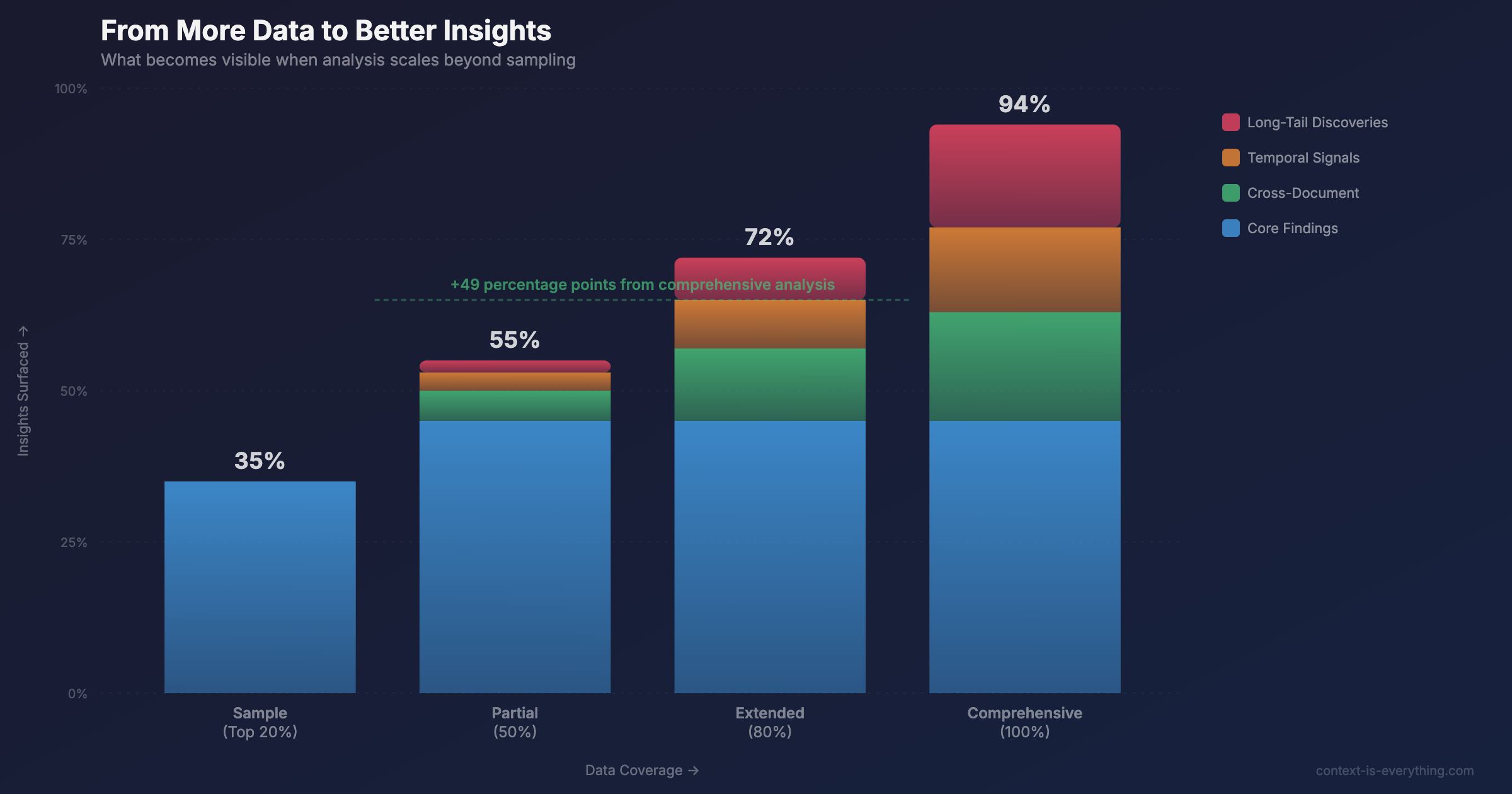
When you can process every data point instead of sampling, different things emerge:
Cross-document patterns. Inconsistencies between financial statements and management representations that only surface when comparing every instance, not spot-checking. A due diligence firm found revenue recognition anomalies across 47 subsidiary reports that manual review of the top 10 subsidiaries would have missed entirely.
Temporal signals. Changes in language, emphasis, or reporting patterns over time. A pharmaceutical consultancy analysing regulatory submissions across five years identified a shift in how adverse events were described — a pattern invisible in any single submission but significant across the longitudinal dataset.
Cross-engagement intelligence. Insights that emerge when synthesising patterns across hundreds of prior engagements. Identifying high-ROI processes becomes dramatically easier when you can compare patterns across your entire engagement history rather than relying on individual consultant memory.
The Private Data Multiplier
This is where the two moats create exponential returns.
Public LLMs see books, articles, and published research. Your AI, informed by years of confidential client work, sees patterns that no public model will ever access. That private corpus isn't just additional data — it's calibration data. It tells the AI what matters in your domain, what distinguishes genuine signals from noise, and what patterns actually predict outcomes.
More data only helps with the right analytical framework. The framework comes from your accumulated professional expertise. The volume comes from AI's processing capacity. Together, they produce insights neither could generate alone.
The Expert Multiplier
AI doesn't replace the expert's analytical role. It transforms it.
Without AI, experts spend most of their time on data processing — reading, extracting, correlating, summarising. The actual analysis — interpreting, judging, advising — gets squeezed into whatever time remains.
With AI handling the processing, experts spend their time where it matters: higher-order analysis. Not "what does this document say?" but "what does this pattern mean?" Not "find the relevant data" but "what are the implications?"
A consultancy that previously spent a week compiling organisational assessments now produces initial synthesis in 20–40 minutes. The consultants don't work less. They analyse deeper. The quality of insight improves because the bottleneck shifts from data processing to professional interpretation.
Quality Over Quantity
More data doesn't automatically mean better insights. It means better insights are possible — if the analytical framework is right.
The framework requirements:
The Future of Analytical Depth
The future of consulting isn't faster. It's more thorough.
Not "we processed your documents in two hours instead of two weeks" — though that matters. Rather: "we analysed every data point in your dataset, cross-referenced it against patterns from hundreds of comparable engagements, and surfaced three insights that traditional sampling would have missed."
The firms with years of private data have an advantage that compounds with every engagement. Each new analysis adds to the corpus. Each new insight refines the framework. The analytical depth achievable next year will exceed what's possible today.
Start with understanding where AI can add the most value to your analytical processes — the firms that move from sampling to comprehensive analysis first will set a quality standard competitors struggle to match.
Related Articles
The Two Moats: Why Consultancies' AI Advantages Are Structural, Not Timing
Most professional services firms are still asking 'should we explore AI?' The firms pulling ahead are already in production. But the advantage isn't timing — it's structural. Two competitive moats are forming that can't be bought, replicated, or rushed: private data and custom tooling.
Identifying High-ROI Processes for AI Automation
Most people intuitively know which tasks are too complex, too arduous, or too boring for humans alone. We've found high-value processes fall into three categories — and picking one from each is the fastest way to prove AI value.
The Hidden Complexity: Why AI Tuning Determines Everything in Professional Services
Two identical consulting analyses. Same frontier AI model. Wildly different results. What changed? Everything invisible. The difference between accurate AI and expensive mistakes comes down to configuration choices end users never see.