
Your Clients Are Already Using AI to Check Your Work - Here's How to Stay Ahead
39% of clients now validate accountancy advice with AI before acting. Discover how the confidence gap is holding firms back, and why the window for competitive advantage is closing fast.
Industry surveys suggest around 39% of clients now validate accountancy advice with AI tools before acting on it. That's not a threat - it's an opportunity.
The relationship between accountant and client has fundamentally shifted. Clients aren't waiting for their accountants to explain AI to them - they're already using it. They're running tax recommendations through ChatGPT. They're asking Claude to review management accounts commentary. They're checking whether strategic advice aligns with what AI suggests.
This isn't about clients not trusting their accountants. It's about clients having unprecedented access to information and using every tool available to make better decisions. The question facing the profession isn't whether clients will use AI - they already are. The question is whether accountancy firms position themselves ahead of this shift or behind it.
The repositioning that's already happening
For decades, accountants held informational advantage. Firms had access to knowledge, precedents, and insights that weren't readily available elsewhere. That advantage is evaporating quickly.
The new value isn't in holding knowledge - it's in interpreting it. Clients can get generic tax advice from AI in seconds. What they can't get is advice that understands their specific situation, their risk tolerance, their business context, and their long-term objectives. That's where the profession adds value.
But only if firms are working with AI themselves.
The confidence gap holding firms back
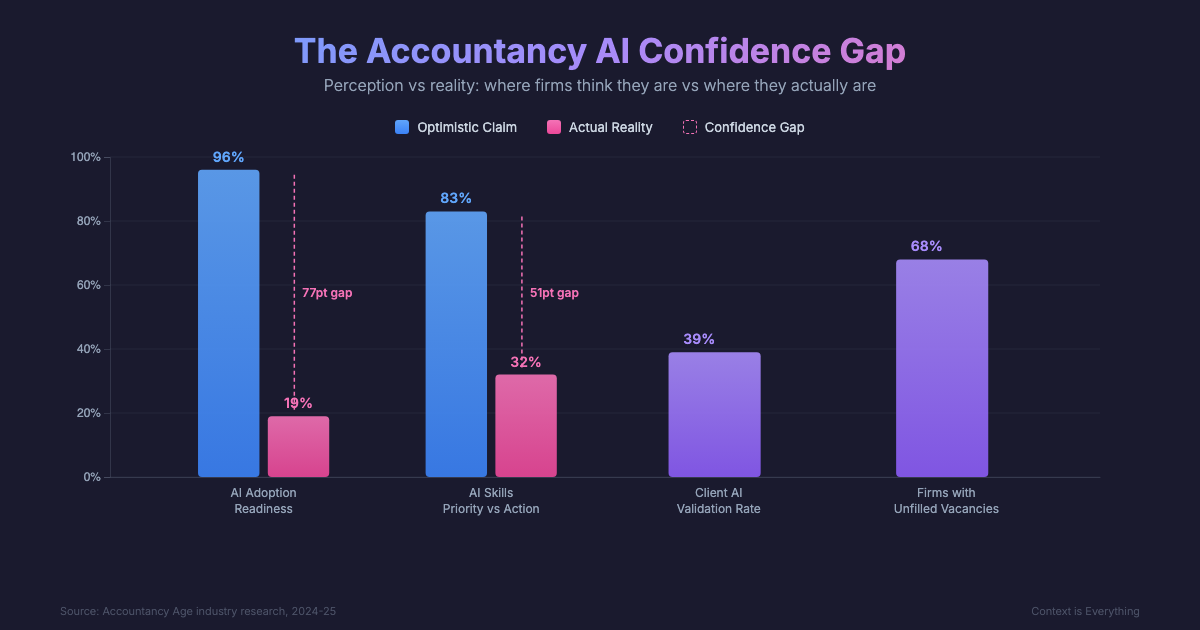
There's a curious contradiction in the profession right now. According to recent industry research, 96% of accountancy firms claim they feel prepared for AI adoption. Yet only 19% feel confident in their ability to implement it effectively.
That gap reveals something important. Firms know they should be doing something about AI, but most don't know what that something is. There's a pervasive sense that AI can't replace human judgement - which is true - but that sentiment is being used to justify inaction rather than strategic positioning. This pattern mirrors what we see across industries: why most AI projects fail isn't usually about the technology.
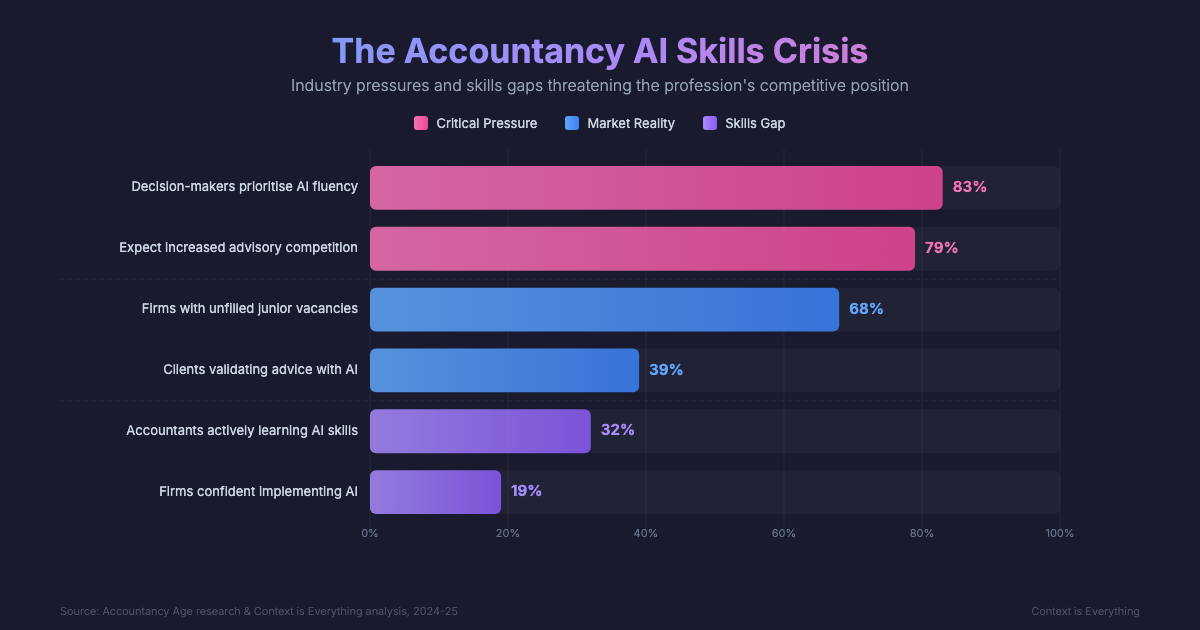
The firms at risk aren't the ones refusing to use AI. They're the ones stuck in this uncomfortable middle ground: acknowledging AI matters whilst lacking confidence to actually implement it. Meanwhile, clients aren't waiting. 39% are already using AI to validate advice, and that number is growing.
The opportunity for firms that move first
When firms get ahead of their clients on AI, several things change:
Advice becomes more defensible. When a client says "AI told me to do X," the firm can explain why that generic advice doesn't account for their specific circumstances - because they've already tested it against AI themselves and know where the gaps are.
Capacity increases without hiring. This matters particularly given that 68% of firms report unfilled vacancies for junior roles, according to Accountancy Age research. AI handles the routine analysis, freeing qualified staff to focus on the interpretation and strategic guidance that clients actually value.
Positioning shifts from reactive to proactive. Instead of responding to client questions about AI, firms show them how AI-enhanced analysis reveals insights they hadn't considered.
What this looks like in practice
The accountants succeeding with this shift aren't replacing their expertise with AI. They're augmenting it. They're using AI to analyse patterns across client portfolios faster than manual review allows. They're testing strategic recommendations against AI-generated scenarios. They're surfacing insights that would take weeks to identify manually.
Most importantly, they're having different conversations with clients. Not "here's what the numbers show" but "here's what the numbers show, here's what AI analysis suggests, and here's why we recommend something different based on what we know about your specific situation."
That's the conversation clients are looking for. It demonstrates understanding of the tools they're using whilst bringing the contextual expertise those tools can't replicate.
The skills gap that needs closing
Here's the challenge: 83% of senior decision-makers now say AI fluency and working effectively with AI tools are more important than traditional technical expertise, according to research published in Accountancy Age. Yet only 32% of accountants say they're learning AI skills.
The profession is experiencing a fundamental redefinition of what "expertise" means. Technical accounting knowledge is becoming table stakes - the differentiator is now the ability to work effectively with AI. Firms that don't upskill their people will find themselves outcompeted by those who do. If you're unsure whether AI is right for your firm, here are 5 signs you're ready.
Moving faster than clients
The window for this advantage is narrow. Right now, most clients are experimenting with AI but aren't sophisticated users. They're getting generic advice and haven't yet learned to prompt effectively for their specific circumstances. That gives firms time to get ahead - but not much.
The firms that position themselves as AI-enhanced advisors now will own that space. The ones that wait until clients demand it will be scrambling to catch up whilst losing advisory relationships to competitors who moved first.
---
AI Training for Accountancy Firms
We've created an AI training programme specifically for accountancy professionals - practical skills, not theoretical possibilities.
What firms learn:
If you're not sure where your practice stands, the AI readiness calculator gives you a score across 5 dimensions in 5 minutes.
Format: Half-day workshops delivered in-person or remotely, tailored to your firm's specific client base and service mix.
Who it's for: Partners, senior accountants, and advisory teams at mid-tier firms who want to get ahead of this shift rather than react to it.
Contact: hello@context-is-everything.com
Related Articles
Why Most AI Projects Fail (And What the 5% Do Differently)
MIT's Project NANDA found 95% of enterprise AI pilots deliver zero return. Companies have invested £30-40 billion with nothing to show. But 5% achieve rapid revenue acceleration. The difference isn't the technology - it's implementation and context.
8 AI Mistakes Costing UK Small Businesses £50K+ (And How to Avoid Them)
AI spending is up six-fold, yet UK small business adoption crashed from 42% to 28%. Discover the 8 expensive mistakes costing £5K-£50K+ each to fix—and learn how businesses getting it right avoided these patterns.
5 Signs Your Business Actually Needs AI (And 5 Signs It Doesn't)
Most businesses don't need AI right now. Here are 5 signs you genuinely need it—and 5 signs you definitely don't. The honest assessment most consultants won't give you.