
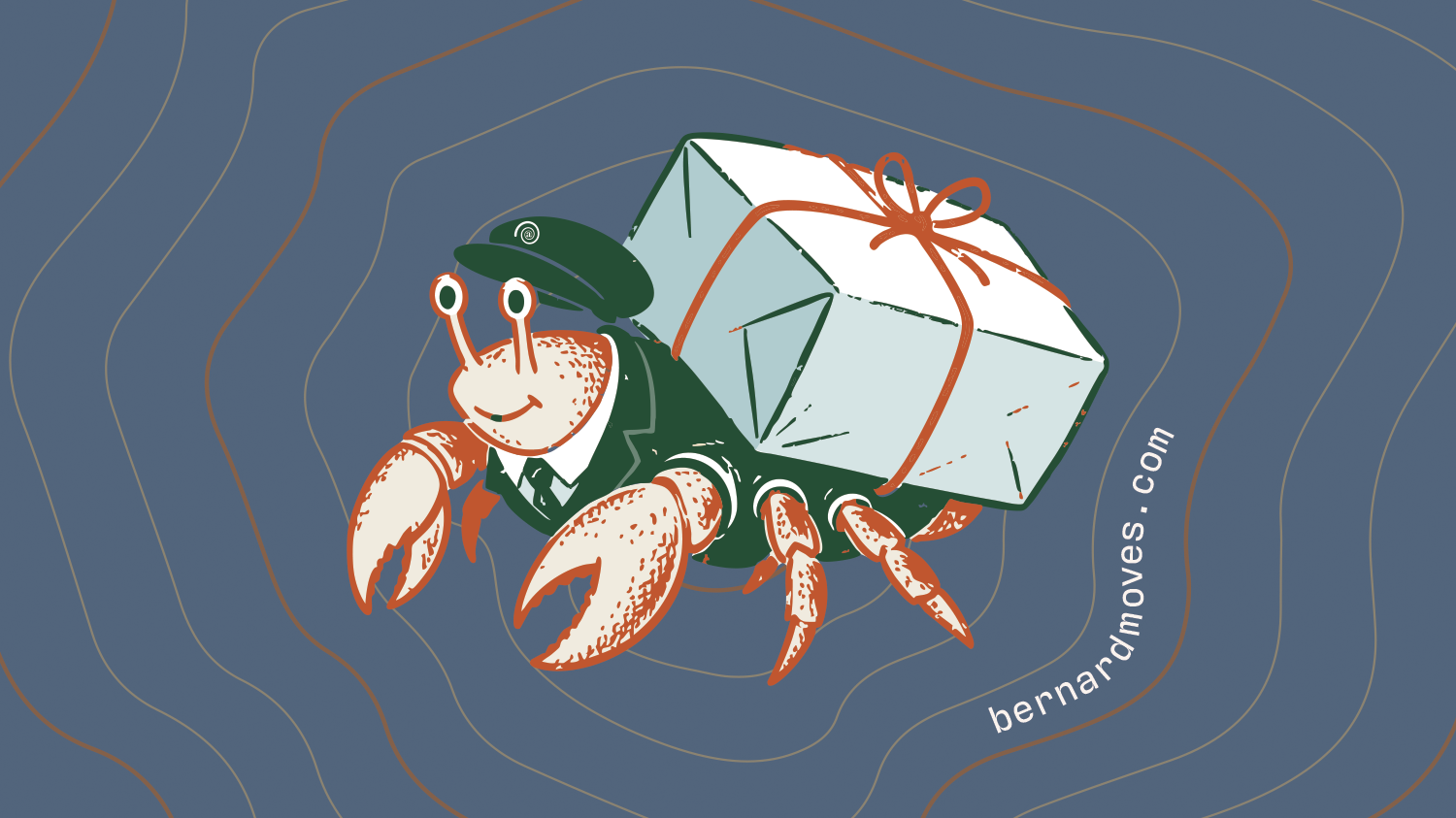
A hermit crab cannot make a shell. That is the whole of its problem. It grows, steadily, inside something it did not build and cannot extend, until the thing that was protecting it becomes the thing squeezing it.
So it goes looking… and when a hermit crab finds an empty shell that is slightly too big, it does not move in. It waits. Others turn up, they then sort themselves into a queue by size, largest at the front, and hold. When the biggest one finally moves, the crab behind it takes the shell just vacated, and the one behind takes that one, and so on down the line until the smallest crab has moved too. One empty shell rehouses the whole queue. Marine biologists call it a vacancy chain.
I have not sent a newsletter since May. This is roughly what I have been obsessing about since.
Two people with almost no useful skills in common
Lindsay and I have been friends for a long time. Professionally we overlap almost nowhere. He builds technology systems and frameworks. I have spent twenty-five years walking into industries I didn’t understand and working out what makes them tick.
Our Venn diagram is pretty much coffee, beer and trust.
What we discovered is that the work each of us finds tedious is the work the other one enjoys. The recurring exchange, when one of us describes something that looks like a hard thing, is four words long: “This is what I do!”
That’s obviously not a company, but it turns out to be a very good reason to start one, and genuinely, this is turning out to be one of the best things that has ever happened to either of us professionally.
Back to the thing I have been banging on about all along…
The first edition of this newsletter was about Margaret, and the argument was that AI fails in businesses not because the technology is weak but because AI has no idea who Margaret is. That became SASHA, the Contour Methodology, and most of what I have written here since.
Then I noticed the same argument at the other end of the scale, via a mate who is an abstract landscape painter (I know right).
A small business does not have a Margaret. The owner is Margaret. All the context is in one head. Why the work is priced that way, which customers need more time, what the business is actually for. And the website, the one public thing that is supposed to explain the business to everybody else, doesn’t really, say or express any of that.
It has a homepage written in a hurry in 2019, a plugin nobody dares update, and a login for a developer who has stopped helping.
How this actually happened, in order
The University of Westminster brought me in as a consultant to improve their visibility to prospective Fashion students. Several months of Search Console and Analytics, working out what people were genuinely searching for, and shaping the content around the answer instead of around the marketing plan.
And this is where my painter friend whose work I have admired for years, comes in. He was frustrated his business was more about marketing tech-stacks than art. Squarespace for the site; Podia for the courses; MailerLite for the list; Zapier holding hands with all of it, and then me, in the middle, hot-gluing it all.
So I accidentally built an AI marketing stack for an artist. It worked. It was also held together with string, and every piece of it charged him rent - and even though it was making him money, we knew these costs would inevitably go up.
At the same time, but separately, Lindsay was watching the same problem from the other side. Tracey is a fashion illustrator. She has the kind of Instagram audience most brands would pay handsomely for, and a Squarespace site she could not make do what she wanted, could not easily improve, and could not sell from without paying a toll to every platform.
Two of us, independently, wiring a multitude of single-use tools around a business. Neither of us stopped to ask the obvious question: Why is the website not the place all of this lives?
So we built one for Tracey. Something she could actually run. That was easy, and she could use plain language to describe what she wants.
We got excited and our friends wanted to know more. Education. Energy. Writing. Creative work. Businesses with nothing in common at all, which was the clue we nearly missed. The problem was never the sector. It was the same structural loss of control, arriving from different directions.
We were solving the wrong problem
For a while I thought the pitch was cheaper, faster, easier to run. It is actually all three. The sites get lighter and quicker, which is worth having on its own. But few people move their website because it loads a bit quicker or has better sustainability credentials.
People seem to move for a different reason, and they say it in almost the same words every time: They’re worried that nobody can find them any more. Not, our bounce rate is up (who says that - other than marketeers). It’s actually something closer to dread. The internet changed shape around them, discovery moved into places they cannot see, and their site is a shell built for an internet that just isn’t the same.
Which is a much harder problem, and the only one worth solving.
Be boring not wrong
A faster, cleaner, better structured site that explains a business properly ought to be easier for people and machines alike to understand. We think that is true. We’ve seen signals worth taking seriously. We cannot prove it… yet.
I have written nine editions of this newsletter about markets where nobody can tell good from bad, about the cost of refuting confident nonsense, about vendors who sound certain because certainty sells. No-one wants to be that guy.
So we are measuring it instead. Openly, over repeated two to three month cycles, with the method published before the results, baselines defined, our commercial interest stated plainly, and the findings that do not support us published alongside the ones that do.
The honest answer to the question “does this improve how AI sees you?”, is currently, we’re finding out. We’d both rather earn it than boast before time.
The shell
Bernard is named after Pagurus bernhardus, the common hermit crab. It’s not decoration. It is a fairly literal description of the product. An existing website moves into a better fitting home, and the business does not have to abandon everything it has built to do it.
And a crab does not move because the new shell is nicer. It moves because it has outgrown the old one, and staying put would eventually kill it.
The queue is the part I did not expect. Every business we have moved has taught us something that made the move better for the next one. The site we moved last week was easier to move because of every one that went before it, and the next one will be easier still. That’s our version of the vacancy chain. We didn’t design that. It’s just what happens when you build in the open and stop pretending you had it all worked out at the start.
Like I said we didn’t mean to start a website company, an email marketing service, an ASEO content creation tool, an online courses machine and an e-commerce platform…
I am really glad we did.
The Contour · Newsletter
Want this in your inbox?
The Contour goes out roughly every ten days. Published here first, then on LinkedIn and Substack.