
The Sat Nav Problem: When Every Business Gets the Same 'Smart' Route
When every business gets the same AI recommendations, the advantage disappears. Why hiring freezes signal commoditization, and why context still wins.
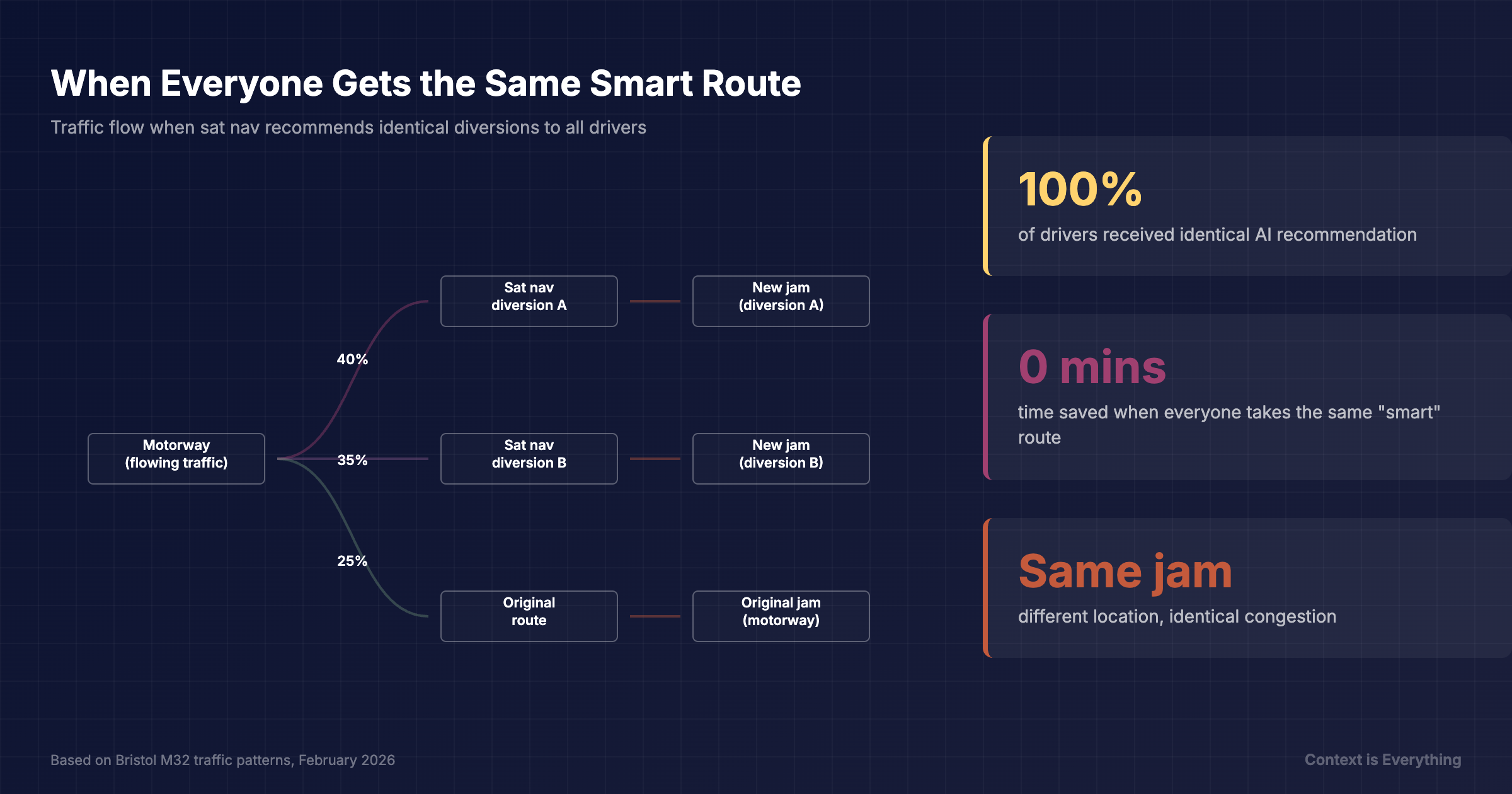
Last weekend, driving into Bristol, Google Maps flagged that the motorway ahead was reducing to two lanes. It told everyone else too. Within minutes, a queue of cars filed obediently off the same exit, down the same single-lane alternative. Every driver following the same intelligent recommendation, all arriving at the same new traffic jam.
The information was perfect. The lanes really were merging. But when every driver gets the same perfect information at the same time, the advantage disappears the moment you act on it. You haven't outsmarted the traffic. You've just moved it.
This is what's starting to happen with AI in business.
When Smart Recommendations Become Standard Issue
When a company buys the latest AI model and asks it to analyse their market, optimise their pricing, or draft their strategy, the output is genuinely good. The analysis is sound. The recommendations are sensible. The problem is that their three nearest competitors licensed the same platform, fed it similar data, and got back essentially the same sensible recommendations.
When three consulting firms in the same city all use ChatGPT to draft market entry strategies for clients in the same sector, they get variations on the same framework. Different words. Same thinking. Same competitive position.
Everyone followed the same smart route. Everyone ended up in the same place.
The Hiring Freeze That Signals Commoditization
In December 2024, Klarna's CEO announced the company had instituted a hiring freeze, aiming to reduce headcount from 4,500 to 2,000 by letting AI replace workers. The narrative was efficiency and innovation. What it actually signals is commoditization. If AI can do your company's work, it can do your competitor's too.
The CEOs making these announcements aren't building competitive advantage. They're dismantling it. They're replacing the thing that makes them distinctive (people who understand their specific context) with the same platforms their competitors are licensing.
When every company in a sector does this, they converge. Same capabilities. Same outputs. Same blind spots. The only thing left to compete on is price. And price competition without differentiation is a race to the bottom. That's not a technology problem. It's an economics problem, and it's as old as commodity markets.
The Local Who Knows the Back Roads
Meanwhile, the local who knows the back roads still gets there first.
Every organisation has them. The senior partner who knows which clause will kill a deal because she's seen that client panic before. The operations manager who spots the anomaly in the data because he's been reading those reports for fifteen years. The person everyone calls when something doesn't feel right, even when the numbers say it should.
These people aren't performing tasks that can be automated. They're carrying context that can't be downloaded. The pattern recognition that stops you making the expensive mistake the data says you should make.
The smart play isn't replacing them with AI. It's giving them AI that amplifies what they already know, that turns fifteen years of pattern recognition into something the whole organisation can access.
What Works When Everyone's Got Smart
The sat nav is useful. Nobody's arguing otherwise. But on Saturday, it got dozens of us to the same back road at the same time, and none of us arrived any faster. Funny how 'smart' works when everyone's got it.
The advantage doesn't come from having the tool. It comes from knowing when to ignore it. Assess whether your organisation is ready to use AI for competitive advantage rather than just efficiency.
Also from The Contour
The personal-voice version of these ideas, from Spencer Thursfield's newsletter.

Related Articles
The Hard Part Isn't the AI
How we built an agentic workflow that turns months of manual analysis into auditable, presentation-ready reports — and why understanding the domain was harder than building the AI.
The Irreplaceable Expert: Why AI Without Human Oversight Fails in High-Stakes Consulting
As AI gets better, you would expect to need less human oversight. The opposite is true. When AI is 95% correct, the 5% that is wrong is camouflaged by the quality of everything around it. The oversight paradox in high-stakes professional services.