
Our Team

  • Lindsay Smith, CTO - Enterprise software veteran, 20+ years FinTech, former CTO at Telrock
  • Robbie MacIntosh, Operations Director - Crisis management and operational transformation specialist
  • Spencer Thursfield, Chief Marketing Officer - Brand development, commercial strategy, and cross-sector pattern recognition

Proven Results

  • 150% conversion increase: same leads, seven figures in new annual revenue
  • 95% faster processing: 3 hours of senior time reduced to 9 minutes
  • £200K+ hidden costs uncovered in a single 48-hour engagement
  • £15M procurement decision delivered in 48 hours from 1,200 pages
  • Live with paying clients since October 2024
Why Your B2B Buyers Don't Visit Your Website Anymore (And Why That's Actually Good News) - Thought leadership article by Context is Everything on AI implementation

Why Your B2B Buyers Don't Visit Your Website Anymore (And Why That's Actually Good News)

·5 min read·650 words
B2B MarketingAI SearchBuyer BehaviourForrester Research

B2B buyers have adopted AI search at 3x the rate of consumers and now trust it more than vendor websites. But the surprising data shows AI-referred visitors spend 300% more time on site and convert at higher rates. Declining traffic might be the best thing that's happened to your marketing.

Your content team publishes a comprehensive buyer's guide. Your SEO is solid. Your messaging is sharp. And traffic keeps declining.

Meanwhile, a competitor with objectively worse content keeps showing up in prospect conversations you never knew were happening.

What changed? Your buyers stopped Googling. They started asking ChatGPT, Claude, and Perplexity. And according to Forrester's latest research, B2B buyers have adopted AI-powered search at three times the rate of consumers [Forrester, 2026]. Nearly every business buyer now uses AI in their buying process — and they find it more valuable than your website, your product experts, or any other information source [Forrester, 2026].

But here's the part most people miss: this might be the best thing that's happened to B2B marketing in years.

Where are B2B buyers going instead of vendor websites?

This isn't early-adopter behaviour. Forrester's Buyers' Journey Survey shows AI search is now the top information source for buyers discovering new solutions. And it doesn't stop at discovery — AI permeates the entire buying cycle.

Fifty-seven percent of buyers use AI to gather best practices. Fifty-five percent use it to compare product strengths and weaknesses. Forty-nine percent use it to create shortlists of potential providers. Even at the commitment stage, 47% are using AI to build business cases and generate contract terms [Forrester, 2026].

AI isn't replacing one channel. It's becoming the operating system for B2B buying.
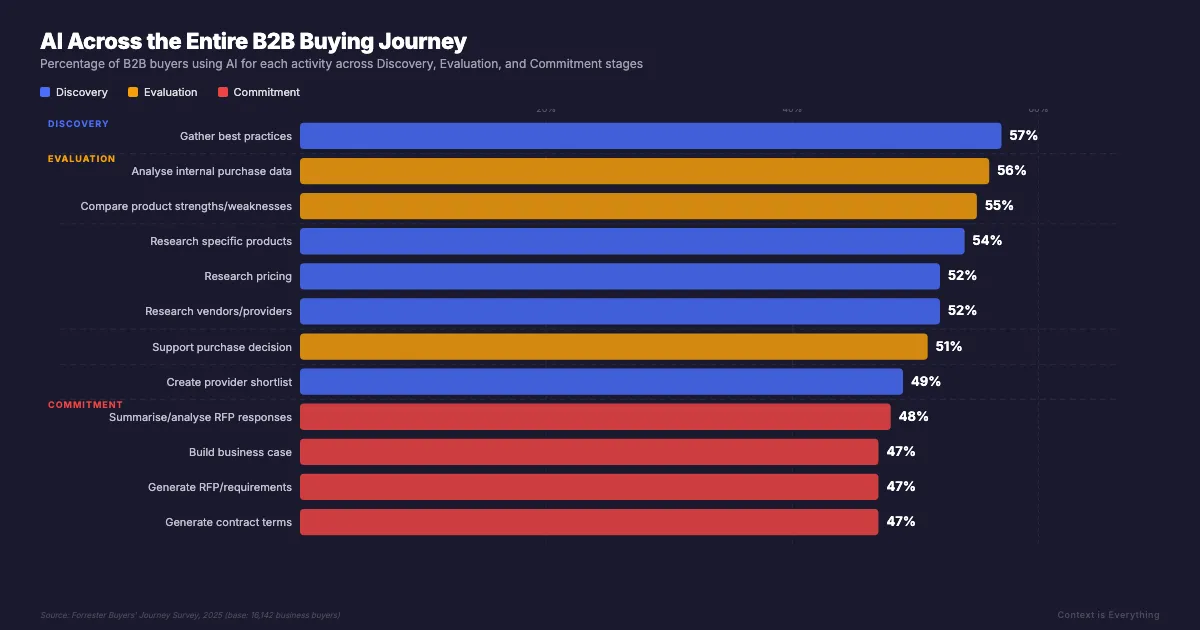
AI usage across the entire B2B buying journey — Discovery, Evaluation, and Commitment stages

Percentage of B2B buyers using AI for each buying activity. Source: Forrester Buyers' Journey Survey, 2025.

The psychology behind it is straightforward. Natural language queries in AI search average 15–23 words versus 3–4 for keyword searches [Forrester, 2026]. Buyers get synthesised answers from multiple sources instantly, without filling out forms or fielding sales calls. They're not choosing AI because they distrust vendors. They're choosing it because it gives them control over their research without commitment.

The Quality Paradox

Here's where declining traffic becomes good news.

When buyers using AI search do click through to a website, they're dramatically more engaged. One CMO at a security company reported that visitors referred by ChatGPT spend 300% more time on his website than those from Google organic search [Forrester, 2026]. Outside findings suggest AI-referred visitors convert at higher rates too.

Think about what a 15-word query means. That's not a casual browser. That's someone who knows enough to ask a sophisticated question. When they reach your site, they're further along in their journey and more qualified than traditional organic traffic ever was.

You're losing volume. You're gaining quality.
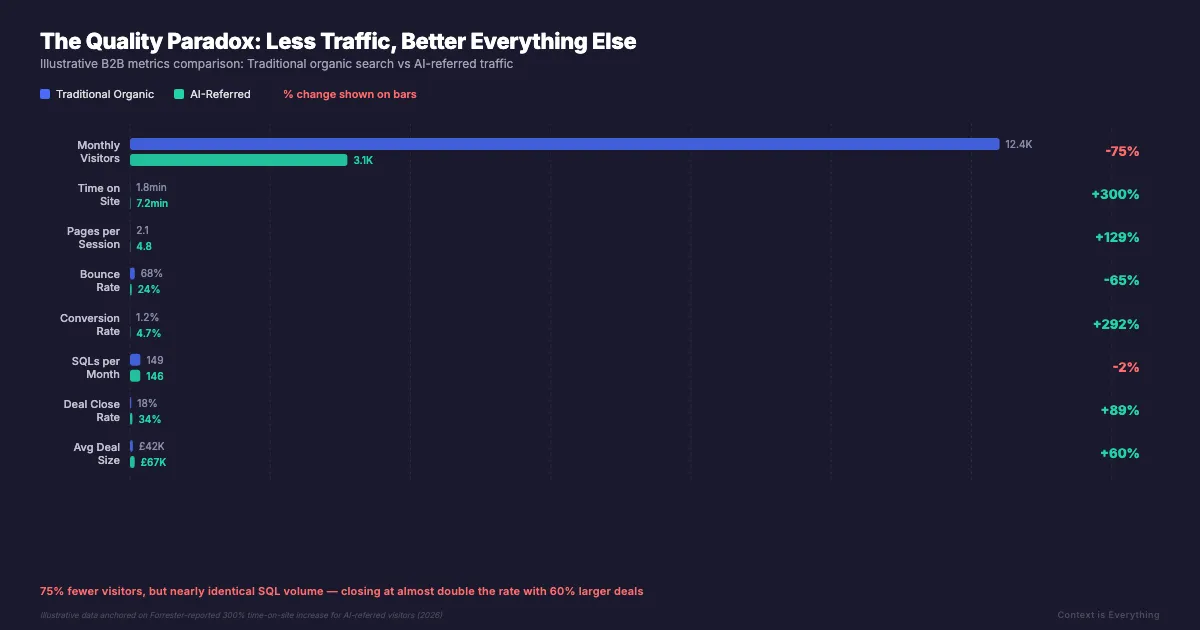
The Quality Paradox — less traffic but better engagement, conversion, and deal metrics

Illustrative comparison of traditional organic vs AI-referred traffic metrics, anchored on Forrester-reported 300% time-on-site increase.

How should B2B companies adapt to AI-first buyers?

This is part of why private data and original research form one of the two structural AI competitive moats — AI search amplifies proprietary insight that generic content cannot replicate.

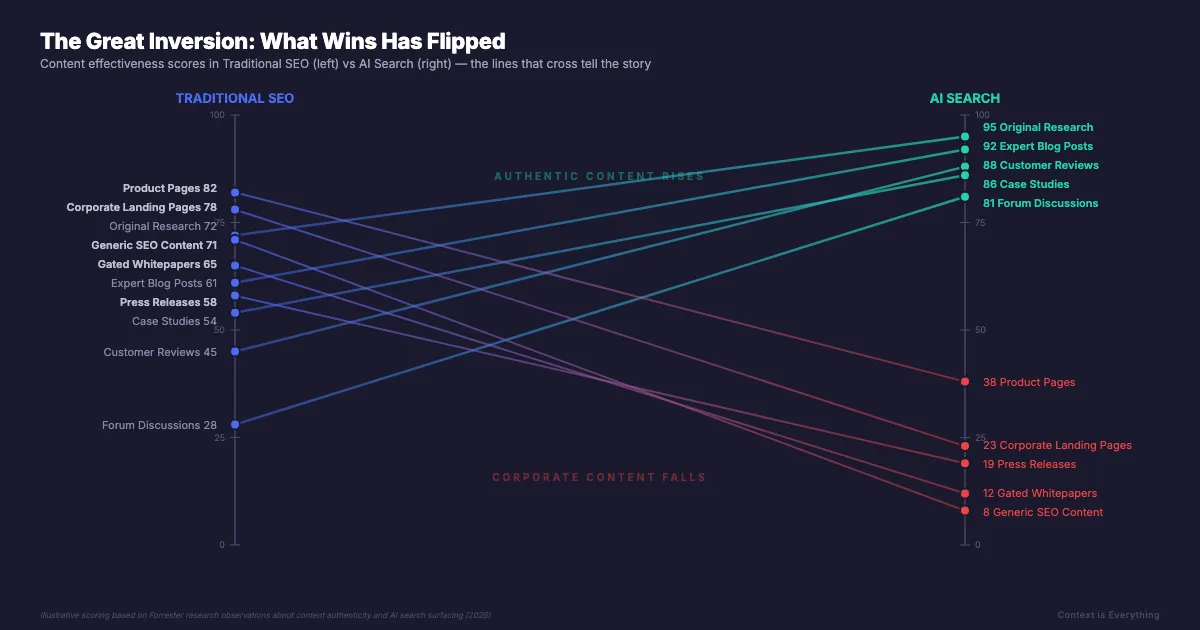
AI search favours content with an authentic voice — blog posts, reviews, user-generated content [Forrester, 2026]. Corporate-speak and marketing jargon actively hurt your discoverability. For the first time in years, authenticity is a competitive advantage, not a liability.

The mindset shift required is real:

  • Traffic volume becomes engagement quality
  • First touch becomes last touch that matters
  • Keyword rankings become answer engine citations
  • Controlling the message becomes earning the citation
  • Gating content becomes demonstrating expertise
  • Thin, high-level content won't cut it. AI search rewards richness, credibility, and depth — original research, data, and insights corroborated by human voices [Forrester, 2026]. Your content needs to answer the sophisticated questions buyers are actually asking, not the three-word keywords you've been optimising for. The tests an answer engine actually applies are fewer than most content strategies assume: our open manual on AI discoverability sets them out as eight things that make a page citable, in the order they fail.

    And it's not just about your website. Answer engines rely heavily on content that isn't on your own site — forums like Reddit, review aggregators, guest articles, industry events [Forrester, 2026]. Building authority beyond your website creates what Forrester calls a "surround-sound effect" that enhances your brand's credibility wherever AI search looks.

    The Window Is Open

    Most B2B marketers haven't adapted yet. AI search behaviour is mainstream but content strategies still aren't built for it. That gap is an opportunity.

    The organisations that audit their content through an AI lens, test their visibility in answer engines, and shift their strategy toward depth and authenticity will own their categories. The ones still optimising for the old playbook will keep wondering why nothing works.

    The question isn't whether AI search is the future of B2B buying. That's already settled. The question is: will your brand be visible when buyers ask? Assess your AI search visibility now before competitors do.

    ---

    Data and analysis referenced from Forrester Research, "How To Stand Out In A Zero-Click World: Master AEO, Build Influence, And Earn Trust" (2026). Statistics sourced from Forrester's Buyers' Journey Survey, 2025 (base: 16,142 business buyers).

    Related Articles

    What happens next?

    Talk to us. We'll tell you honestly whether AI makes sense for your situation.

    If it does, we'd love to work with you. If it doesn't, we'll tell you that too.

    Start a Conversation
    Skip to main content

    Our Team

    • Lindsay Smith, CTO - Enterprise software veteran, 20+ years FinTech, former CTO at Telrock
    • Robbie MacIntosh, Operations Director - Crisis management and operational transformation specialist
    • Spencer Thursfield, Chief Marketing Officer - Brand development, commercial strategy, and cross-sector pattern recognition

    Proven Results

    • 150% conversion increase: same leads, seven figures in new annual revenue
    • 95% faster processing: 3 hours of senior time reduced to 9 minutes
    • £200K+ hidden costs uncovered in a single 48-hour engagement
    • £15M procurement decision delivered in 48 hours from 1,200 pages
    • Live with paying clients since October 2024
    Why Your B2B Buyers Don't Visit Your Website Anymore (And Why That's Actually Good News) - Thought leadership article by Context is Everything on AI implementation

    Why Your B2B Buyers Don't Visit Your Website Anymore (And Why That's Actually Good News)

    ·5 min read·650 words
    B2B MarketingAI SearchBuyer BehaviourForrester Research

    B2B buyers have adopted AI search at 3x the rate of consumers and now trust it more than vendor websites. But the surprising data shows AI-referred visitors spend 300% more time on site and convert at higher rates. Declining traffic might be the best thing that's happened to your marketing.

    Your content team publishes a comprehensive buyer's guide. Your SEO is solid. Your messaging is sharp. And traffic keeps declining.

    Meanwhile, a competitor with objectively worse content keeps showing up in prospect conversations you never knew were happening.

    What changed? Your buyers stopped Googling. They started asking ChatGPT, Claude, and Perplexity. And according to Forrester's latest research, B2B buyers have adopted AI-powered search at three times the rate of consumers [Forrester, 2026]. Nearly every business buyer now uses AI in their buying process — and they find it more valuable than your website, your product experts, or any other information source [Forrester, 2026].

    But here's the part most people miss: this might be the best thing that's happened to B2B marketing in years.

    Where are B2B buyers going instead of vendor websites?

    This isn't early-adopter behaviour. Forrester's Buyers' Journey Survey shows AI search is now the top information source for buyers discovering new solutions. And it doesn't stop at discovery — AI permeates the entire buying cycle.

    Fifty-seven percent of buyers use AI to gather best practices. Fifty-five percent use it to compare product strengths and weaknesses. Forty-nine percent use it to create shortlists of potential providers. Even at the commitment stage, 47% are using AI to build business cases and generate contract terms [Forrester, 2026].

    AI isn't replacing one channel. It's becoming the operating system for B2B buying.

    AI usage across the entire B2B buying journey — Discovery, Evaluation, and Commitment stages

    Percentage of B2B buyers using AI for each buying activity. Source: Forrester Buyers' Journey Survey, 2025.

    The psychology behind it is straightforward. Natural language queries in AI search average 15–23 words versus 3–4 for keyword searches [Forrester, 2026]. Buyers get synthesised answers from multiple sources instantly, without filling out forms or fielding sales calls. They're not choosing AI because they distrust vendors. They're choosing it because it gives them control over their research without commitment.

    The Quality Paradox

    Here's where declining traffic becomes good news.

    When buyers using AI search do click through to a website, they're dramatically more engaged. One CMO at a security company reported that visitors referred by ChatGPT spend 300% more time on his website than those from Google organic search [Forrester, 2026]. Outside findings suggest AI-referred visitors convert at higher rates too.

    Think about what a 15-word query means. That's not a casual browser. That's someone who knows enough to ask a sophisticated question. When they reach your site, they're further along in their journey and more qualified than traditional organic traffic ever was.

    You're losing volume. You're gaining quality.

    The Quality Paradox — less traffic but better engagement, conversion, and deal metrics

    Illustrative comparison of traditional organic vs AI-referred traffic metrics, anchored on Forrester-reported 300% time-on-site increase.

    How should B2B companies adapt to AI-first buyers?

    This is part of why private data and original research form one of the two structural AI competitive moats — AI search amplifies proprietary insight that generic content cannot replicate.

    AI search favours content with an authentic voice — blog posts, reviews, user-generated content [Forrester, 2026]. Corporate-speak and marketing jargon actively hurt your discoverability. For the first time in years, authenticity is a competitive advantage, not a liability.

    The mindset shift required is real:

  • Traffic volume becomes engagement quality
  • First touch becomes last touch that matters
  • Keyword rankings become answer engine citations
  • Controlling the message becomes earning the citation
  • Gating content becomes demonstrating expertise
  • Thin, high-level content won't cut it. AI search rewards richness, credibility, and depth — original research, data, and insights corroborated by human voices [Forrester, 2026]. Your content needs to answer the sophisticated questions buyers are actually asking, not the three-word keywords you've been optimising for. The tests an answer engine actually applies are fewer than most content strategies assume: our open manual on AI discoverability sets them out as eight things that make a page citable, in the order they fail.

    And it's not just about your website. Answer engines rely heavily on content that isn't on your own site — forums like Reddit, review aggregators, guest articles, industry events [Forrester, 2026]. Building authority beyond your website creates what Forrester calls a "surround-sound effect" that enhances your brand's credibility wherever AI search looks.

    The Window Is Open

    Most B2B marketers haven't adapted yet. AI search behaviour is mainstream but content strategies still aren't built for it. That gap is an opportunity.

    The organisations that audit their content through an AI lens, test their visibility in answer engines, and shift their strategy toward depth and authenticity will own their categories. The ones still optimising for the old playbook will keep wondering why nothing works.

    The question isn't whether AI search is the future of B2B buying. That's already settled. The question is: will your brand be visible when buyers ask? Assess your AI search visibility now before competitors do.

    ---

    Data and analysis referenced from Forrester Research, "How To Stand Out In A Zero-Click World: Master AEO, Build Influence, And Earn Trust" (2026). Statistics sourced from Forrester's Buyers' Journey Survey, 2025 (base: 16,142 business buyers).

    Related Articles

    What happens next?

    Talk to us. We'll tell you honestly whether AI makes sense for your situation.

    If it does, we'd love to work with you. If it doesn't, we'll tell you that too.

    Start a Conversation
    made with bernard

    Cookie settings