
Your Expert Has a Name. Does Your Website?
A reader should be able to discover who is making an argument and what experience supports it. A byline begins that work.
"Our experts believe" leaves a reader with some reasonable questions. Which experts? What have they worked on? What part of the subject do they know well enough to advise on?
An organisation may have excellent answers internally. A colleague knows who has dealt with the difficult cases, who understands the exceptions and whose judgement is worth seeking. A person arriving at its website does not share that context.
Making some of it available is a worthwhile editorial task. It requires more than placing a name beneath a headline.
Let the reader inspect the expertise
A useful author profile explains why this person is relevant to this subject. A job title helps, but specific experience gives it meaning.
Take an article on procurement, as an illustration. "Written by our experienced team" gives the reader little to examine. A named practitioner explaining the kinds of procurement decisions they work on, linking to an attributable piece of work and stating the limits of the article offers a firmer basis for judgement.
None of that requires revealing a client's confidential information. A description of the work can stay general where necessary. If a result cannot be disclosed, it should not acquire an invented number to make the profile more persuasive.
The article itself must also carry the expertise. Relevant distinctions, conditions and examples tell the reader more than a decorative list of credentials. A person can have an impressive career and still be writing outside their field.
The search claim needs its own evidence
There is a separate question about whether author information improves visibility in search or AI answers.
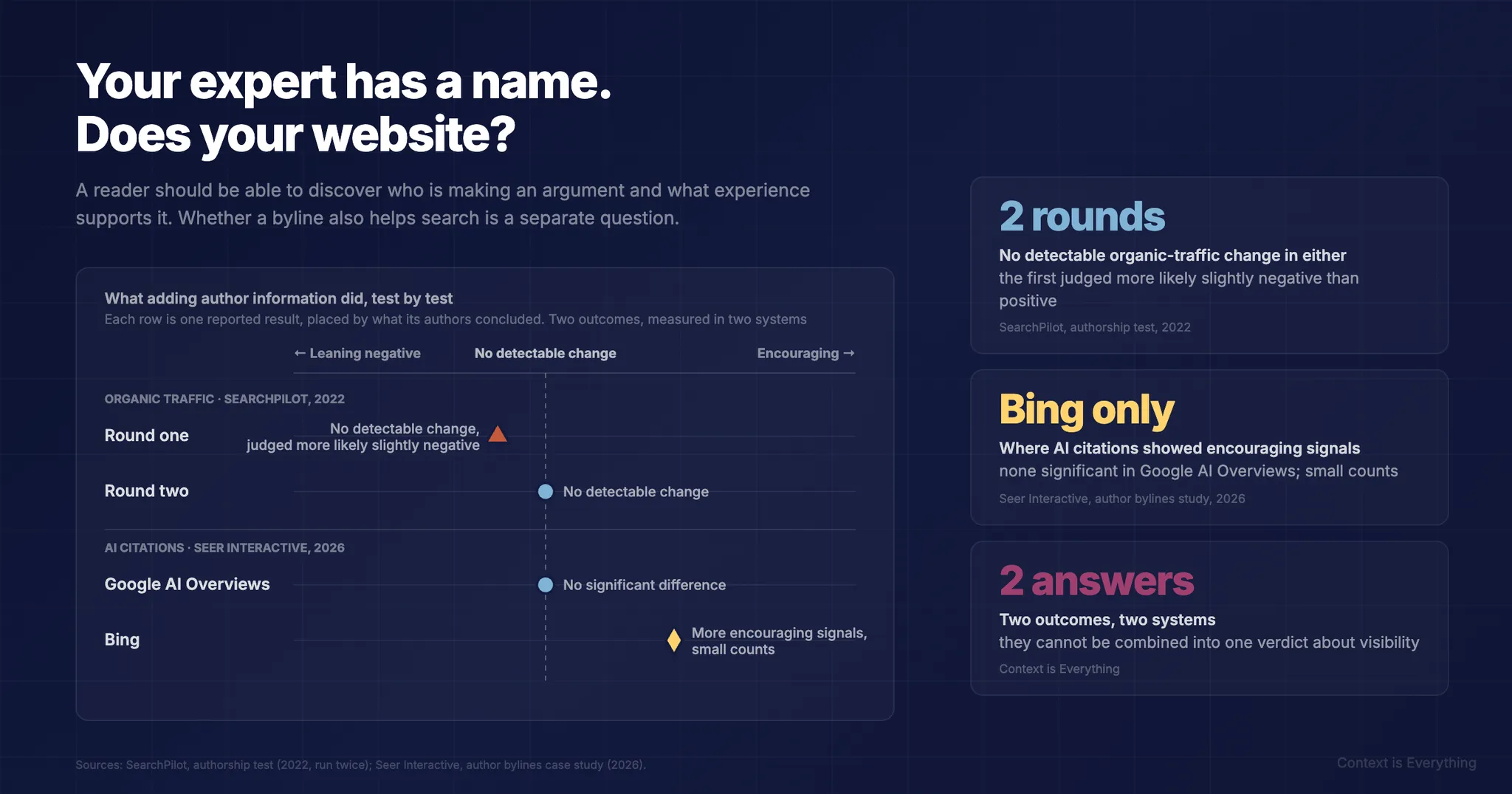
SearchPilot's authorship test, run twice in slightly different forms in 2022, found no detectable organic-traffic change in either round, and SearchPilot judged the first round more likely slightly negative than positive. Four years later, Seer Interactive's byline experiment measured something different, AI citations, and found no statistically significant difference in Google AI Overviews but more encouraging signals in Bing, with the qualifications about small counts that such data needs.
Two outcomes, two systems, two answers. They cannot be combined into a single verdict about "visibility".
The responsible editorial decision is to explain the value of attribution to the reader, and test any additional search claim on its own terms. Promising a ranking improvement is not necessary to justify telling people who wrote the advice.
Make the credit accurate
Authorship can be shared without being obscure. If a practitioner supplied the expertise and a writer shaped the article, credit their respective contributions where useful. If someone reviewed it, specify what they checked. A technical review is different from a copy edit.
This becomes especially relevant when AI helps prepare a draft. A named expert should not appear to have written or approved material they have never seen. The person credited for its substance should read the final version and agree that it represents their judgement.
That review includes the awkward parts: when the advice does not apply, which claims need a source and where the available evidence is insufficient. Removing those details to make the article sound more confident can remove the part that made the expert useful.
Keep a route back to the person
Take an important article and follow its attribution as a new reader would. Can you find the person? Does their profile explain relevant experience? Can you distinguish their own observations from someone else's research? Is there a way to report a mistake?
If the author has left the organisation, preserve accurate historical credit and decide who now maintains the advice. Changing the name to whoever currently owns the page would blur two different responsibilities.
A website cannot reproduce the experience of working alongside an expert. It can give a stranger enough context to assess what that expert is saying. Begin with the name, then show why it belongs there.