
Our Team

  • Lindsay Smith, CTO - Enterprise software veteran, 20+ years FinTech, former CTO at Telrock
  • Robbie MacIntosh, Operations Director - Crisis management and operational transformation specialist
  • Spencer Thursfield, Chief Marketing Officer - Brand development, commercial strategy, and cross-sector pattern recognition

Proven Results

  • 150% conversion increase: same leads, seven figures in new annual revenue
  • 95% faster processing: 3 hours of senior time reduced to 9 minutes
  • £200K+ hidden costs uncovered in a single 48-hour engagement
  • £15M procurement decision delivered in 48 hours from 1,200 pages
  • Live with paying clients since October 2024
The Missing Context Behind the Impressive Percentage - Thought leadership article by Context is Everything on AI implementation

The Missing Context Behind the Impressive Percentage

·4 min read·830 words
SEO EvidenceCase StudiesDecision MakingEvidence

A measured improvement can be real and still tell us surprisingly little about what another business should do. The useful work begins with the conditions behind the number.

A measured improvement can be real and still tell us surprisingly little about what another business should do. The useful work begins with the conditions behind the number.

A website changes. Traffic rises. The case study records the improvement, and a prospective client asks a reasonable question: could we achieve something similar?

To answer it, we need to know what changed, what else was happening and whether the result was unusual. We also need to know what the extra traffic was worth. Those details determine whether the case study offers a useful precedent for the next business.

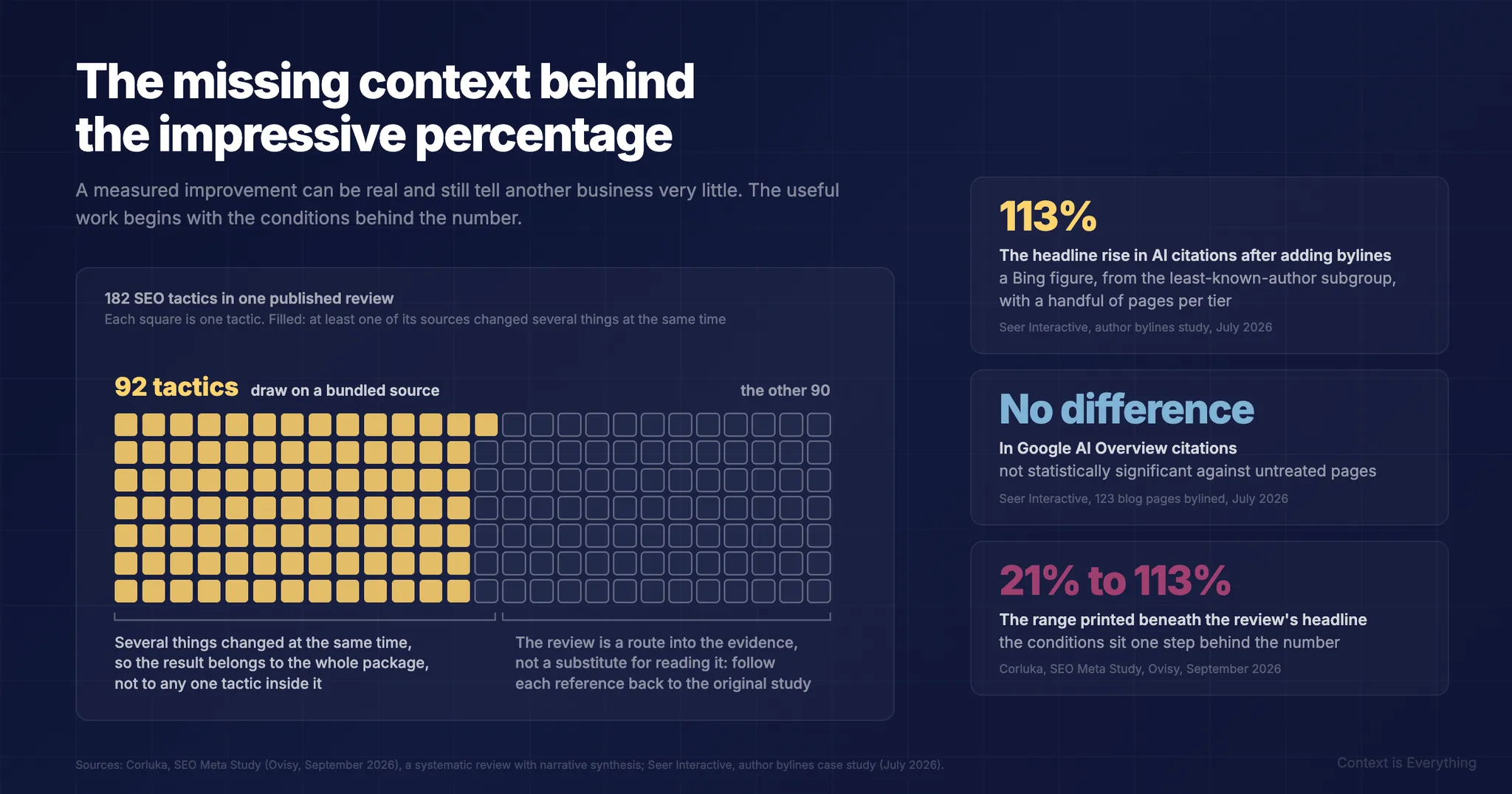
Kresimir Corluka's SEO Meta Study, published by Ovisy in September 2026, makes that problem unusually visible. The review organises published research into 182 tactics. It reports that 92 of those tactics draw on at least one source where several things changed at the same time.

An agency might have rewritten the pages, repaired technical faults and improved the navigation. The client may be entirely satisfied with the result. But the improvement belongs to that package of work. It cannot tell us how much the rewritten pages contributed, or what would happen if another business copied only that part.

That distinction matters when the next decision involves someone's budget.

What improved, exactly?

The review is a useful route into the evidence, rather than a substitute for reading it. It describes itself as a systematic review with narrative synthesis, not a statistical meta-analysis. Language models did the discovery, screening and extraction; a mechanical check then located each printed number in its source text. The author says individual figures were not rechecked by hand.

Following one of its references shows why the original context matters.

The review headlines a 113% increase in AI citations after adding author bylines, although the entry itself prints the range, 21% to 113%, beneath the headline. In Seer Interactive's original study, published in July 2026, bylines were added to 123 blog pages, with untreated pages used for comparison.

The findings depended on the measurement. Seer found no statistically significant difference in Google AI Overview citations against its control group. Bing citation data showed more encouraging signals. Within that Bing data, the 113% increase belonged to the least-known-author subgroup, and Seer cautioned that each tier held only a handful of pages and that a few high-volume pages drove the totals.

This is useful evidence for further investigation. It does not establish that adding a name to an article will double its visibility. Nor does it settle whether author information helps readers judge the advice. Those are different questions.

Once the conditions disappear, a tentative finding begins to sound like an instruction.

The business behind the result

Transferring a finding means comparing the businesses as well as the websites.

Consider a hypothetical consultancy whose service page attracts visitors but rarely produces a relevant enquiry. The page never explains who the service suits, what an engagement includes or when the firm would recommend another approach. Answering those questions could be worthwhile even if the visitor count stayed exactly where it was.

Now consider an online shop with a clear, useful product page that potential buyers cannot find. It has a different problem. The consultancy's remedy would not necessarily address it.

"Improve the content" is too broad a prescription for either business. We need to identify what a prospective customer is missing and how that gap affects a decision. Only then can we judge whether someone else's result gives us a reason to try a particular change.

This is where organisational knowledge becomes practical. The people answering customer questions may know which misunderstanding stalls a sale. The team delivering the work may know which promise creates the wrong expectation. That information helps define what the website needs to explain, and what an improvement should achieve.

A useful result includes its limits

For someone commissioning work, the first question is what the proposed change is expected to accomplish. More appearances in an AI answer, more visits and more qualified enquiries are separate outcomes. A report should keep them separate.

The next question is why the evidence applies here. What was the starting position in the original study? Was there an unchanged comparison group? Did several interventions arrive together? Are the customers, pages and buying decisions sufficiently similar?

Finally, there should be a decision attached to the measurement. What would justify extending the change? What would prompt a revision? What would leave us unable to tell?

Sometimes a business will have too little traffic to distinguish a modest effect from ordinary variation. It can still correct an inaccurate page or answer a neglected question. It should describe the reason honestly, rather than presenting every sensible improvement as a proven growth intervention.

Keeping the conditions attached

At Context is Everything, we build AI systems and the Bernard website platform. We have a commercial interest in businesses investing in this work. That makes the distinction between a plausible improvement and a demonstrated result relevant to our own claims too.

A useful case study should give the next decision-maker enough information to judge where its result might travel. The starting point, the work performed, the measurement and the unresolved questions all belong with the percentage.

Before approving the next proposal, ask for a short account of those conditions. What happened in the original case? What makes our situation comparable? What outcome will we use to decide whether this was worth doing?

The percentage earns attention. The conditions make it useful.

Related Articles

What happens next?

Talk to us. We'll tell you honestly whether AI makes sense for your situation.

If it does, we'd love to work with you. If it doesn't, we'll tell you that too.

Start a Conversation
Skip to main content

Our Team

  • Lindsay Smith, CTO - Enterprise software veteran, 20+ years FinTech, former CTO at Telrock
  • Robbie MacIntosh, Operations Director - Crisis management and operational transformation specialist
  • Spencer Thursfield, Chief Marketing Officer - Brand development, commercial strategy, and cross-sector pattern recognition

Proven Results

  • 150% conversion increase: same leads, seven figures in new annual revenue
  • 95% faster processing: 3 hours of senior time reduced to 9 minutes
  • £200K+ hidden costs uncovered in a single 48-hour engagement
  • £15M procurement decision delivered in 48 hours from 1,200 pages
  • Live with paying clients since October 2024
The Missing Context Behind the Impressive Percentage - Thought leadership article by Context is Everything on AI implementation

The Missing Context Behind the Impressive Percentage

·4 min read·830 words
SEO EvidenceCase StudiesDecision MakingEvidence

A measured improvement can be real and still tell us surprisingly little about what another business should do. The useful work begins with the conditions behind the number.

A measured improvement can be real and still tell us surprisingly little about what another business should do. The useful work begins with the conditions behind the number.

A website changes. Traffic rises. The case study records the improvement, and a prospective client asks a reasonable question: could we achieve something similar?

To answer it, we need to know what changed, what else was happening and whether the result was unusual. We also need to know what the extra traffic was worth. Those details determine whether the case study offers a useful precedent for the next business.

Kresimir Corluka's SEO Meta Study, published by Ovisy in September 2026, makes that problem unusually visible. The review organises published research into 182 tactics. It reports that 92 of those tactics draw on at least one source where several things changed at the same time.

An agency might have rewritten the pages, repaired technical faults and improved the navigation. The client may be entirely satisfied with the result. But the improvement belongs to that package of work. It cannot tell us how much the rewritten pages contributed, or what would happen if another business copied only that part.

That distinction matters when the next decision involves someone's budget.

What improved, exactly?

The review is a useful route into the evidence, rather than a substitute for reading it. It describes itself as a systematic review with narrative synthesis, not a statistical meta-analysis. Language models did the discovery, screening and extraction; a mechanical check then located each printed number in its source text. The author says individual figures were not rechecked by hand.

Following one of its references shows why the original context matters.

The review headlines a 113% increase in AI citations after adding author bylines, although the entry itself prints the range, 21% to 113%, beneath the headline. In Seer Interactive's original study, published in July 2026, bylines were added to 123 blog pages, with untreated pages used for comparison.

The findings depended on the measurement. Seer found no statistically significant difference in Google AI Overview citations against its control group. Bing citation data showed more encouraging signals. Within that Bing data, the 113% increase belonged to the least-known-author subgroup, and Seer cautioned that each tier held only a handful of pages and that a few high-volume pages drove the totals.

This is useful evidence for further investigation. It does not establish that adding a name to an article will double its visibility. Nor does it settle whether author information helps readers judge the advice. Those are different questions.

Once the conditions disappear, a tentative finding begins to sound like an instruction.

The business behind the result

Transferring a finding means comparing the businesses as well as the websites.

Consider a hypothetical consultancy whose service page attracts visitors but rarely produces a relevant enquiry. The page never explains who the service suits, what an engagement includes or when the firm would recommend another approach. Answering those questions could be worthwhile even if the visitor count stayed exactly where it was.

Now consider an online shop with a clear, useful product page that potential buyers cannot find. It has a different problem. The consultancy's remedy would not necessarily address it.

"Improve the content" is too broad a prescription for either business. We need to identify what a prospective customer is missing and how that gap affects a decision. Only then can we judge whether someone else's result gives us a reason to try a particular change.

This is where organisational knowledge becomes practical. The people answering customer questions may know which misunderstanding stalls a sale. The team delivering the work may know which promise creates the wrong expectation. That information helps define what the website needs to explain, and what an improvement should achieve.

A useful result includes its limits

For someone commissioning work, the first question is what the proposed change is expected to accomplish. More appearances in an AI answer, more visits and more qualified enquiries are separate outcomes. A report should keep them separate.

The next question is why the evidence applies here. What was the starting position in the original study? Was there an unchanged comparison group? Did several interventions arrive together? Are the customers, pages and buying decisions sufficiently similar?

Finally, there should be a decision attached to the measurement. What would justify extending the change? What would prompt a revision? What would leave us unable to tell?

Sometimes a business will have too little traffic to distinguish a modest effect from ordinary variation. It can still correct an inaccurate page or answer a neglected question. It should describe the reason honestly, rather than presenting every sensible improvement as a proven growth intervention.

Keeping the conditions attached

At Context is Everything, we build AI systems and the Bernard website platform. We have a commercial interest in businesses investing in this work. That makes the distinction between a plausible improvement and a demonstrated result relevant to our own claims too.

A useful case study should give the next decision-maker enough information to judge where its result might travel. The starting point, the work performed, the measurement and the unresolved questions all belong with the percentage.

Before approving the next proposal, ask for a short account of those conditions. What happened in the original case? What makes our situation comparable? What outcome will we use to decide whether this was worth doing?

The percentage earns attention. The conditions make it useful.

Related Articles

What happens next?

Talk to us. We'll tell you honestly whether AI makes sense for your situation.

If it does, we'd love to work with you. If it doesn't, we'll tell you that too.

Start a Conversation
made with bernard

Cookie settings