
Our Team

  • Lindsay Smith, CTO - Enterprise software veteran, 20+ years FinTech, former CTO at Telrock
  • Robbie MacIntosh, Operations Director - Crisis management and operational transformation specialist
  • Spencer Thursfield, Chief Marketing Officer - Brand development, commercial strategy, and cross-sector pattern recognition

Proven Results

  • 150% conversion increase: same leads, seven figures in new annual revenue
  • 95% faster processing: 3 hours of senior time reduced to 9 minutes
  • £200K+ hidden costs uncovered in a single 48-hour engagement
  • £15M procurement decision delivered in 48 hours from 1,200 pages
  • Live with paying clients since October 2024
How Website Builders Are Really Ranked (And Who Pays for the List) - Thought leadership article by Context is Everything

How Website Builders Are Really Ranked (And Who Pays for the List)

·15 min read·2,880 words
Search VisibilityEvidenceDecision MakingSmall BusinessAI Search

Best website builder lists disagree because they measure different things, and many earn a fee per signup. Here is how four well-known rankings are made, and what none of them measure.

Every “best website builder” list measures something. Before you trust one, find out what it measured, who chose the weights and who gets paid when you click.

Search for the best website builder and you get a list. Try another site and you get a different list. The same few names come up, in a different order with different winners, and the method behind the order is usually one short paragraph you have to hunt for.

Plenty of people read these lists. Google’s own keyword tool estimates that UK searchers type “best website builder for small business” around 880 times a month and “best cms” around 480 times. It puts searches at about 3,600 a month for “best site builder” and its close variants. Most of those people are about to spend money on something they will live with for years.

They disagree because each publisher measures different things, weights them differently and has a different reader in mind. So it pays to know how a list was built before you look at who came top.

There is no single, definitive website builder ranking

We read four well-known sources on 19 October 2026: a large technology publication, a specialist review site, and two software review directories. Each one answers a slightly different question.

TechRadar: hands-on testing, sorted into “best for” categories

TechRadar’s guide, last updated on 16 October 2026, says its experts “tested over 80 web building platforms”. The method section describes building and managing sites “in real-world scenarios”, covering the page editor and the marketing, shop, AI and search tools.

The result is not one league table. It names Wix as best overall, then hands out roles: Hostinger as best value, Shopify for shops, GoDaddy for small businesses, Squarespace for templates, Weebly for its free plan, and so on. That makes sense, because a shop and a physiotherapist need different things.

The problem is what sits around the testing. The page carries the line “When you purchase through links on our site, we may earn an affiliate commission.” When we looked at where the buttons went, the links for Wix, Shopify, Squarespace, BigCommerce and HubSpot all passed through tracking addresses, and the Hostinger links went to an address with “aff” in it. The one pick whose links went straight to the company’s own site was Weebly. The Hostinger entry also offers a TechRadar discount code. None of that proves the order was bought. But TechRadar earns more when you pick some builders than others, and you can’t see how much more.

Website Builder Expert: a weighted scorecard

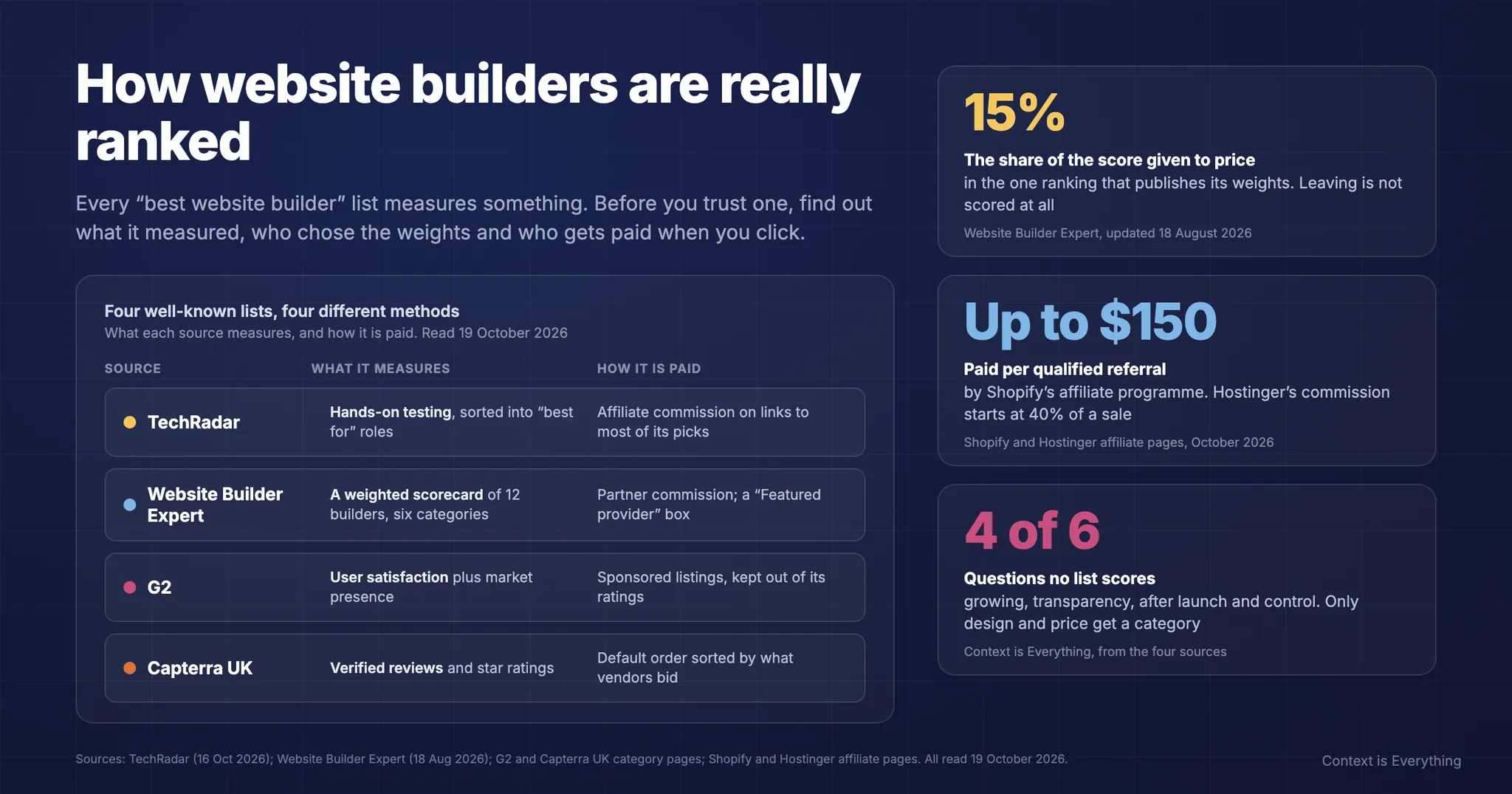
Website Builder Expert, updated on 18 August 2026, publishes its weights, which is more than most do. It says it spent “300+ hours analyzing 12 of the best website builders, across 207 investigation areas”, then scored six categories: website functionality 30%, design features 25%, pricing 15%, user experience 15%, help and support 10%, and reputation 5%. Its top five, in order, were Wix, Squarespace, Hostinger, Shopify and GoDaddy.

A published scorecard lets you check whether its priorities are yours. If you care most about the yearly bill, you can see that price is worth 15 points out of 100. If you care what happens when you want to leave, you will not find it as a category at all, even though the same page warns that switching builders usually means you will “need to start from scratch again”.

The page says commissions do “not impact our ratings”. It also places a “Featured provider” box for Hostinger above the list, while the scorecard ranks Hostinger third, and one of its Hostinger buttons points to a link whose name ends “_cpa”, the industry shorthand for cost per acquisition. Only the 12 builders it chose to analyse can appear in the result.

G2: user reviews and market presence

G2 is a directory built on reviews from users. Its scoring documentation says each product is plotted on “Satisfaction” and “Market Presence”. Satisfaction comes from reviewers’ answers about ease of use, support and so on, weighted for recency and thoroughness. Market Presence uses review counts plus company size and web-traffic estimates from outside data providers. A product needs at least 10 reviews to qualify.

The category page says: “We do not allow paid placements in any of our ratings, rankings, or reports.” That counts in its favour. The trouble is what G2 counts as a website builder. When we read it, the category held 880 listings, and the first two results sorted by G2 Score were Canva and Google Workspace. Both are good products. Neither is what most people mean when they ask which platform should run their business website. A “Sponsored” listing also appeared among the results, which is a separate thing from the scores and is labelled as such.

Because Market Presence rewards size, a large company with many reviews has a head start over a small one with very happy customers.

Capterra: verified reviews, sorted by bids

Capterra UK lists 737 products under website builder software. It says its reviews are checked by human moderators, and it states that “Software and service providers pay us for sponsored profiles”.

Look at the order the page opens in. It is sorted by “Sponsored”, and Capterra’s own explanation of that option reads: “Vendors bid for placement within our listings. This option sorts the directory by those bids, highest to lowest.” Paying vendors get an orange “Visit Website” button. When we read it, the first listing was a floor-plan tool for estate agents with no reviews at all, sitting above WordPress with almost 15,000. You can switch to “Highest Rated”. Use that one.

The four lists at a glance

SourceWhat it measuresHow it is paidBlind spot
TechRadarHands-on testing of 80+ platforms, sorted into “best for” rolesAffiliate commission on links to most of its picksYou cannot see which picks earn it more, or by how much
Website Builder ExpertA published scorecard of 12 builders across six weighted categoriesCommission from partners; a “Featured provider” box above the listPrice is 15% of the score and leaving is not scored at all
G2User satisfaction plus market presence (reviews, company size, web traffic)Sponsored listings, which it says play no part in its ratingsA broad category where Canva and Google Workspace top the list, and size helps
Capterra UKVerified user reviews and star ratingsVendors pay for sponsored profiles and referral feesThe default order is sorted by what vendors bid

Who pays for the list

Most of the big platforms run affiliate programmes, which pay a publisher when a reader it sends goes on to buy. We read each company’s own programme page on 19 October 2026 and print only what they publish.

  • Shopify says affiliates can “Earn up to $150 USD per qualified referral” (about £112 at 75p to the dollar), paid for signups to its Basic, Grow or Advanced plans, with amounts that vary by country.
  • Hostinger says each eligible sale earns a commission that “starts at 40% and grows depending on sales volume”.
  • Squarespace says affiliates “earn payouts for every website or commerce subscription” from a first-time customer, but only tells you the rate once you apply. Its programme page quotes a testimonial from someone at a site called Site Builder Report.
  • Wix invites affiliates to “Collect recurring payouts, month after month” but does not publish a rate on its page.

None of this is secret or wrong. Affiliate money pays for a lot of useful testing, and every source above says it takes it. But a publisher paid per signup has a reason to recommend platforms that sign people up easily and pay well. A platform with a small affiliate programme, or none, has less reason to be written about at all. So the money decides which names get onto the list before anyone scores them.

So who is actually the “best”? It depends entirely on you

Every list has to imagine a reader. TechRadar’s imagines several and gives each a category. Website Builder Expert’s imagines one person whose priorities match its weights. G2 and Capterra imagine the average of everyone who left a review, which includes large companies, agencies and people who are not building a website at all.

Someone who searches “best website builder for small business” is usually none of those. It might be a ceramicist who wants to sell 40 pieces a year, a physiotherapist who needs bookings, or a shop moving off a platform that has got too expensive. Each of them would weight the same scorecard very differently, so a list built for an average buyer won’t fit any of them well.

The cost question nobody ranks

The lists lead with the starting price. TechRadar’s top three box shows Hostinger “Starting at $2.99/mo (intro rate)”, and Website Builder Expert shows the same plan “Starting from $11.99 $2.99/mo”. That price is real, but you only pay it once, at the start.

After that you pay the renewal price, plus the extras that turn out not to be included, plus the time it takes to keep the site running. Our sister publication, The Measure, reads those numbers from each company’s own pricing page. A ranking that scores price at 15% of the total, and usually on the starting figure, tells you little about any of that.

What rankings do not measure

The rankings mostly test what a platform is like to set up. A small business needs to know what it costs, and what it takes, to keep the website useful as the business grows. We would ask six questions. Design gets a share of one scorecard (25% at Website Builder Expert) and price gets 15%. None of the sources we read has a scoring category for the other four.

Cost, after the first year

What will you pay at renewal, with the extras you need, such as email and the tools that keep the site found?

Growing

Can the site take more pages, a shop or a second website without a forced move to a bigger plan? A second website is an easy test, because the rules are printed. Wix’s help pages say each site needs its own Premium or Studio plan. Squarespace says each website is paid for separately and it offers no multi-site plans. Webflow prices every plan per site. SiteGround’s StartUp plan hosts one website, while its GrowBig and GoGeek plans host unlimited websites.

Design freedom

Can you start from a blank page, keep the look you already have, or only pick from templates? A big template gallery is not the same as freedom to start from nothing.

Transparency

Can you see what you are paying and what is changing? Look for a price that does not jump after an introductory offer, limits that are written down, and changes that wait on a draft until you approve them.

After launch

A reviewer tests a platform for a few weeks, but you will run it for years. Someone has to keep the site fast, findable and working. Ask what the platform does once the site is live, and split the answer two ways.

First, does it check, or does it fix? Squarespace’s SEO Report can scan a site for missing image descriptions and page descriptions. That is useful, but someone still has to write them.

Second, is it in the plan, or an extra? On WordPress, search tools usually come from a plugin. Yoast SEO Premium is £118.80 a year before VAT. Wix says its search tools are built into every site, though connecting Google Search Console needs a Premium plan and your own domain.

This is a real difference in how platforms are built. Some are a base you finish with plugins, apps and outside services, each with its own bill, settings and updates. Others build the checking, the fixing and now AI-assisted editing into the platform. A table that ticks “SEO tools” for both cannot show you that.

Part of being found is how machines read the site. We spend our working lives on this. More and more people now get their first answer from an AI assistant or a search engine’s AI summary rather than a list of links. Those systems read the underlying text and structure of a page: whether the words are in the page itself, whether headings make sense, whether the business’s name, services and location are stated plainly. Two sites can look identical to a person and read completely differently to a machine. We have written about why most pages are never found at all in The Ocean of Noise.

The review directories have already spotted this. G2’s category page invites readers to connect G2 to Claude or ChatGPT “for answers grounded in G2’s trusted reviews”. If AI answers are built from these lists, then how the lists are made shapes the answers too.

Control

Who can make changes, who approves them, and can you run several sites from one account? And what can you take with you if you leave? Some platforms let you take your pages, posts and products in a form you can use. Others let you take very little. Website Builder Expert says outright that switching usually means starting again.

Where do we sit?

Context is Everything and Bernard are made by the same people. Bernard is a website platform for small businesses and independents, and we have a commercial interest in people choosing him. That is why this piece doesn’t rank anything.

We built Bernard around the six questions above, so we are not neutral about them. From his own help pages: he builds a new site from nothing or moves an existing one. Each time a site is published he re-checks its links, page titles and descriptions, structured data and Google’s speed test. Measuring is on from the start. Each week he reads the site’s numbers and suggests what to do next, with a button that does it, and he counts the visits AI assistants make to read the site. Every change waits on a draft that the owner approves. A second site is £150 a year on any plan. He has gaps too. Dragging things into a new order is limited, and there is no free-form canvas.

If you want a side-by-side look at the platforms themselves, with prices read from each company’s own page and Bernard’s weak points stated alongside everyone else’s, The Measure does that in The best website builder for a small business. It does not crown a winner either.

How to choose a website builder

Use the lists to make a shortlist. Then do four things.

  1. Read the method before the result. If you cannot find how the list was built, treat the order as opinion. If you can, check whether its weights match what you care about.
  2. Change the sort order. On Capterra, switch from “Sponsored” to “Highest Rated”. On G2, filter to the small-business segment and ignore products that are not website builders.
  3. Ask the questions no list scores. What will this cost at renewal, and for a second site? Who keeps it fast and findable, and is that in the plan or an extra? Can I see and approve changes before they go live? What can I take with me if I leave?
  4. Look at the page the way a machine does. View a few sites built on each platform with the styling stripped away, or ask an AI assistant what it can tell about a business from its site alone. If the words and structure aren’t there, good design won’t add them.

Rankings are a fair place to start. After that, pick the one that suits your business at the price you will pay after the first year.

Frequently asked questions

Are best website builder lists paid for?

Many are partly funded by affiliate commission, which means the publisher earns money when a reader signs up through its link. TechRadar, Website Builder Expert and Capterra all say they may earn a fee. Capterra’s default “Sponsored” order is sorted by what vendors bid. G2 says it does not allow paid placement in its ratings.

How much do website builders pay affiliates?

On their own programme pages, Shopify says up to $150 (about £112) per qualified referral and Hostinger says commission starts at 40% of an eligible sale. Squarespace and Wix run programmes but do not publish their rates on the page.

Which website builder ranking can I trust?

Trust the ones that publish their method, then check whether that method measures what you care about. A published scorecard, such as Website Builder Expert’s six weighted categories, lets you see the priorities behind the order. A review directory is most useful sorted by rating and filtered to businesses like yours.

Why do G2 and Capterra list tools that are not website builders?

Their categories are broad. Any product with a page editor or templates can qualify, so design tools, office suites and booking systems sit alongside Wix and Squarespace. That makes the top of the list less useful for choosing a business website.

What do website builder reviews not tell you?

Mostly what happens after the first few weeks: the renewal price, what a second site costs, whether search tools are in the plan or a paid extra, whether you approve changes before they go live, how easily you can leave, and how well search engines and AI assistants can read the finished site.

Related Articles

What happens next?

Talk to us. We'll tell you honestly whether AI makes sense for your situation.

If it does, we'd love to work with you. If it doesn't, we'll tell you that too.

Start a Conversation
Skip to main content

Our Team

  • Lindsay Smith, CTO - Enterprise software veteran, 20+ years FinTech, former CTO at Telrock
  • Robbie MacIntosh, Operations Director - Crisis management and operational transformation specialist
  • Spencer Thursfield, Chief Marketing Officer - Brand development, commercial strategy, and cross-sector pattern recognition

Proven Results

  • 150% conversion increase: same leads, seven figures in new annual revenue
  • 95% faster processing: 3 hours of senior time reduced to 9 minutes
  • £200K+ hidden costs uncovered in a single 48-hour engagement
  • £15M procurement decision delivered in 48 hours from 1,200 pages
  • Live with paying clients since October 2024
How Website Builders Are Really Ranked (And Who Pays for the List) - Thought leadership article by Context is Everything

How Website Builders Are Really Ranked (And Who Pays for the List)

·15 min read·2,880 words
Search VisibilityEvidenceDecision MakingSmall BusinessAI Search

Best website builder lists disagree because they measure different things, and many earn a fee per signup. Here is how four well-known rankings are made, and what none of them measure.

Every “best website builder” list measures something. Before you trust one, find out what it measured, who chose the weights and who gets paid when you click.

Search for the best website builder and you get a list. Try another site and you get a different list. The same few names come up, in a different order with different winners, and the method behind the order is usually one short paragraph you have to hunt for.

Plenty of people read these lists. Google’s own keyword tool estimates that UK searchers type “best website builder for small business” around 880 times a month and “best cms” around 480 times. It puts searches at about 3,600 a month for “best site builder” and its close variants. Most of those people are about to spend money on something they will live with for years.

They disagree because each publisher measures different things, weights them differently and has a different reader in mind. So it pays to know how a list was built before you look at who came top.

There is no single, definitive website builder ranking

We read four well-known sources on 19 October 2026: a large technology publication, a specialist review site, and two software review directories. Each one answers a slightly different question.

TechRadar: hands-on testing, sorted into “best for” categories

TechRadar’s guide, last updated on 16 October 2026, says its experts “tested over 80 web building platforms”. The method section describes building and managing sites “in real-world scenarios”, covering the page editor and the marketing, shop, AI and search tools.

The result is not one league table. It names Wix as best overall, then hands out roles: Hostinger as best value, Shopify for shops, GoDaddy for small businesses, Squarespace for templates, Weebly for its free plan, and so on. That makes sense, because a shop and a physiotherapist need different things.

The problem is what sits around the testing. The page carries the line “When you purchase through links on our site, we may earn an affiliate commission.” When we looked at where the buttons went, the links for Wix, Shopify, Squarespace, BigCommerce and HubSpot all passed through tracking addresses, and the Hostinger links went to an address with “aff” in it. The one pick whose links went straight to the company’s own site was Weebly. The Hostinger entry also offers a TechRadar discount code. None of that proves the order was bought. But TechRadar earns more when you pick some builders than others, and you can’t see how much more.

Website Builder Expert: a weighted scorecard

Website Builder Expert, updated on 18 August 2026, publishes its weights, which is more than most do. It says it spent “300+ hours analyzing 12 of the best website builders, across 207 investigation areas”, then scored six categories: website functionality 30%, design features 25%, pricing 15%, user experience 15%, help and support 10%, and reputation 5%. Its top five, in order, were Wix, Squarespace, Hostinger, Shopify and GoDaddy.

A published scorecard lets you check whether its priorities are yours. If you care most about the yearly bill, you can see that price is worth 15 points out of 100. If you care what happens when you want to leave, you will not find it as a category at all, even though the same page warns that switching builders usually means you will “need to start from scratch again”.

The page says commissions do “not impact our ratings”. It also places a “Featured provider” box for Hostinger above the list, while the scorecard ranks Hostinger third, and one of its Hostinger buttons points to a link whose name ends “_cpa”, the industry shorthand for cost per acquisition. Only the 12 builders it chose to analyse can appear in the result.

G2: user reviews and market presence

G2 is a directory built on reviews from users. Its scoring documentation says each product is plotted on “Satisfaction” and “Market Presence”. Satisfaction comes from reviewers’ answers about ease of use, support and so on, weighted for recency and thoroughness. Market Presence uses review counts plus company size and web-traffic estimates from outside data providers. A product needs at least 10 reviews to qualify.

The category page says: “We do not allow paid placements in any of our ratings, rankings, or reports.” That counts in its favour. The trouble is what G2 counts as a website builder. When we read it, the category held 880 listings, and the first two results sorted by G2 Score were Canva and Google Workspace. Both are good products. Neither is what most people mean when they ask which platform should run their business website. A “Sponsored” listing also appeared among the results, which is a separate thing from the scores and is labelled as such.

Because Market Presence rewards size, a large company with many reviews has a head start over a small one with very happy customers.

Capterra: verified reviews, sorted by bids

Capterra UK lists 737 products under website builder software. It says its reviews are checked by human moderators, and it states that “Software and service providers pay us for sponsored profiles”.

Look at the order the page opens in. It is sorted by “Sponsored”, and Capterra’s own explanation of that option reads: “Vendors bid for placement within our listings. This option sorts the directory by those bids, highest to lowest.” Paying vendors get an orange “Visit Website” button. When we read it, the first listing was a floor-plan tool for estate agents with no reviews at all, sitting above WordPress with almost 15,000. You can switch to “Highest Rated”. Use that one.

The four lists at a glance

SourceWhat it measuresHow it is paidBlind spot
TechRadarHands-on testing of 80+ platforms, sorted into “best for” rolesAffiliate commission on links to most of its picksYou cannot see which picks earn it more, or by how much
Website Builder ExpertA published scorecard of 12 builders across six weighted categoriesCommission from partners; a “Featured provider” box above the listPrice is 15% of the score and leaving is not scored at all
G2User satisfaction plus market presence (reviews, company size, web traffic)Sponsored listings, which it says play no part in its ratingsA broad category where Canva and Google Workspace top the list, and size helps
Capterra UKVerified user reviews and star ratingsVendors pay for sponsored profiles and referral feesThe default order is sorted by what vendors bid

Who pays for the list

Most of the big platforms run affiliate programmes, which pay a publisher when a reader it sends goes on to buy. We read each company’s own programme page on 19 October 2026 and print only what they publish.

  • Shopify says affiliates can “Earn up to $150 USD per qualified referral” (about £112 at 75p to the dollar), paid for signups to its Basic, Grow or Advanced plans, with amounts that vary by country.
  • Hostinger says each eligible sale earns a commission that “starts at 40% and grows depending on sales volume”.
  • Squarespace says affiliates “earn payouts for every website or commerce subscription” from a first-time customer, but only tells you the rate once you apply. Its programme page quotes a testimonial from someone at a site called Site Builder Report.
  • Wix invites affiliates to “Collect recurring payouts, month after month” but does not publish a rate on its page.

None of this is secret or wrong. Affiliate money pays for a lot of useful testing, and every source above says it takes it. But a publisher paid per signup has a reason to recommend platforms that sign people up easily and pay well. A platform with a small affiliate programme, or none, has less reason to be written about at all. So the money decides which names get onto the list before anyone scores them.

So who is actually the “best”? It depends entirely on you

Every list has to imagine a reader. TechRadar’s imagines several and gives each a category. Website Builder Expert’s imagines one person whose priorities match its weights. G2 and Capterra imagine the average of everyone who left a review, which includes large companies, agencies and people who are not building a website at all.

Someone who searches “best website builder for small business” is usually none of those. It might be a ceramicist who wants to sell 40 pieces a year, a physiotherapist who needs bookings, or a shop moving off a platform that has got too expensive. Each of them would weight the same scorecard very differently, so a list built for an average buyer won’t fit any of them well.

The cost question nobody ranks

The lists lead with the starting price. TechRadar’s top three box shows Hostinger “Starting at $2.99/mo (intro rate)”, and Website Builder Expert shows the same plan “Starting from $11.99 $2.99/mo”. That price is real, but you only pay it once, at the start.

After that you pay the renewal price, plus the extras that turn out not to be included, plus the time it takes to keep the site running. Our sister publication, The Measure, reads those numbers from each company’s own pricing page. A ranking that scores price at 15% of the total, and usually on the starting figure, tells you little about any of that.

What rankings do not measure

The rankings mostly test what a platform is like to set up. A small business needs to know what it costs, and what it takes, to keep the website useful as the business grows. We would ask six questions. Design gets a share of one scorecard (25% at Website Builder Expert) and price gets 15%. None of the sources we read has a scoring category for the other four.

Cost, after the first year

What will you pay at renewal, with the extras you need, such as email and the tools that keep the site found?

Growing

Can the site take more pages, a shop or a second website without a forced move to a bigger plan? A second website is an easy test, because the rules are printed. Wix’s help pages say each site needs its own Premium or Studio plan. Squarespace says each website is paid for separately and it offers no multi-site plans. Webflow prices every plan per site. SiteGround’s StartUp plan hosts one website, while its GrowBig and GoGeek plans host unlimited websites.

Design freedom

Can you start from a blank page, keep the look you already have, or only pick from templates? A big template gallery is not the same as freedom to start from nothing.

Transparency

Can you see what you are paying and what is changing? Look for a price that does not jump after an introductory offer, limits that are written down, and changes that wait on a draft until you approve them.

After launch

A reviewer tests a platform for a few weeks, but you will run it for years. Someone has to keep the site fast, findable and working. Ask what the platform does once the site is live, and split the answer two ways.

First, does it check, or does it fix? Squarespace’s SEO Report can scan a site for missing image descriptions and page descriptions. That is useful, but someone still has to write them.

Second, is it in the plan, or an extra? On WordPress, search tools usually come from a plugin. Yoast SEO Premium is £118.80 a year before VAT. Wix says its search tools are built into every site, though connecting Google Search Console needs a Premium plan and your own domain.

This is a real difference in how platforms are built. Some are a base you finish with plugins, apps and outside services, each with its own bill, settings and updates. Others build the checking, the fixing and now AI-assisted editing into the platform. A table that ticks “SEO tools” for both cannot show you that.

Part of being found is how machines read the site. We spend our working lives on this. More and more people now get their first answer from an AI assistant or a search engine’s AI summary rather than a list of links. Those systems read the underlying text and structure of a page: whether the words are in the page itself, whether headings make sense, whether the business’s name, services and location are stated plainly. Two sites can look identical to a person and read completely differently to a machine. We have written about why most pages are never found at all in The Ocean of Noise.

The review directories have already spotted this. G2’s category page invites readers to connect G2 to Claude or ChatGPT “for answers grounded in G2’s trusted reviews”. If AI answers are built from these lists, then how the lists are made shapes the answers too.

Control

Who can make changes, who approves them, and can you run several sites from one account? And what can you take with you if you leave? Some platforms let you take your pages, posts and products in a form you can use. Others let you take very little. Website Builder Expert says outright that switching usually means starting again.

Where do we sit?

Context is Everything and Bernard are made by the same people. Bernard is a website platform for small businesses and independents, and we have a commercial interest in people choosing him. That is why this piece doesn’t rank anything.

We built Bernard around the six questions above, so we are not neutral about them. From his own help pages: he builds a new site from nothing or moves an existing one. Each time a site is published he re-checks its links, page titles and descriptions, structured data and Google’s speed test. Measuring is on from the start. Each week he reads the site’s numbers and suggests what to do next, with a button that does it, and he counts the visits AI assistants make to read the site. Every change waits on a draft that the owner approves. A second site is £150 a year on any plan. He has gaps too. Dragging things into a new order is limited, and there is no free-form canvas.

If you want a side-by-side look at the platforms themselves, with prices read from each company’s own page and Bernard’s weak points stated alongside everyone else’s, The Measure does that in The best website builder for a small business. It does not crown a winner either.

How to choose a website builder

Use the lists to make a shortlist. Then do four things.

  1. Read the method before the result. If you cannot find how the list was built, treat the order as opinion. If you can, check whether its weights match what you care about.
  2. Change the sort order. On Capterra, switch from “Sponsored” to “Highest Rated”. On G2, filter to the small-business segment and ignore products that are not website builders.
  3. Ask the questions no list scores. What will this cost at renewal, and for a second site? Who keeps it fast and findable, and is that in the plan or an extra? Can I see and approve changes before they go live? What can I take with me if I leave?
  4. Look at the page the way a machine does. View a few sites built on each platform with the styling stripped away, or ask an AI assistant what it can tell about a business from its site alone. If the words and structure aren’t there, good design won’t add them.

Rankings are a fair place to start. After that, pick the one that suits your business at the price you will pay after the first year.

Frequently asked questions

Are best website builder lists paid for?

Many are partly funded by affiliate commission, which means the publisher earns money when a reader signs up through its link. TechRadar, Website Builder Expert and Capterra all say they may earn a fee. Capterra’s default “Sponsored” order is sorted by what vendors bid. G2 says it does not allow paid placement in its ratings.

How much do website builders pay affiliates?

On their own programme pages, Shopify says up to $150 (about £112) per qualified referral and Hostinger says commission starts at 40% of an eligible sale. Squarespace and Wix run programmes but do not publish their rates on the page.

Which website builder ranking can I trust?

Trust the ones that publish their method, then check whether that method measures what you care about. A published scorecard, such as Website Builder Expert’s six weighted categories, lets you see the priorities behind the order. A review directory is most useful sorted by rating and filtered to businesses like yours.

Why do G2 and Capterra list tools that are not website builders?

Their categories are broad. Any product with a page editor or templates can qualify, so design tools, office suites and booking systems sit alongside Wix and Squarespace. That makes the top of the list less useful for choosing a business website.

What do website builder reviews not tell you?

Mostly what happens after the first few weeks: the renewal price, what a second site costs, whether search tools are in the plan or a paid extra, whether you approve changes before they go live, how easily you can leave, and how well search engines and AI assistants can read the finished site.

Related Articles

What happens next?

Talk to us. We'll tell you honestly whether AI makes sense for your situation.

If it does, we'd love to work with you. If it doesn't, we'll tell you that too.

Start a Conversation
made with bernard

Cookie settings