
Our Team

  • Lindsay Smith, CTO - Enterprise software veteran, 20+ years FinTech, former CTO at Telrock
  • Robbie MacIntosh, Operations Director - Crisis management and operational transformation specialist
  • Spencer Thursfield, Chief Marketing Officer - Brand development, commercial strategy, and cross-sector pattern recognition

Proven Results

  • 150% conversion increase: same leads, seven figures in new annual revenue
  • 95% faster processing: 3 hours of senior time reduced to 9 minutes
  • £200K+ hidden costs uncovered in a single 48-hour engagement
  • £15M procurement decision delivered in 48 hours from 1,200 pages
  • Live with paying clients since October 2024
You Can Only Build an Agent for a Job You Could Teach a New Starter - Thought leadership article by Context is Everything

You Can Only Build an Agent for a Job You Could Teach a New Starter

·7 min read·1,600 words
AI AgentsSashaAI ImplementationDelegation

Most requests for AI agents name a result and skip the job. The test we use before we build one, and how Sasha turns a first-day induction into an agent you can read, correct and keep an eye on.

Most requests for "agents" are a wish for a result with no job description attached. The test we use before we build one is simple: could you induct a junior into this job?

First, a word on Sasha. Sasha is a private AI that holds one business's knowledge: its documents, its meetings and the tools it connects to. It is also the business brain behind Bernard, our website product. When a site moves to Bernard, Bernard starts a brain for that site: what the business sells, how it writes, who it serves. Sasha holds the whole business brain, and the site brain is its first part. Nothing moves and nothing starts again as the brain grows. In practice, Bernard does the work on your website and Sasha does the thinking about your business.

Sasha also builds agents. This article is about how, and about the opinions we built into it.

Twenty agents is not a brief

A founder told us recently that he wanted twenty agents. I asked what they would do. The honest answer was: "I want my business to run itself, and I don't know how."

I have heard that request before, in a different form. It is the chief executive who asks engineering to turn the bugs down to zero. Or the one who asks marketing to turn the leads up to ten. The request names a result and skips the job. Sales, under the covers, is lead generation, qualification, objection handling and follow-up. Somebody in that chain has to understand it. If nobody does, a vendor sells you a box with a handle on it, you wind the handle, and you hope.

Compare that with Spencer, our CMO. He runs an agent on our Google Ads account. It reads the signals, works through a checklist and makes changes inside a narrow remit. It works because Spencer can tell it exactly what to do. He sets the strategy, he tunes it, and he keeps the monitoring for himself. "I don't want to delegate monitoring," he told me. "That's my job."

That is the whole test. If you could sit a junior down on their first day and explain the job, you can build the agent. If you can't explain the job, the first piece of work is to understand it. And if the knowledge isn't in your business at all, someone who has it must build the agent for you.

What I got wrong first

I'm on roughly the fifth version of how I build agents.

The first was a script on my laptop that pulled information together. The second also wrote a report from it. The third ran with fewer permissions, so it could no longer do everything. The current one splits the work: one model does the job, a second reviews it and a third assesses the risk. That is how our own small software fixes get made overnight now, and it works because I know how to induct a junior developer. I have done it for twenty years.

The early versions of Sasha had "experts": a compliance expert, a technical expert and so on. Each one told the AI which lens to look through. None of them said what to do, what the remit was, what it was allowed to touch or which tools it had. Two years ago we couldn't have described that part, let alone built it.
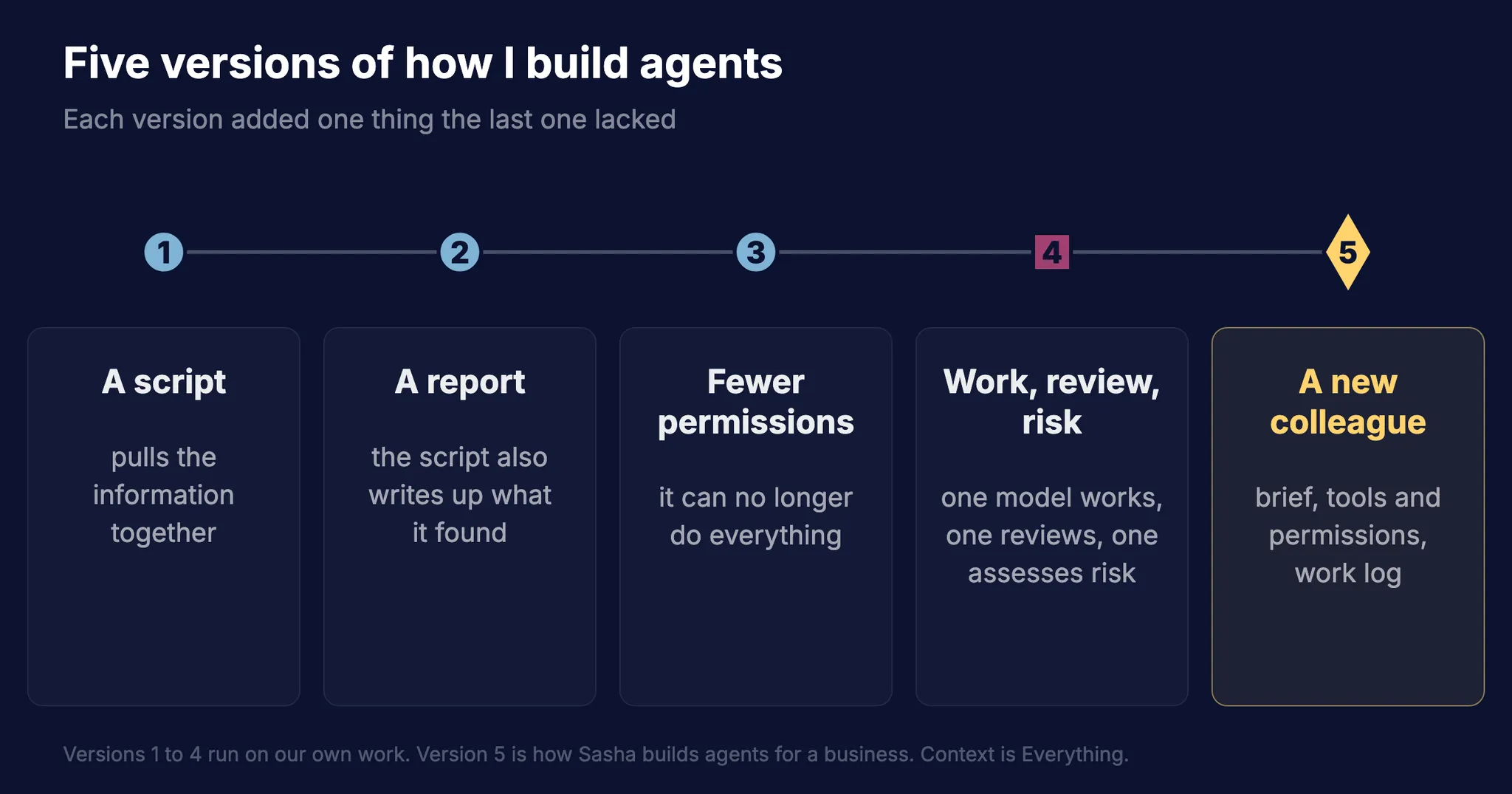
Five versions of how I build agents: a script, a report, fewer permissions, work with review and risk, and a new colleague with a brief, tools and permissions, and a work log

A Sasha agent is a new colleague

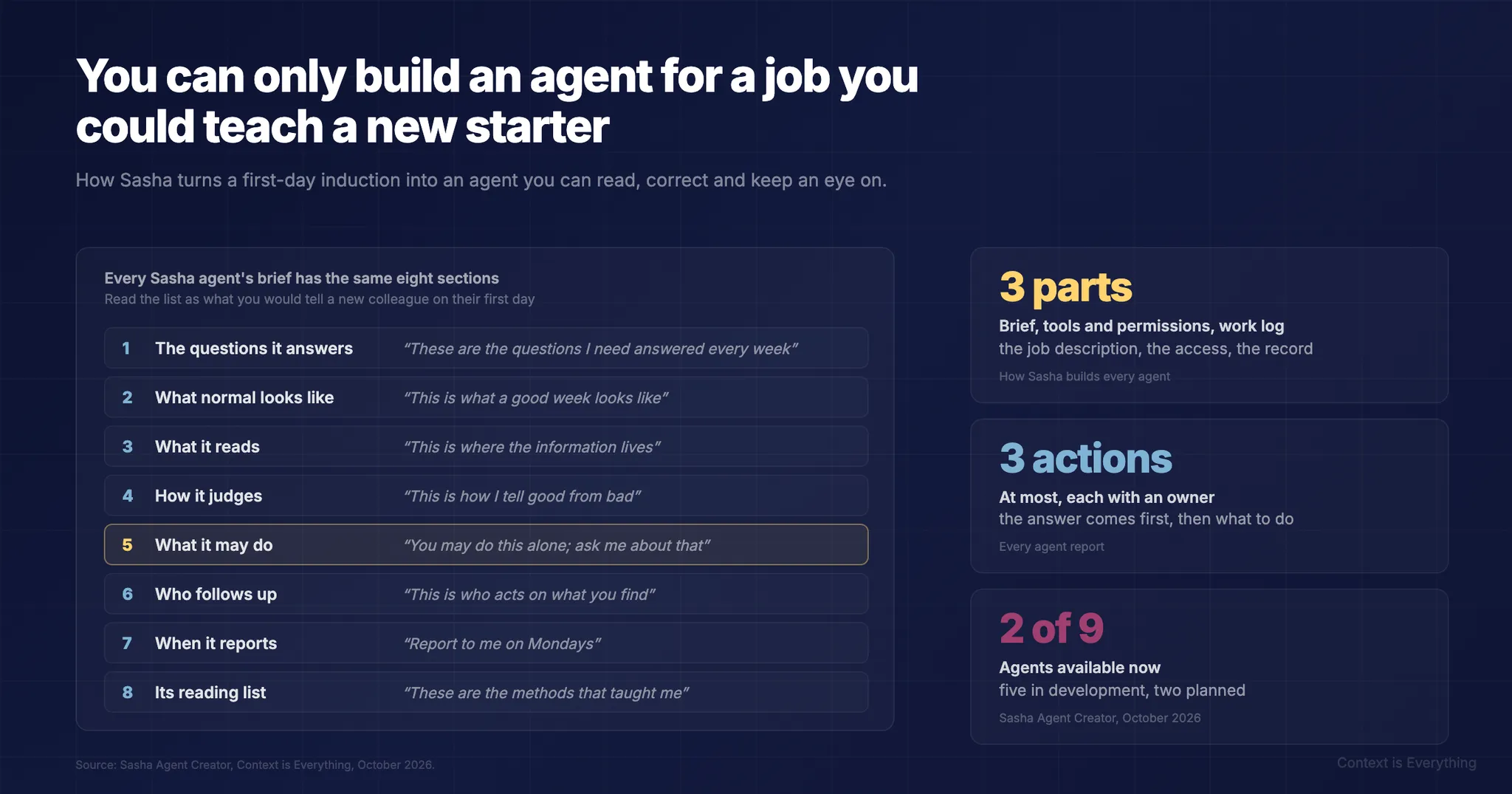
So Sasha now builds every agent the way you would set up a new member of staff. There are three parts, and each can change without the others.

The brief is the job description and "how we do things here". You can read it, and you can change it in a sentence.

Tools and permissions are the system access and the authority you give a new hire. Read-only first. The agent uses a tool, but the keys stay locked inside Sasha, and the agent can't read or copy them.

The work log is their record of what they found, what they did and why. You can point at any line in a report and ask "why did you say this?"

Every brief has the same eight sections:

  1. The questions it answers
  2. What normal looks like
  3. What it reads
  4. How it judges
  5. What it may do
  6. Who follows up
  7. When it reports
  8. Its reading list

Read that list as an induction. "These are the questions I need answered every week. This is what a good week looks like. This is where the information lives. This is how I tell good from bad. You may do this alone; ask me about that. Report to me on Mondays." The reading list is the one people forget: a good expert can tell you which books and methods taught them, and an agent should be able to do the same. (The reading list ships with each agent today. A guided way to review it is still to come.)

The opinions Sasha holds

Sasha comes with strong views on how an agent should work. They are the same views we would hold about a new starter.

It needs context before it starts. A new colleague who knows nothing about your customers does generic work, and so does an agent. Before Sasha builds one, it checks what it knows about your business and says Ready, Thin or Not ready. When something is missing, it gives you the questions to answer first.

It copies a job somebody already does. Every agent we have built started as a real piece of our own work. The Marketing Agent came from Spencer's daily marketing report. The Operations Agent came from our daily ops emails. The Finance Agent came from our monthly cost reports. None of them was invented.

Code does the sums. Tested scripts calculate every number, ranking and comparison. The AI explains them and judges only what a script cannot.

Missing is not zero. A figure Sasha could not read shows as "not read", never as a guess. When we first analysed one client's business, the most valuable finding was that their tracking was broken, so no sale could be traced to a campaign. A report built on that data would have been confident nonsense.

The answer comes first, then three things to do. Each action has an owner and a request you can paste into Sasha. One business owner put it better than I can: "We want a cappuccino, not to boil the ocean."

It drafts; a person sends. An agent works at three levels: it reports, it recommends, and it acts only with your approval. Anything it may not do waits for a person.

It remembers. An older news job of ours reported the same story seven days running, because it had no memory. The work log fixes that. The agent knows what it has already said, and it measures change against what it saw last time.

A worked example: the CRM Agent

Here is the induction for a CRM Agent at Northwind Advisory, an imaginary consultancy. Sam, who runs it, has more customers needing attention than he has hours. On the new colleague's first day, he says:

  • "These are our customers and leads, and this is how I tell a new one from a quiet one."
  • "When we fix a problem someone hit, tell them. Every few weeks, check in. Never more than once a week."
  • "When I've done some work for a lead, draft my follow-up. I'll send it myself."
  • "Write short and plain. Say it's automatic, and that a real person reads every reply."
  • "Never write to anyone who asked us not to."
  • "Tell me twice a week who needs me personally."

Sasha turns those sentences into the brief. Each morning the agent reads what happened overnight. A script decides who is due a message. The AI writes the drafts. A fix note reads like this:

Hello Dev, you had trouble exporting your report this week. We fixed it overnight and it works again now. If anything still looks wrong, just reply. This note was written automatically, and a real person reads every reply. Sam

Sam keeps the judgement. The agent takes the routine attention. We use the same kind of note with our own Bernard customers, and busy people read them because they are short and true.

What to do with this

Write the induction before you build anything. If you can't write the six sentences Sam wrote, you are not ready for an agent. You are ready for a conversation about how that part of your business works.

Start with the brain. An agent is only as good as what it knows. If your site is on Bernard, your site brain has already started. Sasha grows it into a business brain that every agent reads.

Decide what it may do alone. The default in Sasha is nothing. Add actions one at a time, as you would with a new hire.

Keep the monitoring. Delegate the noise, not the oversight.

To be plain about what exists today: the Finance and Marketing agents are available now. The CRM, Operations, PR, Project and Content Creator agents are in development. Sales Outreach and HR agents are planned. Describing a new agent of your own in plain words is designed but not built.
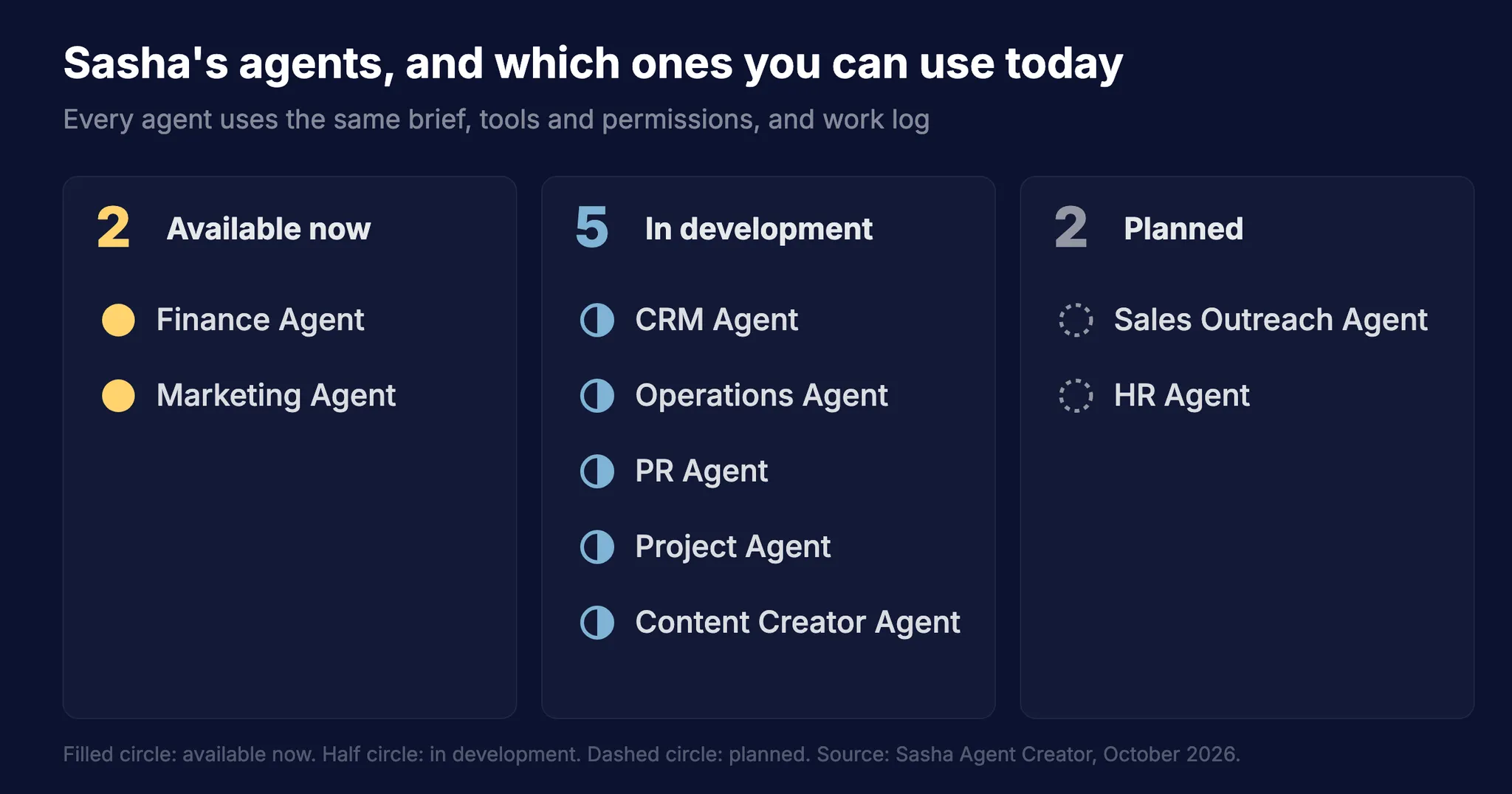
Sasha's nine agents: Finance and Marketing available now; CRM, Operations, PR, Project and Content Creator in development; Sales Outreach and HR planned

We are not replacing people with any of this. A small team gets the capable assistant it can't yet afford to hire, and the person who owns the job gets their time back for the parts that need a person.

See the agents in Sasha's Agent Creator. Start your site brain with Bernard.

Related Articles

What happens next?

Talk to us. We'll tell you honestly whether AI makes sense for your situation.

If it does, we'd love to work with you. If it doesn't, we'll tell you that too.

Start a Conversation
Skip to main content

Our Team

  • Lindsay Smith, CTO - Enterprise software veteran, 20+ years FinTech, former CTO at Telrock
  • Robbie MacIntosh, Operations Director - Crisis management and operational transformation specialist
  • Spencer Thursfield, Chief Marketing Officer - Brand development, commercial strategy, and cross-sector pattern recognition

Proven Results

  • 150% conversion increase: same leads, seven figures in new annual revenue
  • 95% faster processing: 3 hours of senior time reduced to 9 minutes
  • £200K+ hidden costs uncovered in a single 48-hour engagement
  • £15M procurement decision delivered in 48 hours from 1,200 pages
  • Live with paying clients since October 2024
You Can Only Build an Agent for a Job You Could Teach a New Starter - Thought leadership article by Context is Everything

You Can Only Build an Agent for a Job You Could Teach a New Starter

·7 min read·1,600 words
AI AgentsSashaAI ImplementationDelegation

Most requests for AI agents name a result and skip the job. The test we use before we build one, and how Sasha turns a first-day induction into an agent you can read, correct and keep an eye on.

Most requests for "agents" are a wish for a result with no job description attached. The test we use before we build one is simple: could you induct a junior into this job?

First, a word on Sasha. Sasha is a private AI that holds one business's knowledge: its documents, its meetings and the tools it connects to. It is also the business brain behind Bernard, our website product. When a site moves to Bernard, Bernard starts a brain for that site: what the business sells, how it writes, who it serves. Sasha holds the whole business brain, and the site brain is its first part. Nothing moves and nothing starts again as the brain grows. In practice, Bernard does the work on your website and Sasha does the thinking about your business.

Sasha also builds agents. This article is about how, and about the opinions we built into it.

Twenty agents is not a brief

A founder told us recently that he wanted twenty agents. I asked what they would do. The honest answer was: "I want my business to run itself, and I don't know how."

I have heard that request before, in a different form. It is the chief executive who asks engineering to turn the bugs down to zero. Or the one who asks marketing to turn the leads up to ten. The request names a result and skips the job. Sales, under the covers, is lead generation, qualification, objection handling and follow-up. Somebody in that chain has to understand it. If nobody does, a vendor sells you a box with a handle on it, you wind the handle, and you hope.

Compare that with Spencer, our CMO. He runs an agent on our Google Ads account. It reads the signals, works through a checklist and makes changes inside a narrow remit. It works because Spencer can tell it exactly what to do. He sets the strategy, he tunes it, and he keeps the monitoring for himself. "I don't want to delegate monitoring," he told me. "That's my job."

That is the whole test. If you could sit a junior down on their first day and explain the job, you can build the agent. If you can't explain the job, the first piece of work is to understand it. And if the knowledge isn't in your business at all, someone who has it must build the agent for you.

What I got wrong first

I'm on roughly the fifth version of how I build agents.

The first was a script on my laptop that pulled information together. The second also wrote a report from it. The third ran with fewer permissions, so it could no longer do everything. The current one splits the work: one model does the job, a second reviews it and a third assesses the risk. That is how our own small software fixes get made overnight now, and it works because I know how to induct a junior developer. I have done it for twenty years.

The early versions of Sasha had "experts": a compliance expert, a technical expert and so on. Each one told the AI which lens to look through. None of them said what to do, what the remit was, what it was allowed to touch or which tools it had. Two years ago we couldn't have described that part, let alone built it.

Five versions of how I build agents: a script, a report, fewer permissions, work with review and risk, and a new colleague with a brief, tools and permissions, and a work log

A Sasha agent is a new colleague

So Sasha now builds every agent the way you would set up a new member of staff. There are three parts, and each can change without the others.

The brief is the job description and "how we do things here". You can read it, and you can change it in a sentence.

Tools and permissions are the system access and the authority you give a new hire. Read-only first. The agent uses a tool, but the keys stay locked inside Sasha, and the agent can't read or copy them.

The work log is their record of what they found, what they did and why. You can point at any line in a report and ask "why did you say this?"

Every brief has the same eight sections:

  1. The questions it answers
  2. What normal looks like
  3. What it reads
  4. How it judges
  5. What it may do
  6. Who follows up
  7. When it reports
  8. Its reading list

Read that list as an induction. "These are the questions I need answered every week. This is what a good week looks like. This is where the information lives. This is how I tell good from bad. You may do this alone; ask me about that. Report to me on Mondays." The reading list is the one people forget: a good expert can tell you which books and methods taught them, and an agent should be able to do the same. (The reading list ships with each agent today. A guided way to review it is still to come.)

The opinions Sasha holds

Sasha comes with strong views on how an agent should work. They are the same views we would hold about a new starter.

It needs context before it starts. A new colleague who knows nothing about your customers does generic work, and so does an agent. Before Sasha builds one, it checks what it knows about your business and says Ready, Thin or Not ready. When something is missing, it gives you the questions to answer first.

It copies a job somebody already does. Every agent we have built started as a real piece of our own work. The Marketing Agent came from Spencer's daily marketing report. The Operations Agent came from our daily ops emails. The Finance Agent came from our monthly cost reports. None of them was invented.

Code does the sums. Tested scripts calculate every number, ranking and comparison. The AI explains them and judges only what a script cannot.

Missing is not zero. A figure Sasha could not read shows as "not read", never as a guess. When we first analysed one client's business, the most valuable finding was that their tracking was broken, so no sale could be traced to a campaign. A report built on that data would have been confident nonsense.

The answer comes first, then three things to do. Each action has an owner and a request you can paste into Sasha. One business owner put it better than I can: "We want a cappuccino, not to boil the ocean."

It drafts; a person sends. An agent works at three levels: it reports, it recommends, and it acts only with your approval. Anything it may not do waits for a person.

It remembers. An older news job of ours reported the same story seven days running, because it had no memory. The work log fixes that. The agent knows what it has already said, and it measures change against what it saw last time.

A worked example: the CRM Agent

Here is the induction for a CRM Agent at Northwind Advisory, an imaginary consultancy. Sam, who runs it, has more customers needing attention than he has hours. On the new colleague's first day, he says:

  • "These are our customers and leads, and this is how I tell a new one from a quiet one."
  • "When we fix a problem someone hit, tell them. Every few weeks, check in. Never more than once a week."
  • "When I've done some work for a lead, draft my follow-up. I'll send it myself."
  • "Write short and plain. Say it's automatic, and that a real person reads every reply."
  • "Never write to anyone who asked us not to."
  • "Tell me twice a week who needs me personally."

Sasha turns those sentences into the brief. Each morning the agent reads what happened overnight. A script decides who is due a message. The AI writes the drafts. A fix note reads like this:

Hello Dev, you had trouble exporting your report this week. We fixed it overnight and it works again now. If anything still looks wrong, just reply. This note was written automatically, and a real person reads every reply. Sam

Sam keeps the judgement. The agent takes the routine attention. We use the same kind of note with our own Bernard customers, and busy people read them because they are short and true.

What to do with this

Write the induction before you build anything. If you can't write the six sentences Sam wrote, you are not ready for an agent. You are ready for a conversation about how that part of your business works.

Start with the brain. An agent is only as good as what it knows. If your site is on Bernard, your site brain has already started. Sasha grows it into a business brain that every agent reads.

Decide what it may do alone. The default in Sasha is nothing. Add actions one at a time, as you would with a new hire.

Keep the monitoring. Delegate the noise, not the oversight.

To be plain about what exists today: the Finance and Marketing agents are available now. The CRM, Operations, PR, Project and Content Creator agents are in development. Sales Outreach and HR agents are planned. Describing a new agent of your own in plain words is designed but not built.

Sasha's nine agents: Finance and Marketing available now; CRM, Operations, PR, Project and Content Creator in development; Sales Outreach and HR planned

We are not replacing people with any of this. A small team gets the capable assistant it can't yet afford to hire, and the person who owns the job gets their time back for the parts that need a person.

See the agents in Sasha's Agent Creator. Start your site brain with Bernard.

Related Articles

What happens next?

Talk to us. We'll tell you honestly whether AI makes sense for your situation.

If it does, we'd love to work with you. If it doesn't, we'll tell you that too.

Start a Conversation
built with bernardCookie settings