
Who Owns the Truth After Publication?
A business changes continuously. Its published account of itself needs someone responsible for keeping up.
The page has an author, an approval history and a place in the content calendar. What it lacks is a person responsible for its continued accuracy.
Take an invented but familiar case. A firm changes how it delivers a service. The team knows the new process. Proposals describe it correctly. The website still explains the old arrangement, because updating it was nobody's part of the change.
The example is imagined; the question it exposes is not, for any organisation with a substantial website: who owns the truth after publication?
A published page remains a business statement
A service page makes commitments about what the organisation does. An article explains its view of a problem. A case study records what it believes it achieved. Each needs a way to change when the underlying knowledge changes.
That means distinguishing the person who can edit a page from the person who can tell whether it is still right. Marketing may control publication. A practice lead may know that the advice has become incomplete. A delivery team may know that an advertised process has been replaced.
If those responsibilities never meet, a perfectly functional publishing system can preserve the wrong answer indefinitely.
The remedy begins with a modest requirement: every consequential page should have a named owner for its substance. That person need not write the copy. They need to recognise when its meaning has changed and have a route to correct it.
Refreshing a page is real work
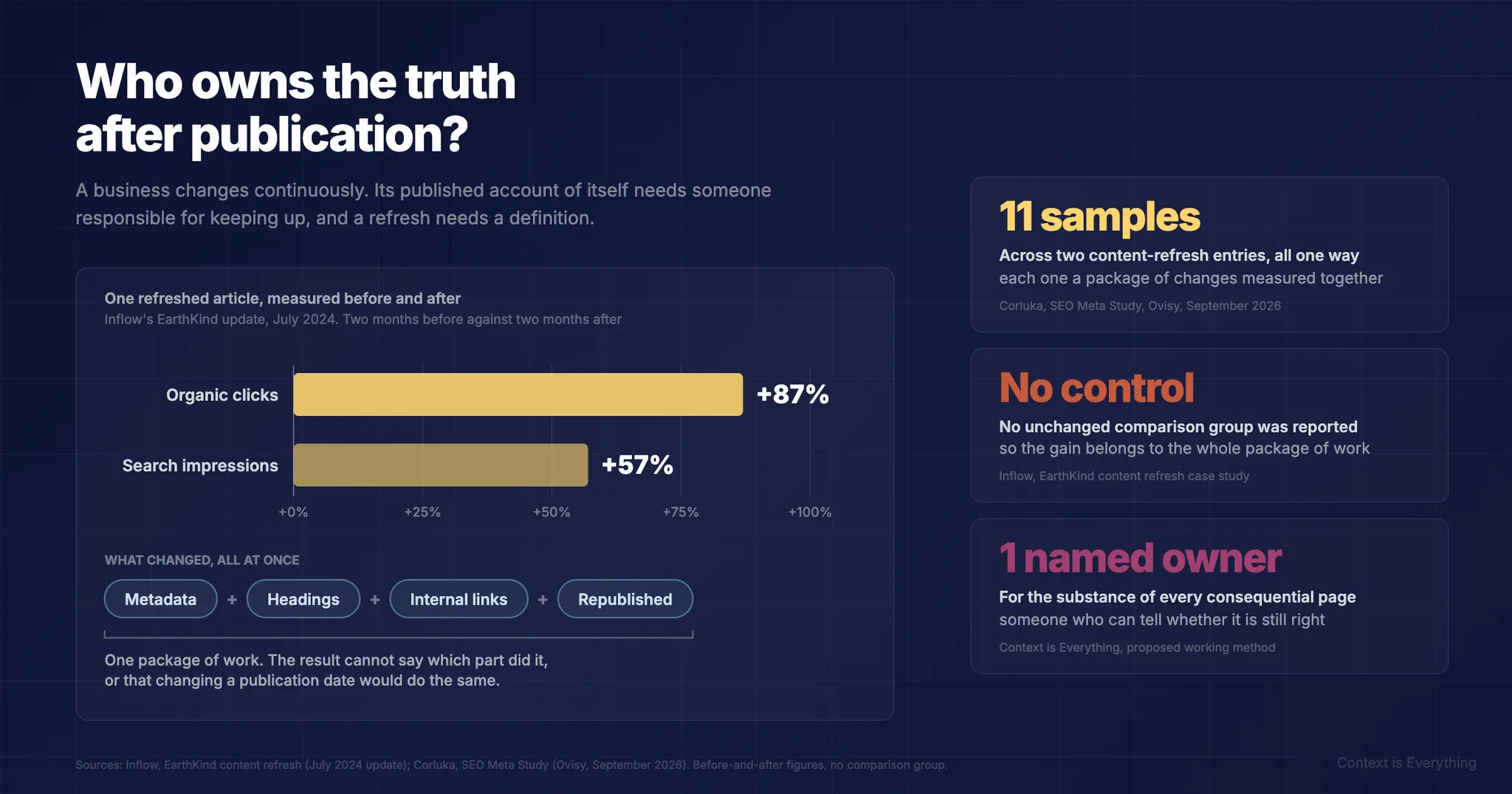
The content-refresh entries in Corluka's SEO Meta Study offer a reason to examine existing pages as well as commission new ones: eleven independent samples across two entries, all pointing the same way, and every one of them a package of changes measured together. The original studies also show why "refresh" needs a definition.
Inflow's EarthKind case study describes a July 2024 update to an existing article. It reports 87% more organic clicks and 57% more search impressions when comparing the two months before and after the changes. Its process included metadata, headings and internal links, and the article was republished. There was no reported unchanged comparison group for that result. Inflow's headline example from the same client reports a larger gain from a second refresh a month later, measured the same way.
That is an account of a particular package of work, not evidence that changing a publication date produces the same return. The useful question for another organisation is which part of its published knowledge now needs attention.
Sometimes the answer is a factual correction. Sometimes an article needs an example that makes its advice usable. Sometimes it describes a service the organisation should no longer offer. Those are different editorial decisions, even if a content calendar records all three as an update.
Give change a route to the page
A scheduled review catches what someone remembers to look for. It is worth supplementing it with specific triggers.
When a service changes, its owner should identify the pages that describe it. When a piece of research is superseded, the person responsible for the claim should revisit where it is used. When customers repeatedly misunderstand the same condition, that should prompt a review of the explanation they encounter.
The record can be simple: the page, the person responsible, the source behind important claims, and the event that should trigger another look. This is our proposed working method, not a claim that a particular review interval improves search rankings.
An evergreen explanation does not need rewriting merely because a date has passed. A time-sensitive promise may need attention the moment the business changes. The consequence of being wrong should help determine the attention it receives.
AI needs the corrected knowledge too
For organisations using AI to help prepare content, the same responsibility extends to the material supplied to the system. If the approved source still describes the old service, producing a new draft from it is unlikely to solve the editorial problem.
Correct the source first, identify where its claims have been reused and have the responsible person approve the changed meaning. Rephrasing can then follow. The purpose is to keep the organisation's account consistent with what it now knows and does.
Start with the pages closest to a consequential decision: choosing a service, understanding a price, assessing a qualification or acting on advice. Give each a substantive owner and a clear reason to return to it.
The next content meeting can begin with those responsibilities. Before asking what to publish, establish which existing statements the business is still prepared to stand behind.