
Our Team

  • Lindsay Smith, CTO - Enterprise software veteran, 20+ years FinTech, former CTO at Telrock
  • Robbie MacIntosh, Operations Director - Crisis management and operational transformation specialist
  • Spencer Thursfield, Chief Marketing Officer - Brand development, commercial strategy, and cross-sector pattern recognition

Proven Results

  • 150% conversion increase: same leads, seven figures in new annual revenue
  • 95% faster processing: 3 hours of senior time reduced to 9 minutes
  • £200K+ hidden costs uncovered in a single 48-hour engagement
  • £15M procurement decision delivered in 48 hours from 1,200 pages
  • Live with paying clients since October 2024
Your Sales Conversations Contain Knowledge Your Website Is Missing - Thought leadership article by Context is Everything on AI implementation

Your Sales Conversations Contain Knowledge Your Website Is Missing

·3 min read·620 words
Customer QuestionsContent StrategyKnowledge ManagementFAQ

The questions asked before a purchase reveal what a business still needs to explain. Preserving the conditions in those answers is part of the work.

The questions asked before a purchase reveal what a business still needs to explain. Preserving the conditions in those answers is part of the work.

"How long does it take?" may really mean "Can we finish before our next board meeting?" "Do you offer training?" may mean "Will our people be able to use what you leave behind?"

These are illustrative questions, not reported client conversations. Their value is the way they expose the decision behind the wording. The response needs enough context to help someone judge suitability.

A question reveals a decision

The condition that decides suitability is often discovered late. A consultancy, to take an invented case, offers a review of a client's operations; during the first call, the consultant has to establish whether the client keeps the records the review depends on. That requirement belongs in the public explanation. There may be good reasons to discuss the details privately. The basic condition can still be stated before someone invests their time.

A generic answer about flexible delivery would add little. A useful explanation would state what affects timing, what the client must provide and when a firm commitment can be made. It should reflect the real service, including the points where the business cannot yet give a definite answer.

That is source material for a service page, a guide or a worked example. The format follows the question.

Recover the explanation without exposing the customer

Start with the people who answer enquiries and deliver the work. Ask which questions repeat, which misunderstandings lead to unsuitable enquiries and which conditions they find themselves explaining late.

Keep an internal record of the question, the answer and who can confirm it. Remove customer identifiers when they are not needed. Do not publish private correspondence or an identifiable story without the appropriate permission.

The person drafting the page should understand whether an answer describes a general policy, a typical arrangement or an exception negotiated for one client. A helpful concession can become an accidental public promise if that distinction is lost.

Where AI helps group and draft from that material, the service owner still checks conditions, exceptions and commitments before publication; fluency is not evidence that the answer applies to the next customer.

Search gives us a reason to investigate, not a guarantee

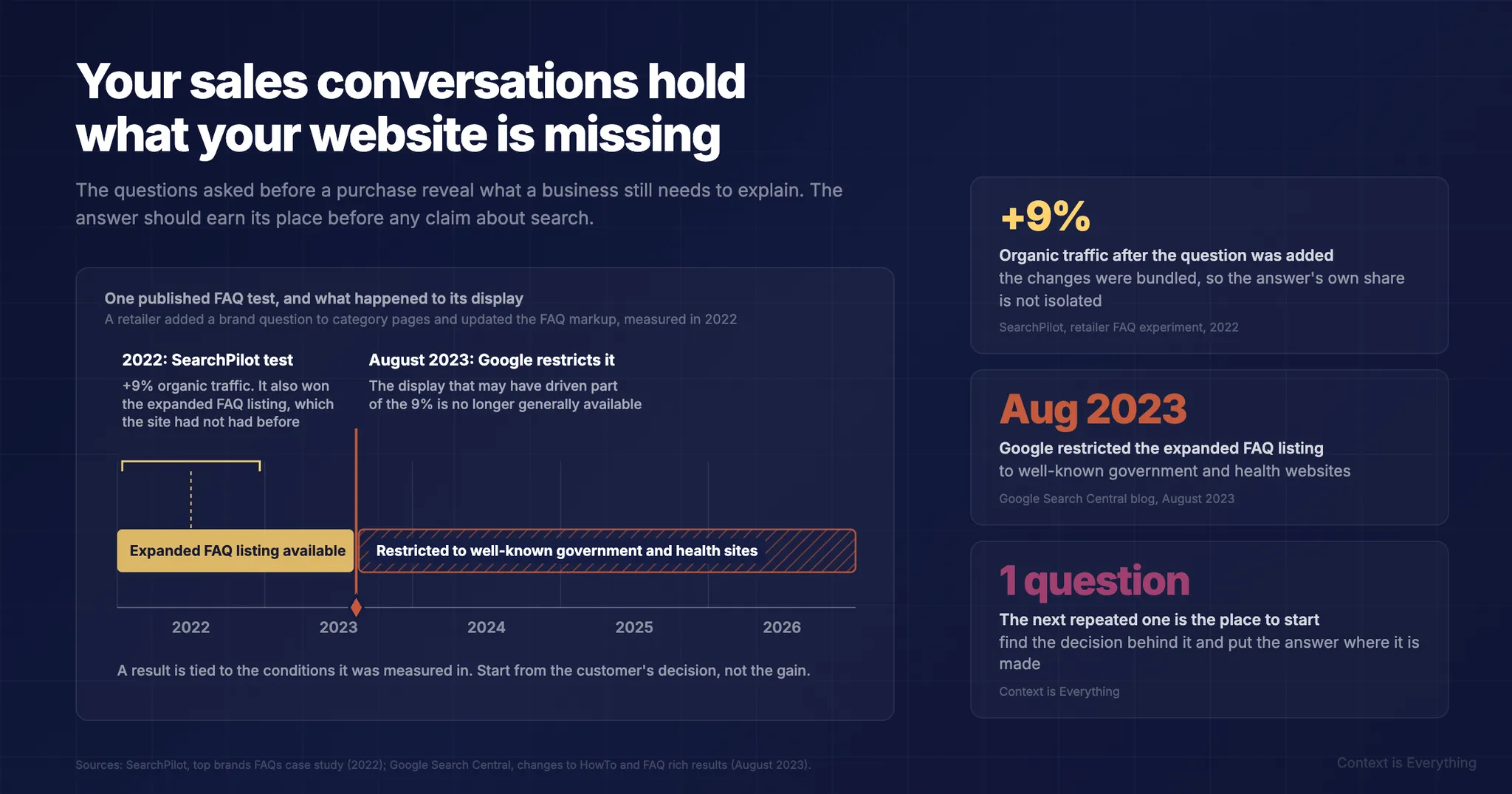
A SearchPilot retailer experiment published in 2022 added a brand-related question to category pages and updated the accompanying FAQ markup. It reported a 9% increase in organic traffic. The changes were bundled, so the result does not isolate the contribution of the answer itself.

That is a useful example of a specific question being tested. It is not a promise that adding a questions section to another website will produce the same gain. SearchPilot also noted that the change won the site an expanded FAQ listing in Google's results, which it had not previously been awarded. Google restricted that listing in August 2023 to well-known government and health websites, so the display that may have driven part of the 9% is no longer generally available.

For a business reviewing its own pages, begin with the customer decision. The answer should earn its place even before a claim about search performance is made.

Put knowledge where the decision happens

An eligibility condition belongs near the service it qualifies. A delivery explanation belongs within reach of the purchase. A detailed comparison may deserve its own page, linked from the choice it helps resolve.

Avoid collecting everything into an enormous FAQ simply because the questions arrived in that form. A clear paragraph in the right place may do the job better.

After publication, ask the people handling enquiries whether the explanation is working. Are customers still confused about the same condition? Do they refer to the page? Is the wording attracting expectations the team cannot meet? These observations can guide a revision without pretending to establish a causal sales uplift.

The next repeated question is the place to start. Find the decision behind it, have the responsible person confirm the answer and place it where a prospective customer needs it. Then keep a route back from the conversation to the page.

What happens next?

Talk to us. We'll tell you honestly whether AI makes sense for your situation.

If it does, we'd love to work with you. If it doesn't, we'll tell you that too.

Start a Conversation
Skip to main content

Our Team

  • Lindsay Smith, CTO - Enterprise software veteran, 20+ years FinTech, former CTO at Telrock
  • Robbie MacIntosh, Operations Director - Crisis management and operational transformation specialist
  • Spencer Thursfield, Chief Marketing Officer - Brand development, commercial strategy, and cross-sector pattern recognition

Proven Results

  • 150% conversion increase: same leads, seven figures in new annual revenue
  • 95% faster processing: 3 hours of senior time reduced to 9 minutes
  • £200K+ hidden costs uncovered in a single 48-hour engagement
  • £15M procurement decision delivered in 48 hours from 1,200 pages
  • Live with paying clients since October 2024
Your Sales Conversations Contain Knowledge Your Website Is Missing - Thought leadership article by Context is Everything on AI implementation

Your Sales Conversations Contain Knowledge Your Website Is Missing

·3 min read·620 words
Customer QuestionsContent StrategyKnowledge ManagementFAQ

The questions asked before a purchase reveal what a business still needs to explain. Preserving the conditions in those answers is part of the work.

The questions asked before a purchase reveal what a business still needs to explain. Preserving the conditions in those answers is part of the work.

"How long does it take?" may really mean "Can we finish before our next board meeting?" "Do you offer training?" may mean "Will our people be able to use what you leave behind?"

These are illustrative questions, not reported client conversations. Their value is the way they expose the decision behind the wording. The response needs enough context to help someone judge suitability.

A question reveals a decision

The condition that decides suitability is often discovered late. A consultancy, to take an invented case, offers a review of a client's operations; during the first call, the consultant has to establish whether the client keeps the records the review depends on. That requirement belongs in the public explanation. There may be good reasons to discuss the details privately. The basic condition can still be stated before someone invests their time.

A generic answer about flexible delivery would add little. A useful explanation would state what affects timing, what the client must provide and when a firm commitment can be made. It should reflect the real service, including the points where the business cannot yet give a definite answer.

That is source material for a service page, a guide or a worked example. The format follows the question.

Recover the explanation without exposing the customer

Start with the people who answer enquiries and deliver the work. Ask which questions repeat, which misunderstandings lead to unsuitable enquiries and which conditions they find themselves explaining late.

Keep an internal record of the question, the answer and who can confirm it. Remove customer identifiers when they are not needed. Do not publish private correspondence or an identifiable story without the appropriate permission.

The person drafting the page should understand whether an answer describes a general policy, a typical arrangement or an exception negotiated for one client. A helpful concession can become an accidental public promise if that distinction is lost.

Where AI helps group and draft from that material, the service owner still checks conditions, exceptions and commitments before publication; fluency is not evidence that the answer applies to the next customer.

Search gives us a reason to investigate, not a guarantee

A SearchPilot retailer experiment published in 2022 added a brand-related question to category pages and updated the accompanying FAQ markup. It reported a 9% increase in organic traffic. The changes were bundled, so the result does not isolate the contribution of the answer itself.

That is a useful example of a specific question being tested. It is not a promise that adding a questions section to another website will produce the same gain. SearchPilot also noted that the change won the site an expanded FAQ listing in Google's results, which it had not previously been awarded. Google restricted that listing in August 2023 to well-known government and health websites, so the display that may have driven part of the 9% is no longer generally available.

For a business reviewing its own pages, begin with the customer decision. The answer should earn its place even before a claim about search performance is made.

Put knowledge where the decision happens

An eligibility condition belongs near the service it qualifies. A delivery explanation belongs within reach of the purchase. A detailed comparison may deserve its own page, linked from the choice it helps resolve.

Avoid collecting everything into an enormous FAQ simply because the questions arrived in that form. A clear paragraph in the right place may do the job better.

After publication, ask the people handling enquiries whether the explanation is working. Are customers still confused about the same condition? Do they refer to the page? Is the wording attracting expectations the team cannot meet? These observations can guide a revision without pretending to establish a causal sales uplift.

The next repeated question is the place to start. Find the decision behind it, have the responsible person confirm the answer and place it where a prospective customer needs it. Then keep a route back from the conversation to the page.

What happens next?

Talk to us. We'll tell you honestly whether AI makes sense for your situation.

If it does, we'd love to work with you. If it doesn't, we'll tell you that too.

Start a Conversation
made with bernard

Cookie settings